
Trirhabda
LeConte, 1865
skeletonizing leaf beetles, goldenrod beetles
Species Guides
21- Trirhabda adela
- Trirhabda attenuata(skeletonizing leaf beetle)
- Trirhabda bacharidis (Weber, 1801)(groundselbush beetle)
- Trirhabda borealis(Boreal Goldenrod Leaf Beetle)
- Trirhabda canadensis(goldenrod leaf beetle)
- Trirhabda confusa
- Trirhabda convergens
- Trirhabda diducta(skeletonizing leaf beetle)
- Trirhabda eriodictyonis(yerba santa beetle)
Trirhabda is a of skeletonizing leaf beetles in the Chrysomelidae, comprising over 30 described distributed in North America and Mexico. These beetles are herbivores primarily associated with plants in the Asteraceae family, particularly goldenrods (Solidago), asters, and related composites. The genus has been extensively studied in ecological research due to its -specific feeding habits, -dependent , and potential effects on plant dynamics. Several species are notable for sequestering defensive compounds and exhibiting complex movement behaviors in response to landscape structure and host plant quality.
Pronunciation
How to pronounce Trirhabda: //traɪˈræbdə//
These audio files are automatically generated. While they are not always 100% accurate, they are a good starting point.
Identification
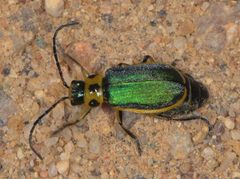
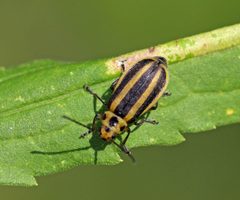
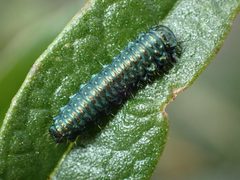
of Trirhabda are elongate, moderately sized leaf beetles with parallel-sided bodies typical of Galerucinae. within the can be challenging to distinguish without examination of specific morphological characters such as antennal segmentation, elytral coloration patterns, and male genitalia. Trirhabda species are most reliably identified in the field by their association with specific plants and characteristic skeletonizing feeding damage on leaves. Larvae are elongate, soft-bodied, and feed externally on host foliage.
Images
Habitat
Trirhabda inhabit a range of environments including old fields, meadows, prairies, open woodlands, and desert scrub where their Asteraceae plants occur. Specific associations vary by species: T. virgata and T. borealis are found in goldenrod-dominated old fields and meadows; T. geminata occurs in arid environments with brittlebush (Encelia farinosa); T. pilosa is associated with sagebrush (Artemisia) ; T. bacharidis inhabits coastal and disturbed areas with Baccharis species. The beetles require patches of suitable host plants for larval development and feeding.
Distribution
North America and Mexico. Documented from the United States (including Vermont and widespread across the continent) through Mexico, with distributions varying by plant range.
Diet
herbivores feeding almost exclusively on Asteraceae. Documented plants include Solidago (goldenrods), Aster species, Encelia farinosa (brittlebush), Baccharis species, and Artemisia species (sagebrush). Both larvae and feed on host foliage, producing characteristic skeletonizing damage by consuming leaf tissue between the .
Host Associations
- Solidago canadensis - primary for T. virgata, supports highest mass and
- Solidago altissima - for T. virgata; plant genets with longer larval development times experience less tissue loss
- Solidago graminifolia - acceptable for T. virgata but results in lower than S. canadensis
- Solidago missouriensis - shared with Eurosta comma rhizome galler
- Aster lateriflorus - acceptable for T. virgata but results in lower
- Encelia farinosa - brittlebush; for T. geminata in desert environments
- Baccharis halimifolia - for T. bacharidis, observed heavily infested in Florida
- Artemisia tridentata and related species - sagebrush; for T. pilosa
Life Cycle
Complete with , larval, pupal, and stages. larvae feed externally on foliage, progressing through multiple instars. Larval development occurs on the host plant; in T. virgata, development time varies among host genets and affects total tissue loss. occurs in soil or protected locations. Adults emerge as individuals, feed on host foliage, and disperse to mate and oviposit. In T. virgata, 95% of dispersing females have already mated, enabling lone of empty host patches.
Behavior
-dependent long-distance : emigrate from heavily defoliated, crowded patches but not from low-density, lightly damaged patches. is induced by host defoliation experienced during the teneral phase, not by larval rearing conditions alone. Females preferentially colonize lush, undamaged host patches over defoliated ones at spatial of 2-25 meters; males aggregate on plants with existing conspecifics. Movement varies with landscape structure: in goldenrod patches, beetles move infrequently in brief slow meandering bursts; in cut vegetation, frequent sustained slow directed movements; in structurally complex netting patches, frequent brief fast meandering movements. T. borealis does not detect goldenrod from afar or respond to edge type. Laboratory can occur over multiple , with insects accepting and improving performance on novel host plants.
Ecological Role
Herbivore with potential effects: of Trirhabda on plants can dramatically reduce host , , height, , and , indirectly promoting plant and woody plant invasion in old field . These effects can persist for several years post-outbreak. Density-dependent spreads local outbreaks across larger areas, potentially regulating at regional . As a herbivore, Trirhabda contributes to top-down control of host plant and may influence plant community .
Human Relevance
Subject of extensive ecological research on - interactions, plant-herbivore , induced plant resistance, and metapopulation dynamics. Used as a model organism for studying the ecological consequences of host specificity, -dependent , and landscape effects on movement . Some may have potential as agents for weedy Asteraceae, though host specificity testing would be required.
Similar Taxa
- MicrorhopalaAnother of skeletonizing leaf beetles in Chrysomelidae; Microrhopala vittata is also a goldenrod with similar feeding but differs in being a rather than external feeder, and has eight-segmented versus different antennal structure in Trirhabda
- GalerucellaRelated in tribe Galerucini with similar body form and skeletonizing leaf feeding habits; distinguished by specific morphological characters and often different plant associations
- XanthogalerucaRelated skeletonizing leaf beetle ; Trirhabda can be distinguished by plant specificity patterns and subtle morphological differences in antennal and genitalic characters
More Details
Chemical ecology
T. geminata sequesters hydroxylated anthraquinones (chrysophanol and chrysazin) across all life stages including , larvae, and . These compounds are not excreted in and levels remain stable during starvation. The plant Encelia farinosa does not contain detectable anthraquinones, indicating the synthesizes or sequesters these compounds independently, possibly for chemical defense.
Research significance
Trirhabda has been a model system for testing hypotheses about range evolution, the paradox of sublethal plant defense, and the effects of landscape structure on movement . Studies have demonstrated that antiperformance plant traits can be more effective defenses than previously recognized, and that movement ability depends on landscape structure rather than being constant.
Sources and further reading
- BugGuide
- Wikipedia
- GBIF taxonomy match
- iNaturalist taxon
- NCBI Taxonomy
- Catalogue of Life
- Goldenrod Leaf Miner | Beetles In The Bush
- Heliconiidae | Beetles In The Bush
- Anthraquinones in the Leaf Beetle Trirhabda geminata (Chrysomelidae)
- PERFORMANCE OF TRIRHABDA VIRGATA (COLEOPTERA: CHRYSOMELIDAE) ON THREE POTENTIAL HOSTS
- Biology and Laboratory Development of Trirhabda geminata (Coleoptera: Chrysomelidae) on the Composite, Encelia farinosa
- Biology and Host Specificity of Trirhabda bacharidis (Coleoptera: Chrysomelidae) on Baccharis (Asteraceae: Astereae)
- Effects of Population Density on Long‐Distance Dispersal in the Goldenrod Beetle Trirhabda Virgata
- Colonization of host patches following long‐distance dispersal by a goldenrod beetle, Trirhabda virgata
- Phylogeny and host-plant association in the leaf beetle genus Trirhabda LeConte (Coleoptera: Chrysomelidae)
- Effect of landscape structure on the movement behaviour of a specialized goldenrod beetle, Trirhabda borealis
- Potential Host Plants ofTrirhabda geminata(Coleoptera: Chrysomelidae): Impacts on Survival, Development, and Feeding
- Direct and indirect effects of two herbivore species on resource allocation in their shared host plant: the rhizome galler Eurosta comma , the folivore Trirhabda canadensis and Solidago missouriensis
- Assessing plant-to-plant communication and induced resistance in sagebrush using the sagebrush specialist Trirhabda pilosa
- Disarming the paradox of sublethal plant defense against insects: Trirhabda virgata larval development time and leaf tissue loss on Solidago altissima