
Microrhopala
Chevrolat in Dejean, 1836
Species Guides
8Microrhopala is a of hispine leaf beetles in the Chrysomelidae, containing approximately 18 described in North America. These small beetles are characterized by their clubbed and association with herbaceous vegetation, particularly in prairie and old field . The genus has been subject to taxonomic revision, with species historically placed in the Hispinae now classified within the more broadly defined Cassidinae. Ecological studies have demonstrated that some species, particularly M. vittata, can function as keystone herbivores capable of dramatically altering plant structure through .
Pronunciation
How to pronounce Microrhopala: /ˌmaɪkroʊˈroʊpələ/
These audio files are automatically generated. While they are not always 100% accurate, they are a good starting point.
Identification
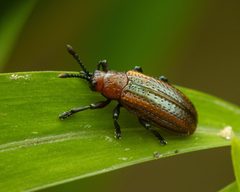
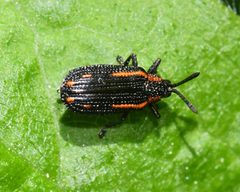
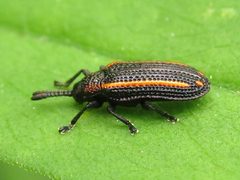
Microrhopala can be distinguished from similar hispine by their small, clubbed (the basis for the genus name, from Greek micr = small, rhopal = club). M. vittata specifically is identified by dull reddish elytral stripes, eight-segmented antennae, and smooth (non-serrate, non-toothed) elytral margins. The genus is distinguished from related hispines such as Anisostena by these antennal and elytral margin characteristics.
Images
Habitat
in this are found in herbaceous vegetation of prairies, old fields, and open woodlands. M. vittata specifically inhabits areas with its plants, true goldenrods (Solidago spp.) and flat-topped goldenrod (Euthamia graminifolia), in old fields and prairie remnants.
Distribution
North America. Documented from the central and eastern United States, including Missouri, with distribution records extending to Vermont.
Seasonality
are active during summer months. Collecting records from Missouri indicate presence in mid-July.
Diet
feed on leaves of plants, creating numerous small holes in the upper portions of the plant. Larvae are leaf miners, feeding between the upper and lower leaf surfaces of Solidago and Euthamia .
Host Associations
- Solidago - larval food planttrue goldenrods
- Euthamia graminifolia - larval food plantflat-topped goldenrod
Life Cycle
Larvae mine within leaves between upper and lower surfaces, eventually causing leaves to brown and shrivel. occurs within the leaf mines or in soil.
Behavior
are found on plant foliage. densities are normally low but can occasionally reach levels causing severe damage to host plants.
Ecological Role
Herbivore. M. vittata has been demonstrated to function as a in old field . can dramatically reduce goldenrod , , height, , and , resulting in increased light penetration that promotes higher abundance, , and flowering shoot production among other plant . These effects can indirectly promote woody plant invasion and accelerate old field to tree-dominated communities.
Human Relevance
Subject of ecological research on herbivore-plant interactions, regulation, and dynamics. No direct agricultural or economic significance documented.
Similar Taxa
- AnisostenaBoth are hispine leaf beetles found in similar prairie and collected by sweeping herbaceous vegetation, but Anisostena differs in antennal structure and elytral margin characteristics.
More Details
Taxonomic History
Historically placed in the Hispinae, Microrhopala and related are now classified within the more broadly defined subfamily Cassidinae following Staines (2002), which also includes tortoise beetles.
Etymology
The name derives from Greek 'micr' (small) and 'rhopal' (club), referring to the small-clubbed characteristic of the genus.
Research Significance
M. vittata has been widely studied by ecologists investigating herbivore impacts on plants and resulting changes to plant . Carson and Root (2000) demonstrated that can have community-level effects lasting several years.