
Microrhopala vittata
(Fabricius, 1798)
goldenrod leaf miner, goldenrod leafminer
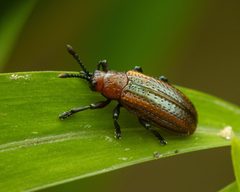
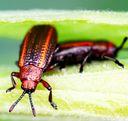
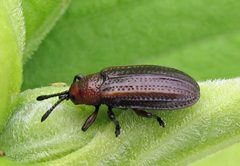
Microrhopala vittata is a small leaf beetle in the Chrysomelidae, commonly known as the goldenrod . are 5–6 mm in length and exhibit variable coloration from red to black with distinctive lighter vittae (stripes) on the . The is highly specialized on goldenrods (Solidago spp.) and flat-topped goldenrod (Euthamia graminifolia), with larvae mining between leaf surfaces and adults feeding on upper leaves. Ecological studies have demonstrated its potential as a in old field , where can dramatically reduce tall goldenrod dominance and alter plant community composition for multiple years.
Pronunciation
How to pronounce Microrhopala vittata: /ˌmɪkroʊˈroʊˌpɑːlə vɪˈtɑːtə/
These audio files are automatically generated. While they are not always 100% accurate, they are a good starting point.
Identification
are distinguished from by dull reddish elytral stripes, eight-segmented , and smooth (non-serrate, non-toothed) elytral margins. Body length 5–6 mm. Coloration varies from red to black with lighter vitta on each .
Images
Habitat
Associated with goldenrod plants in old fields, prairies, and open meadows. Found in both dry and mesic conditions where Solidago or Euthamia graminifolia occur.
Distribution
North America. Recorded from Canada (Alberta, British Columbia, Manitoba, New Brunswick, Ontario, Quebec, Saskatchewan) and the United States (Alabama, California, Colorado, Connecticut, Delaware, District of Columbia, Georgia, Idaho, Illinois, Indiana, Iowa, Kansas, Kentucky, Louisiana, Maine, Maryland, Massachusetts, Michigan, Minnesota, Mississippi, Missouri, Montana, Nebraska, New Hampshire, New Jersey, New Mexico, New York, North Carolina, North Dakota, Ohio, Oklahoma, Oregon, Pennsylvania, Rhode Island, South Carolina, South Dakota, Tennessee, Texas, Utah, Vermont, Virginia, Washington, West Virginia, Wisconsin, Wyoming).
Seasonality
emerge in April. Activity continues through growing season coinciding with goldenrod plant .
Diet
feed on leaves in the upper portion of plants, creating numerous small holes. Larvae mine within leaves between upper and lower surfaces, eventually causing leaves to brown and shrivel. Recorded host plants include Solidago altissima, S. graminifolia, S. canadensis, S. sempervirens, S. juncea, S. missouriensis, S. laciniatum, S. gigantea, S. mollis, S. rugosa, S. uliginosa, S. ulmifolia, S. rigida, Silphium perfoliatum, S. terebinthinaceum, S. laciniatum, and Euthamia graminifolia.
Life Cycle
Females lay in clusters of two to four, covering them with . Larvae develop as leaf miners within plant foliage. Specific site not documented in sources.
Ecological Role
can act as keystone disturbance in old field . Carson and Root (2000) documented that high- populations on Solidago altissima dramatically reduced plant , density, height, , and . This disturbance increased light penetration, resulting in higher abundance, , and flowering shoot production among other plant . Removal of beetles allowed tall goldenrod to form dense stands that suppressed other vegetation. Effects persisted for several years post-outbreak. Indirectly promotes woody plant invasion and accelerates old field to tree-dominated communities.
Human Relevance
Subject of ecological research on herbivore-plant interactions, regulation, and dynamics. No documented agricultural or economic significance.
Similar Taxa
- Microrhopala xereneSimilar hispine leaf beetle member; distinguished by different elytral pattern and segmentation
- Anisostena spp.Co-occurring hispine leaf beetles in same ; differ in body form and elytral sculpturing