
Microrhopala xerene
(Newman, 1838)
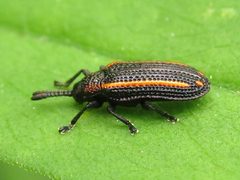
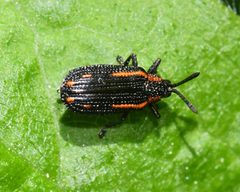
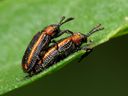
Microrhopala xerene is a small leaf beetle in the Chrysomelidae, Cassidinae. measure 3.6-4.6 mm in length and are characterized by black coloration with orange to red markings on the pronotum and . The is broadly distributed across North America, with records from most Canadian provinces and a wide swath of the eastern and central United States. It is a herbivore with documented feeding on multiple within the Asteraceae family.
Pronunciation
How to pronounce Microrhopala xerene: //ˌmɪkroʊˈhoʊpələ kˈsɛrɪniː//
These audio files are automatically generated. While they are not always 100% accurate, they are a good starting point.
Identification
Microrhopala xerene can be distinguished from by the combination of black body with orange-red pronotal and elytral markings, smooth elytral margins, and small size (under 5 mm). It may be separated from M. vittata, which has dull reddish elytral stripes rather than orange-red markings and eight-segmented . Accurate identification to within Microrhopala typically requires examination of antennae segmentation and detailed coloration patterns.
Images
Habitat
Found in open including prairies, old fields, and meadows where plants occur. Associated with herbaceous vegetation in both dry and moist conditions. Collected in xeric dolomite prairie remnants, sand prairies, and wetland edges.
Distribution
North America. Canada: Alberta, British Columbia, Manitoba, New Brunswick, Nova Scotia, Ontario, Quebec, Saskatchewan. United States: Arkansas, Colorado, Connecticut, Delaware, District of Columbia, Florida, Georgia, Illinois, Indiana, Kansas, Kentucky, Maine, Maryland, Massachusetts, Michigan, Minnesota, Missouri, Nebraska, Nevada, New Hampshire, North Carolina, North Dakota, Oklahoma, Ohio, Pennsylvania, South Carolina, Tennessee, Utah, Vermont, Virginia, West Virginia, Wisconsin, Wyoming.
Seasonality
have been recorded in mid-July in Missouri, suggesting summer activity. Specific across the range is not well documented.
Diet
herbivore feeding on Asteraceae. Documented include Solidago canadensis, Solidago caesia, Solidago juncea, Boltonia asteroides, Seriocarpus asteroides, Aster nova-angliae, Aster patens, Aster paternus, Aster puniceus, Symphyotrichum lanceolatum, Ambrosia chamissonis, Ambrosia psilostachya, Symphyotrichum chilensis, Symphyotrichum cordifolium, and Dorllingeria umbellata.
Life Cycle
Larval development occurs within leaves; larvae are leaf miners that feed between the upper and lower leaf surfaces. This feeding damage causes leaves to turn brown and shrivel.
Behavior
feed on leaves in the upper portions of plants, creating numerous small holes. Larvae mine within leaves. densities are typically low but occasional occur.
Ecological Role
As a herbivore on Asteraceae, this can influence plant composition. Related species in the have been demonstrated to act as in old field communities, where can reduce goldenrod and indirectly promote plant diversity and woody plant invasion.
Human Relevance
No direct economic significance documented. May occasionally reach densities causing visible damage to ornamental goldenrods.
Similar Taxa
- Microrhopala vittataSimilar size and preferences, but distinguished by dull reddish elytral stripes (rather than orange-red markings), eight-segmented , and specialization on Solidago and Euthamia graminifolia rather than the broader range of M. xerene.
More Details
Taxonomic History
The Microrhopala was formerly placed in the Hispinae, but this has been subsumed into a more broadly defined Cassidinae (Staines 2002). The genus name derives from Greek 'micr' (small) and 'rhopal' (club), referring to the small-clubbed .