
Microrhopala rubrolineata
(Mannerheim, 1843)
Species Guides
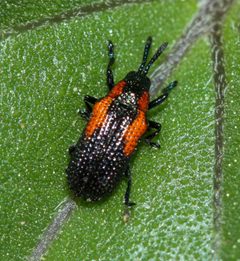
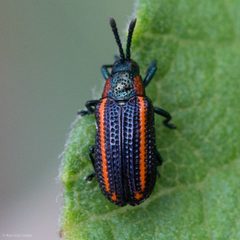
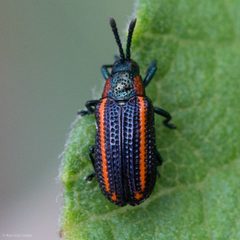
3Microrhopala rubrolineata is a small leaf beetle in the Chrysomelidae, measuring 3.7–5.3 mm in length. are typically black with a metallic blue or purple sheen and often display orange markings on the pronotum and/or . The occurs in the southwestern United States and Mexico, with four recognized distributed across this range. Like , it has been observed on plants with composite flowers, particularly goldenrods and members of the daisy-sunflower group.
Pronunciation
How to pronounce Microrhopala rubrolineata: /ˌmaɪkroʊroʊˈpɑːlə ruˌbroʊlɪniˈeɪtə/
These audio files are automatically generated. While they are not always 100% accurate, they are a good starting point.
Identification
are distinguished from other Microrhopala by the combination of small size (3.7–5.3 mm), black ground color with metallic blue-purple sheen, and presence of orange to reddish linear markings on the pronotum and/or . The four are differentiated primarily by geographic distribution and subtle variations in marking patterns: M. r. militaris (California to Texas), M. r. rubrolineata (southern California and Arizona to Sonora and Durango), M. r. signaticollis (California to Baja California), and M. r. vulnerata (Arizona to New Mexico).
Images
Habitat
Associated with plants bearing composite flowers, particularly goldenrods (Solidago) and members of the Asteraceae including daisy-sunflower types. One field observation documents on Ambrosia ambrosioides (canyon ragweed) in Arizona desert chaparral. preferences align with those of in dry, open to semi-open environments where plants occur.
Distribution
Central America and North America. United States: Arizona, California, New Mexico, and Texas. Mexico: Baja California, Sonora, and Durango. The four show partially overlapping but distinct ranges across this region.
Seasonality
have been observed in late May in Arizona, with activity likely extending through spring and early summer depending on elevation and local conditions. Specific data are sparse.
Diet
Herbivorous; feeds on foliage of plants. Documented on Ambrosia ambrosioides (canyon ragweed) and, like , associated with composite-flowered plants including goldenrods and daisy-sunflower types.
Host Associations
- Ambrosia ambrosioides - food plant observed feeding on leaves
- Solidago - food plantgoldenrods; inferred from congeneric association
- Asteraceae - food plantdaisy-sunflower types; inferred from congeneric association
Behavior
have been observed cohabiting leaves with other small chrysomelids (possibly Exema sp.), suggesting for interspecific leaf sharing. No other specific behavioral observations are documented.
Ecological Role
Herbivore; leaf-feeding beetle contributing to herbivory pressure on Asteraceae plants. Specific ecological impacts are unstudied.
Human Relevance
No documented economic or agricultural significance. Occasionally encountered by entomologists and naturalists in field surveys.
Similar Taxa
- Other Microrhopala speciescongeneric leaf beetles with similar body form and associations; distinguished by specific color pattern and geographic range
- Exema sp.small chrysomelids found cohabiting leaves; distinguished by different body shape and lack of metallic sheen with orange markings
More Details
Subspecies
Four recognized: Microrhopala rubrolineata militaris Van Dyke, 1925 (California to Texas); M. r. rubrolineata (southern California and Arizona to Sonora and Durango); M. r. signaticollis J. L. LeConte, 1859 (California to Baja California); and M. r. vulnerata Horn, 1883 (Arizona to New Mexico). Subspecies differentiation is based on geographic distribution and minor variations in elytral and pronotal markings.
Taxonomic history
Originally described by Mannerheim in 1843. The has undergone subsequent subdivision into based on regional , with the most recent subspecies described in 1925.