
Pyrrhalta viburni
(Paykull, 1799)
Viburnum leaf beetle
Pyrrhalta viburni, the , is a Eurasian leaf beetle (Chrysomelidae) that has become a significant pest in North America. Native to Europe and Asia, it was first detected in Canada in 1947 and spread to the northeastern United States by 1996. The is a herbivore of Viburnum shrubs, with both larvae and feeding on foliage. Severe can completely defoliate plants, leading to plant decline or death. The exhibits distinctive aggregative oviposition , with females preferentially laying on twigs already containing egg masses.
Pronunciation
How to pronounce Pyrrhalta viburni: /pɪˈrhaltə vaɪˈbɜːrnaɪ/
These audio files are automatically generated. While they are not always 100% accurate, they are a good starting point.
Identification
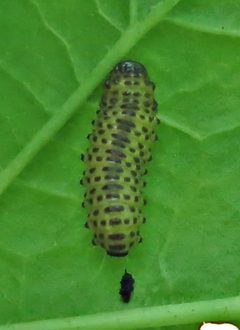
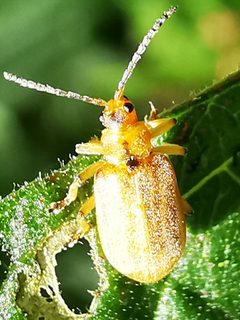
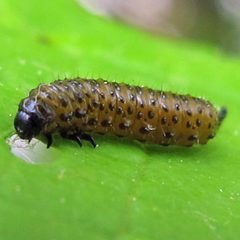
are recognized by the combination of yellowish-brown coloration with four dark spots on the , compact oval body, and association with Viburnum plants. They can be distinguished from the related elm leaf beetle (Xanthogaleruca luteola, formerly Pyrrhalta luteola) by host plant, smaller size, and elytral spot pattern. Larvae are identified by their yellowish-green color with dark lateral markings, skeletonizing feeding damage on Viburnum leaves, and presence of thoracic legs (distinguishing them from caterpillars). masses are diagnostic: females chew small cavities into current-year twigs, deposit 5–8 eggs per cavity, and seal them with a cap of , mucus, and chewed bark.
Images
Habitat
Associated exclusively with Viburnum shrubs in both native and introduced ranges. Occupies diverse settings including ornamental landscapes, gardens, parks, natural woodlands, and forest edges where Viburnum occur. The species shows preference for certain Viburnum species, with Viburnum dentatum (arrowwood), V. opulus (European cranberry bush), and V. sargentii being highly susceptible. More species include V. sieboldii, V. carlesii, V. plicatum, and V. rhytidophyllum.
Distribution
Native to Europe and temperate Asia. Introduced to North America: first detected in Ontario, Canada in 1947 (with earlier specimens from Nova Scotia in 1924); discovered in New York in 1996. Current introduced range includes more than 20 U.S. states from Maine to Florida and west to Washington State, plus eastern Canada. Recently recorded in Bosnia and Herzegovina (2019), representing range expansion within Europe.
Seasonality
to partially depending on latitude. In temperate North America: overwinter in twig cavities and hatch in early spring (approximately when Japanese camellia blooms, March–April in mid-Atlantic region). Larvae feed through three instars over 4–6 weeks, then drop to soil to pupate. emerge in June, feed on foliage, mate, and oviposit from July through September or October. Egg-laying continues until autumn, with eggs entering for winter.
Diet
folivore of Viburnum . Larvae skeletonize leaves by feeding on tender leaf tissue between , leaving a lacy network of veins. chew irregular holes through leaves, often creating a shothole pattern. Both stages feed preferentially on young, tender foliage. Feeding damage can be severe enough to cause complete defoliation, repeated defoliation leads to plant decline and mortality.
Host Associations
- Viburnum dentatum - primary Arrowwood; highly susceptible, native North American
- Viburnum opulus - primary European cranberry bush; highly susceptible
- Viburnum sargentii - primary Sargent viburnum; highly susceptible
- Viburnum lentago - secondary Nannyberry; suboptimal , larvae can complete development but with reduced
- Viburnum carlesii - Koreanspice viburnum; , larvae generally unable to complete development
- Viburnum sieboldii - Siebold viburnum; or immune
- Viburnum plicatum - Doublefile viburnum;
- Viburnum rhytidophyllum - Leatherleaf viburnum;
- Viburnum setigerum - Tea viburnum;
- Viburnum tinus - Laurustinus; in native European range
Life Cycle
Holometabolous with four stages: , larva, pupa, . Eggs are laid in cavities chewed into current-year twigs, sealed with a protective cap, and overwinter in this state. Larvae emerge in spring and pass through three instars while feeding on foliage. Mature larvae drop to the ground, burrow into soil or leaf litter, and pupate. Adults emerge after approximately 10 days, climb to foliage, and feed, mate, and oviposit through summer and autumn. time is approximately one year in northern parts of range, with potential for partial second generation in warmer regions.
Behavior
Females exhibit aggregative oviposition: they preferentially lay on twigs already containing egg masses, positioning new masses adjacent to existing ones. This is mediated by chemical cues associated with conspecific eggs and egg cap secretions, not merely by physical damage or plant volatiles. Aggregative behavior is strongest in mid-season (August) and relaxes in late season (September) when twig wound responses decline and egg is high. Larvae are gregarious and may feed in groups. Both larvae and drop readily when disturbed. Adults are capable of and disperse to locate new host plants.
Ecological Role
Herbivore and pest of Viburnum shrubs. In native range, presumably regulated by natural enemies and co-evolved plant defenses. In introduced North American range, lacks significant natural enemy pressure and can reach densities causing severe defoliation and plant mortality. masses serve as microhabitats for commensal mites (at least 18 documented, including Trichoribates trimaculatus), which appear not to impact . including larvae, lady beetle larvae, and assassin bugs have been observed attacking larvae in North America.
Human Relevance
Major pest of ornamental Viburnum shrubs in landscapes and gardens. Economic impact includes plant replacement costs, reduced aesthetic value, and management expenses. Management strategies include: (1) planting Viburnum or cultivars; (2) pruning and destroying twigs with masses during November–March; (3) conserving natural enemies through diverse plantings; (4) applications when necessary (foliar insecticides such as spinosad, or neonicotinoids applied pre-emptively). Not a threat to food crops or forest products, but significant for horticultural industry and home gardeners.
Similar Taxa
- Xanthogaleruca luteolaFormerly placed in Pyrrhalta; elm leaf beetle is larger (6–8 mm), has different elytral pattern (often with dark margins and more irregular spotting), and feeds exclusively on Ulmus (elm) rather than Viburnum.
- Pyrrhalta luteolaObsolete name for Xanthogaleruca luteola; same distinguishing features as above.
- Galerucella spp.Related leaf beetles in same tribe; generally smaller, with different associations (often aquatic plants or other shrubs), and lack the characteristic four-spot elytral pattern of P. viburni.
- Lilioceris liliiAnother Eurasian chrysomelid in North America; bright red with black and legs, feeds on Lilium and Fritillaria, not Viburnum.
Misconceptions
None documented in provided sources.
More Details
Oviposition biology
Females chew precise cavities (approximately 1.5–2 mm diameter) into current-year twigs using . Each cavity receives 5–8 arranged in a single layer. The cavity is sealed with a cap composed of , mucous secretions, and chewed bark material. This cap protects eggs from desiccation and some . Twig wound response (neoplasm formation) can crush eggs in some Viburnum , particularly earlier in the season, providing a plant defense mechanism.
Invasion history
The was likely introduced to North America multiple times. Specimens from Nova Scotia in 1924 suggest early introduction, but establishment was not detected until 1947 in Ontario. The New York detection in 1996 marked the beginning of rapid range expansion across the northeastern and midwestern United States, followed by westward spread to Washington State by 2015.
Management research
Cornell University research established susceptibility rankings for Viburnum , informing variety recommendations. University of Maryland Extension and other land-grant institutions have developed guidelines emphasizing resistant varieties, mechanical removal, and conservation.
Sources and further reading
- BugGuide
- GBIF taxonomy match
- iNaturalist taxon
- NCBI Taxonomy
- These Beetles Don't Want to Hold Your Hand | Bug Squad
- Publications | Entomology Research Museum
- Archive — Bug of the Week
- Vanishing viburnums: vandalism by the Viburnum leaf beetle, Pyrrhalta viburni — Bug of the Week
- Pseudococcus viburni Archives - Entomology Today
- Pseudococcus-viburni - Entomology Today
- Viburnum Leaf Beetle Pyrrhalta viburni (Paykull) (Insecta: Coleoptera: Chrysomelidae)
- Ovipositional Biology of Viburnum Leaf Beetle,Pyrrhalta viburni(Coleoptera: Chrysomelidae)
- Stimuli associated with viburnum leaf beetle (Pyrrhalta viburni) aggregative oviposition behavior
- First record of Pyrrhalta viburni (Coleoptera: chrysomelidae) in Bosnia and Herzegovina
- Suitability of Various Species of Viburnum as Hosts for Pyrrhalta viburni, an Introduced Leaf Beetle
- Oviposition By Pyrrhalta Viburni (Paykull) On Dead Plant Material: Successful Reproductive Strategy Or Maladaptive Behavior?
- Oviposition By Pyrrhalta Viburni (Paykull) On Dead Plant Material: Successful Reproductive Strategy Or Maladaptive Behavior?
- New Distributional Records of Invasive Coleoptera Found in Connecticut and Other Eastern States: Agrilus cyanescens (Ratzeburg) (Buprestidae), Lilioceris lilii (Scopoli), and Pyrrhalta Viburni (Paykull) (Chrysomelidae)
- Switched after Birth: Performance of the Viburnum Leaf Beetle [Pyrrhalta viburni (Paykull)] after Transfer to a Suboptimal Host Plant
- Evaluation of Insecticides for Control of Larvae of Pyrrhalta Viburni, a New Pest of Viburnums
- Ovipositional Biology of Viburnum Leaf Beetle, <I>Pyrrhalta viburni</I> (Coleoptera: Chrysomelidae)
- Mites associated with egg masses of the viburnum leaf beetle Pyrrhalta viburni (Paykull) on Viburnum tinus L.
- Distribution of Two Invasive Leaf Beetles,Pyrrhalta viburni(Paykull) andLilioceris lilii(Scopoli) (Coleoptera: Chrysomelidae), in Washington State
- Seasonal decline in plant defence is associated with relaxed offensive oviposition behaviour in the viburnum leaf beetle Pyrrhalta viburni
- Harmfulness of the viburnum leaf beetle (Pyrrhalta viburni Payk.) on plants of the Viburnum L. genus and elements of its control technology for strategies in breeding work in the system of fruit and decorative gardening