
Xanthogaleruca luteola
(O.F. Müller, 1766)
elm leaf beetle
, the , is an leaf beetle native to Europe that has become the most serious defoliator of elm trees in North America. are yellow to olive-green with distinctive black lateral stripes and spots. Both adults and larvae feed on elm foliage, with larvae skeletonizing leaves by consuming soft tissue between . The has multiple annually, with larvae in soil or bark crevices. using introduced has reduced its pest status in many regions.
Pronunciation
How to pronounce Xanthogaleruca luteola: /zænˌθɒɡæləˈruːkə luːˈtiːələ/
These audio files are automatically generated. While they are not always 100% accurate, they are a good starting point.
Identification
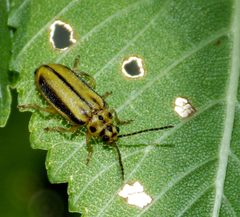
Distinguished from the larger native (Monocesta coryli) by smaller size, more vivid coloration with distinct black striping, and association with urban rather than wildland elms. make irregular holes through leaves, while larvae skeletonize foliage leaving reticulate patterns. Can be confused with other galerucine leaf beetles but specificity to Ulmus and characteristic damage pattern aid identification.
Images
Appearance
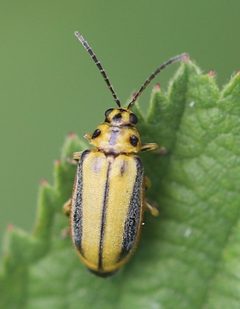
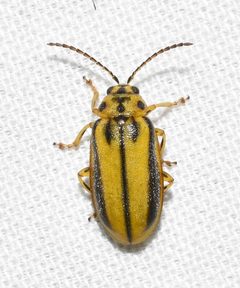
are approximately 6-8 mm long, yellow to olive-green in color, with a black stripe running along each side of the and four black spots near the . Larvae are black when newly hatched, becoming yellowish-green with rows of tiny dark along the sides that resemble two black stripes. Third-instar larvae reach up to 8 mm in length. Pupae are orange to bright yellow.
Habitat
Associated with elm trees (Ulmus spp.) in urban landscapes, parks, and riparian areas. Overwinters in protected locations including bark crevices, woodpiles, leaf litter, and buildings. Larval development occurs on elm foliage in spring and summer.
Distribution
Native to Europe; introduced to North America in the 1930s and now distributed across the continent wherever elm trees occur. Also present in Australia, South America, and other regions where elms have been planted. Not present in Antarctica.
Seasonality
emerge from sites in spring when elm leaves begin to unfold. Multiple occur annually: one generation in northern regions, two to three in central and southern California, with potential for additional generations in warmer areas due to climate change. Adults overwinter beginning in late summer and autumn.
Diet
Foliage of elm (Ulmus spp.), with European elm species generally preferred over American or Asiatic species. chew irregular holes through leaves; larvae skeletonize leaves by feeding on soft mesophyll between .
Host Associations
- Ulmus americana - American elm, less suitable compared to European
- Ulmus rubra - Slippery elm, less suitable
- Ulmus pumila - Siberian elm, suitable
- Ulmus parvifolia - Chinese elm, poor
- Ulmus procera - English elm, preferred
- Ulmus glabra - Wych elm, preferred
- Ulmus laevis - European white elm, preferred
- Ulmus minor - Field elm, preferred
- Zelkova serrata - Japanese zelkova, occasionally attacked
- Oomyzus gallerucae - used in
- Tachinidae - Larval including Erynniopsis antennata
- Harmonia axyridis - Multicolored Asian lady beetle preys on and larvae
Life Cycle
Complete with four stages: , larva, pupa, and . Females lay yellowish eggs in double rows of 5-25 on undersides of leaves. Eggs become grayish before hatching. Larvae pass through three instars, feeding on foliage for several weeks. Mature larvae crawl down tree trunks to become curled , then pupate in soil or bark crevices. Adults emerge after approximately 10 days and fly to to feed and reproduce. occurs as adults in protected locations.
Behavior
are strong fliers that disperse from sites to elm in spring. Larvae exhibit negative geotaxis, crawling down tree trunks to pupate. Both life stages are . When abundant, larvae may drop from leaves with damaged foliage. Adults seek sheltered locations for overwintering .
Ecological Role
Primary consumer of elm foliage; significant pest that can defoliate trees and reduce aesthetic and shade value. Repeated defoliation weakens trees and predisposes them to and other pests. Serves as for introduced agents including and larval parasitoids. Provides food for including lady beetles.
Human Relevance
Major pest of ornamental and landscape elm trees, causing defoliation, reduced property values, and tree decline. Management relies on through introduced , which has successfully reduced in many areas. Chemical control is rarely needed where biological control agents are established. Historical pest status in the 1970s has declined to minor pest status in regions like the mid-Atlantic due to successful parasitoid introductions.
Similar Taxa
- Monocesta coryliLarger elm leaf beetle; native to North America, larger in size (10-12 mm), lacks distinct black striping pattern, associated with wildland rather than urban elms, and produces ragged larval feeding damage rather than fine skeletonization
- Pyrrhalta viburniViburnum leaf beetle; similar and appearance but feeds on Viburnum rather than elms, with different coloration and association
More Details
Biological Control Success
The introduction of the Oomyzus gallerucae and the larval parasitoid Erynniopsis antennata from Europe has dramatically reduced in many parts of the United States. In the DMV region, pest status changed from major to minor between the 1970s and present due to these natural enemies.
Climate Change Implications
Warmer temperatures may allow additional annually in northern regions, potentially increasing damage. However, established agents may also benefit from extended activity periods.
Host Resistance Breeding
Asiatic elm Ulmus parvifolia and U. wilsoniana show poor suitability and are recommended for urban plantings where is problematic. These species serve as resistance sources in elm breeding programs.
Sources and further reading
- BugGuide
- GBIF taxonomy match
- iNaturalist taxon
- NCBI Taxonomy
- These Beetles Don't Want to Hold Your Hand | Bug Squad
- Learn About Plant-Insect Interactions at this UC Davis Seminar | Bug Squad
- Publications | Entomology Research Museum
- Archive — Bug of the Week
- Beautiful beetles and gnarly elm leaves: Larger elm leaf beetle, Monocesta coryli, and elm leaf beetle, Xanthogaleruca luteola — Bug of the Week
- Suitability of Thirteen Different Host Species for Elm Leaf Beetle, Xanthogaleruca luteola (Coleoptera: Chrysomelidae)
- Host Suitability of Three Asiatic Elms to the Elm Leaf Beetle (Xanthogaleruca luteola) (Coleoptera: Chrysomelidae)
- Distribution features of Xanthogaleruca luteola (Coleoptera: Chrysomelidae) in the protective plantings of the Lower Volga
- New Records of Elm Leaf Beetle, Xanthogaleruca luteola, Parasitoids in Colorado, with Notes on Predators
- Host location in Oomyzus gallerucae (Hymenoptera: Eulophidae), an egg parasitoid of the elm leaf beetle Xanthogaleruca luteola (Coleoptera: Chrysomelidae)
- Effect of 1,8-cineol on the biology and physiology of elm leaf beetle, Xanthogaleruca luteola (Col.: Chrysomelidae)
- Life cycle, parasitism and damage of Xanthogaleruca luteola (Muller) in Valencia (SE Spain): A preliminary study
- Molecular identification and polymerase chain reaction analysis of Xanthogaleruca Luteola (Chrysomelidae) species
- Host preference of three elms and hackberry for elm leaf beetle, Xanthogaleruca (=pyrrhalta) luteola (Coleoptera: Chrysomelidae)