
Pyrrhalta
Joannis, 1865
leaf beetles
Species Guides
1- Pyrrhalta viburni(Viburnum leaf beetle)
Pyrrhalta is a of leaf beetles in the Chrysomelidae, Galerucinae. The genus contains approximately 111–115 distributed across the Holarctic, Oriental, and Australian regions. Members are small, elongate beetles, typically 4.5–6.5 mm in length, with extending about half the body length. Several species are significant agricultural and ornamental pests, including the (P. viburni) and the elm leaf beetle (P. luteola). The of Pyrrhalta remains unsettled, with disagreements regarding subgeneric divisions and the status of formerly included groups such as Xanthogaleruca.
Pronunciation
How to pronounce Pyrrhalta: /pɪˈrɑltə/
These audio files are automatically generated. While they are not always 100% accurate, they are a good starting point.
Identification
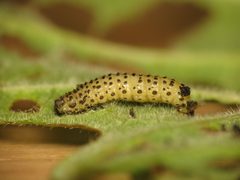
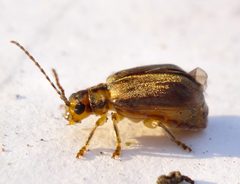
Elongate body form, 4.5–6.5 mm length; approximately half body length; pronotum narrower than ; and covered with fine, dense hairs; elytra coloration variable (yellowish to brown, sometimes with distinct markings or entirely black); tarsal claws may be bifid; gena longer than ; with line of hairy pores. -level identification requires examination of male genitalia, including and internal sac spines.
Images
Habitat
Associated with plants; found in forests, woodlands, urban parks, and gardens where suitable host vegetation occurs. Specific varies by and follows distribution of host plants (e.g., Viburnum species for P. viburni, Ulmus species for P. luteola).
Distribution
Holarctic, Oriental, and Australian regions; includes much of the Northern Hemisphere and Australia. Specific have expanded ranges through introduction: P. viburni (native to Europe and Asia, introduced to North America from Canada south to 20+ states); P. luteola (Palearctic origin, introduced to North America, Argentina, Chile, Central Asia, Middle East, North Africa, Siberia, and South Africa).
Diet
Phytophagous; larvae and feed on leaves of plants. Specific host associations vary by : P. viburni feeds exclusively on Viburnum species; P. luteola feeds on Ulmus (elm) species.
Life Cycle
Complete with , larva, pupa, and stages. (one per year) in some . Eggs laid on undersides of leaves or in pits chewed into branches, coated with protective secretion. Larvae pass through three instars, then move to soil to pupate. Adults emerge, feed, mate, and lay eggs. stage varies: P. luteola adults overwinter in bark crevices, woodpiles, or buildings; P. viburni eggs overwinter in branch .
Behavior
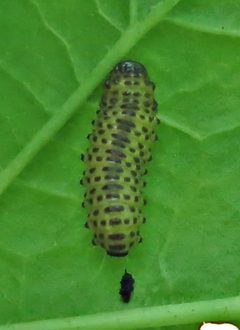
Larvae skeletonize leaves by feeding on tissue between , leaving lacy remains. chew through leaves, sometimes creating shothole patterns. plant switching has been documented in P. viburni when optimal hosts are depleted, though this reduces . Larvae become less choosy as they approach . Some exhibit : male with hand saw-like spines on internal sac used during copulation, causing wounds to female reproductive tract.
Ecological Role
Herbivore; significant defoliator of plants. Can cause complete defoliation of susceptible trees and shrubs, reducing aesthetic value, eliminating shade, and weakening plants. Repeated defoliation leads to tree decline. Serves as prey for natural enemies including larvae, lady beetle larvae, and assassin bugs.
Human Relevance
Several are major pests of ornamental and landscape plants. P. viburni () is in North America, damaging native and cultivated Viburnum. P. luteola (elm leaf beetle) is the most serious elm defoliator in the United States, though have declined in some regions since the 1990s. Management includes planting varieties, pruning and destroying -bearing branches, conserving natural enemies, and targeted application.
Similar Taxa
- XanthogalerucaFormerly treated as a subgenus of Pyrrhalta; some authors now recognize it as a separate . Xanthogaleruca luteola is the elm leaf beetle, though it has been placed in Pyrrhalta by various authorities. Separation based on inconsistent characters including hair distribution.
Sources and further reading
- BugGuide
- Wikipedia
- GBIF taxonomy match
- iNaturalist taxon
- NCBI Taxonomy
- These Beetles Don't Want to Hold Your Hand | Bug Squad
- Vanishing viburnums: vandalism by the Viburnum leaf beetle, Pyrrhalta viburni — Bug of the Week
- Archive — Bug of the Week
- Viburnum Leaf Beetle Pyrrhalta viburni (Paykull) (Insecta: Coleoptera: Chrysomelidae)
- Suitability of Various Species of Viburnum as Hosts for Pyrrhalta viburni, an Introduced Leaf Beetle
- New Distributional Records of Invasive Coleoptera Found in Connecticut and Other Eastern States: Agrilus cyanescens (Ratzeburg) (Buprestidae), Lilioceris lilii (Scopoli), and Pyrrhalta Viburni (Paykull) (Chrysomelidae)
- Oviposition By Pyrrhalta Viburni (Paykull) On Dead Plant Material: Successful Reproductive Strategy Or Maladaptive Behavior?
- The Elm Leaf Beetle, Pyrrhalta luteola1 , in Southern California: Its Host Preference and Host Impact
- Oviposition By Pyrrhalta Viburni (Paykull) On Dead Plant Material: Successful Reproductive Strategy Or Maladaptive Behavior?
- Switched after Birth: Performance of the Viburnum Leaf Beetle [Pyrrhalta viburni (Paykull)] after Transfer to a Suboptimal Host Plant
- Transcriptomic Characterization of miRNAs in Pyrrhalta aenescens Fairmaire in Response to 20-Hydroxyecdysone Treatment.