
Neochlamisus bebbianae
(Brown, 1943)
warty leaf beetle
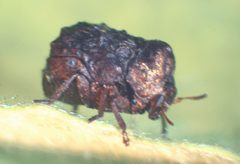
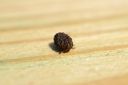
Neochlamisus bebbianae is a small case-bearing leaf beetle in the tribe Chlamisini, commonly known as warty leaf beetles. This has been extensively studied as a model system for ecological speciation, with forming distinct forms specialized on different plant species across six in five . Research has demonstrated host-associated ecological divergence, reproductive isolation, and ongoing speciation processes. The species is part of a complex where different host forms show pre- and post-mating reproductive barriers.
Pronunciation
How to pronounce Neochlamisus bebbianae: //ˌniːoʊˈklæmɪsəs ˌbɛbiˈaneɪ//
These audio files are automatically generated. While they are not always 100% accurate, they are a good starting point.
Identification
Distinguished from other Neochlamisus by plant association and subtle morphological differences. N. alni was removed from synonymy with N. bebbianae based on differences in , larval cases, coloration, and host plant. Identification to species level typically requires knowledge of host plant and examination of genitalia or molecular markers. Within N. bebbianae, different host forms are ecologically divergent but morphologically similar, making host plant the most reliable field indicator.
Images
Habitat
Associated with diverse plants across multiple plant ; found on woody shrubs and trees. Specific varies by host form: occur on Ceanothus in eastern North America, Baccharis species in western regions, Bebbia juncea in arid areas, and other host . Beetles are found on foliage of host plants where they feed and reproduce.
Distribution
North America, with records from Canada (Manitoba, Nova Scotia, Ontario) and the United States. Distribution is patchy and tied to presence of specific plants. Different host forms have distinct geographic ranges corresponding to their host plant distributions.
Diet
Herbivorous; feeds on foliage of plants. Specific host associations include: Ceanothus americanus, Ceanothus herbaceus, Baccharis salicifolia, Baccharis pilularis, Baccharis consanguinea, Bebbia juncea, Isocoma acradenia, and other across six plant in five .
Host Associations
- Ceanothus americanus - obligateeastern form
- Ceanothus herbaceus - obligateeastern form
- Baccharis salicifolia - obligatewestern form
- Baccharis pilularis - obligatewestern form
- Baccharis consanguinea - obligatewestern form
- Bebbia juncea - obligatearid region form
- Isocoma acradenia - obligate form in specific regions
Life Cycle
Case-bearing lifestyle: larvae construct portable cases from fecal material and . are laid with a fecal cap that serves as starting material for the larval case and may deter . Larvae feed on plant foliage while carrying their cases. occurs within the case. Developmental stages include egg, larva (with case), pupa (within case), and .
Behavior
Defensive includes retracting , legs, and into body grooves when disturbed, resulting in a -like appearance with no visible appendages. can clamp against leaf surfaces using modified with adhesive pads and secreted oils to resist . Larvae exhibit case-bearing behavior, carrying protective fecal cases throughout development. forms show genetically variable host use patterns and strong fidelity to natal host plants.
Ecological Role
Herbivore on diverse woody plants; serves as prey for including Cerceris fumipennis (recorded as occasional non-buprestid prey). Supports guilds including 22 of hymenopteran parasitoids across seven . Acts as study system for understanding ecological speciation and -associated diversification in herbivorous insects.
Human Relevance
Important model organism for evolutionary research, particularly studies of ecological speciation, , and reproductive isolation. No known agricultural or economic significance. Occasionally used in biosurveillance studies through association with Cerceris fumipennis nests.
Similar Taxa
- Neochlamisus alniFormerly synonymized with N. bebbianae but reinstated as valid based on differences in , larval cases, coloration, and plant (alder vs. diverse hosts)
- Neochlamisus plataniSimilar and ; distinguished by bright coppery coloration and association with Platanus occidentalis (eastern sycamore) rather than the diverse of N. bebbianae
- Exema speciesSame tribe Chlamisini with similar -mimicry and case-bearing larvae; Exema are smaller (2–3 mm) and typically associated with Asteraceae rather than woody
More Details
Ecological Speciation Model
N. bebbianae is one of the best-documented cases of ongoing ecological speciation in insects. forms represent adapted to different host plants that exhibit host-plant-specific ecological differentiation, assortative mating, and both pre- and post-mating reproductive isolation. Genetic studies have identified strongly differentiated loci despite , reflecting divergent host-related selection.
Parasitoid Associations
Extensive rearing studies documented 22 from 7 (Eulophidae, Ichneumonidae, Pteromalidae, Eupelmidae, Chalcididae, Eurytomidae, Torymidae) associated with N. bebbianae and related Neochlamisus species. This provides opportunity to study whether ecological speciation 'cascades' across to parasitoids.
Sources and further reading
- BugGuide
- Wikipedia
- GBIF taxonomy match
- NCBI Taxonomy
- Working with Cerceris fumipennis—Epilogue | Beetles In The Bush
- Chrysomelidae | Beetles In The Bush | Page 4
- Chrysomelidae | Beetles In The Bush | Page 3
- Ecologically dependent postmating isolation between sympatric host forms ofNeochlamisus bebbianaeleaf beetles
- Isolating a Role for Natural Selection in Speciation: Host Adaptation and Sexual Isolation in Neochlamisus bebbianae Leaf Beetles
- Postmating isolation and genetically variable host use in ecologically divergent host forms of Neochlamisus bebbianae leaf beetles
- ISOLATING A ROLE FOR NATURAL SELECTION IN SPECIATION: HOST ADAPTATION AND SEXUAL ISOLATION INNEOCHLAMISUS BEBBIANAELEAF BEETLES
- SELECTION AND GENOMIC DIFFERENTIATION DURING ECOLOGICAL SPECIATION: ISOLATING THE CONTRIBUTIONS OF HOST ASSOCIATION VIA A COMPARATIVE GENOME SCAN OF NEOCHLAMISUS BEBBIANAE LEAF BEETLES
- IMMATURE STAGES OF CANADIAN NEOCHLAMISUS KARREN (COLEOPTERA: CHRYSOMELIDAE
- Does strong selection promote host specialisation and ecological speciation in insect herbivores? Evidence from Neochlamisus leaf beetles
- Aspects of the Natural History of Neochlamisus (Coleoptera: Chrysomelidae) II: Characterization of Parasitoid Guilds from Different Plant Hosts