
Michthisoma heterodoxum
LeConte, 1850
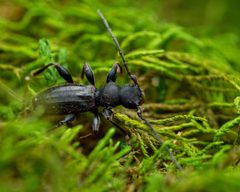
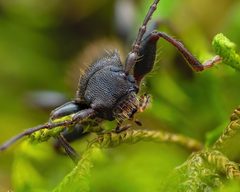
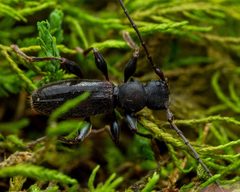
Michthisoma heterodoxum is a small cerambycid beetle in the tribe Saphanini, first described by LeConte in 1850. The is known for its remarkable morphological resemblance to small of the carpenter ant Camponotus pennsylvanicus, representing a case of myrmecomorphy ( mimicry). This mimicry appears to be an evolutionary to avoid . The species has a restricted geographic range, occurring primarily in the southeastern Coastal Plain of the United States. Despite its distinctive appearance, the species appears to be rarely encountered in the field.
Pronunciation
How to pronounce Michthisoma heterodoxum: /mɪkˌθɪs.oʊ.mə ˌhɛt.ə.roʊˈdɔk.səm/
These audio files are automatically generated. While they are not always 100% accurate, they are a good starting point.
Identification
Distinguished from other small cerambycids by its strong resemblance to small Camponotus pennsylvanicus : compact body form, dark coloration, and -like proportions. The mimicry is sufficiently convincing that specimens may be initially mistaken for ants in the field. Differs from the similar Cyrtinus pygmaeus (which also exhibits ant mimicry) in specific morphological details of body shape and pattern. Separation from actual Camponotus ants requires close examination of structure (beetles have geniculate but differently proportioned antennae) and the presence of covering the .
Images
Distribution
Southeastern Coastal Plain of the United States. The appears to have a restricted range within this region, though specific state records are not well documented in available sources.
Ecological Role
Participates in a documented mimicry complex involving Camponotus pennsylvanicus. The -mimetic appearance likely functions in avoidance (), though this has not been experimentally verified for this specific . As a member of Cerambycidae, larvae are presumed to be wood-borers, but specific larval remains undocumented.
Similar Taxa
- Cyrtinus pygmaeusAlso a small cerambycid with -mimetic appearance, particularly resembling small Lasius americanus ; differs in ant mimicked and geographic distribution
- Camponotus pennsylvanicusThe carpenter ant that M. heterodoxus mimics; are similar in size and general appearance but differ in having distinctly elbowed , a narrow petiole, and lack of