
Oberea erythrocephala
(Schrank, 1776)
Leafy Spurge Stem Boring Beetle, Red-headed Leafy Spurge Stem Borer
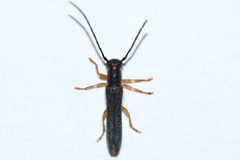
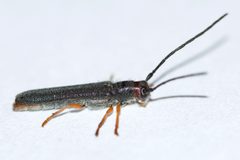
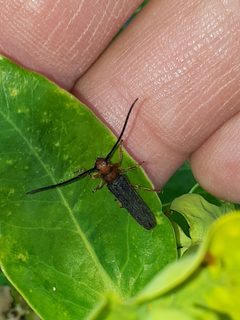
Oberea erythrocephala is a slender, elongate longhorn beetle introduced to North America as a agent for leafy spurge (Euphorbia esula). have distinctive red , black , and grayish-black hind wings. The is and oligophagous, feeding and developing only on certain Euphorbia species in the subgenus Esula. It was approved for release in the United States in 1980 and has since established across at least fifteen states and several Canadian provinces. The is considered secondary to Aphthona flea beetles in leafy spurge management due to its narrower range.
Pronunciation
How to pronounce Oberea erythrocephala: /oʊˈbɪəriə ɛrˌɪθroʊˈsɛfələ/
These audio files are automatically generated. While they are not always 100% accurate, they are a good starting point.
Identification
Distinguished from other Oberea by the combination of red , black , and grayish-black hind wings. The ring-like feeding grooves on plant stems are diagnostic for field detection. Similar to other stem-boring cerambycids but separable by host association with leafy spurge and the characteristic head coloration.
Images
Habitat
Associated with stands of leafy spurge (Euphorbia esula and related ). In North America, found in grasslands, rangelands, and disturbed areas where the plant occurs. In Europe, occurs wherever suitable Euphorbia species grow, including meadows, roadsides, and open woodlands.
Distribution
Native to Europe, where it is widely distributed. Introduced to North America: established in at least fifteen US states and several Canadian provinces as of 1995. First approved for release in 1980.
Seasonality
mate between late May and June. Females oviposit from late June to mid-July. with one per year.
Diet
Oligophagous, feeding exclusively on certain of Euphorbia in the subgenus Esula, including E. esula (leafy spurge). Does not feed on ornamental Euphorbia species such as E. pulcherrima or E. milii. Larvae mine stems and roots; feed on plant tissues.
Host Associations
- Euphorbia esula - primary leafy spurge, target weed for biocontrol
- Euphorbia spp. - subgenus Esula only
Life Cycle
. laid from late June to mid-July. Larvae develop as stem and root miners within plants. stage not explicitly documented in sources but inferred to be larval or pupal based on typical cerambycid .
Behavior
Solitary. come together only to mate. Not usually found in large numbers even where established. Adults and larvae both feed on plant tissues. Larval feeding creates distinctive ring-like grooves on stems.
Ecological Role
agent for leafy spurge (Euphorbia esula). Functions as a herbivore that reduces plant vigor through stem and root mining. Considered secondary to Aphthona flea beetles in programs due to more restricted host range. No documented negative impacts on native North American , attributed to narrow dietary specialization.
Human Relevance
Intentionally introduced to North America for of leafy spurge, an weed of rangelands and natural areas. Approved for release in the United States in 1980. Used in combination with approximately 10 other Eurasian insect for integrated management of leafy spurge. Not commercially valuable; scientific value lies in biocontrol efficacy research and implementation.
Similar Taxa
- Aphthona spp. (flea beetles)Also used for leafy spurge biocontrol; considered primary agents while O. erythrocephala is secondary. Different (Chrysomelidae vs. Cerambycidae) and (root feeders vs. stem/root miners).
- Other Oberea speciesShare general body form and but differ in associations and usually in coloration; O. erythrocephala distinguished by red and specific association with Euphorbia.
More Details
Biocontrol History
Approval for introduction to the United States occurred in 1980. Fifteen years later, the was widely distributed across at least fifteen states and Canadian provinces. Despite being non-native, it has not been documented to harm native , likely due to its restricted diet.
Taxonomic Note
The Catalogue of Life lists this as an ambiguous synonym, while GBIF treats it as accepted. The species has been placed in the subgenus Amaurostoma by some authors.
Sources and further reading
- BugGuide
- Wikipedia
- GBIF taxonomy match
- iNaturalist taxon
- Catalogue of Life
- Meloidae Holdings | Entomology Research Museum
- Cerambycidae | Beetles In The Bush | Page 9
- Investigations on Oberea erythrocephala (Schrank) (Col.: Cerambycidae), a possible biocontrol agent of leafy spurge, Euphorbia spp. (Euphorbiaceae) in Canada