
Aphthona
Chevrolat in Dejean, 1836
Spurge Flea Beetles
Species Guides
5- Aphthona cyparissiae(brown dot leafy spurge flea beetle)
- Aphthona czwalinai
- Aphthona flava(Copper Leafy Spurge Flea Beetle)
- Aphthona lacertosa(Brown-legged Leafy Spurge Flea Beetle)
- Aphthona nigriscutis(Black Dot Leafy Spurge Flea Beetle)
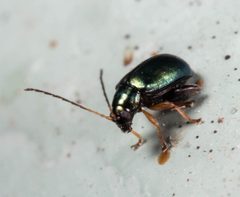
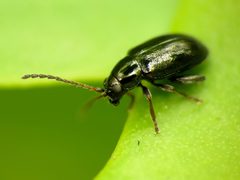
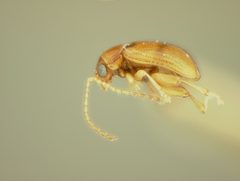
Aphthona is a of flea beetles in the leaf beetle Chrysomelidae, native to Europe and Asia with approximately 135 in the Palaearctic region and some 300 species worldwide. Members possess enlarged hind legs adapted for jumping, a characteristic trait of the tribe Alticini. The genus has gained significant attention for applications, with several species introduced to North America to manage leafy spurge (Euphorbia esula), a major weed. Six species—A. abdominalis, A. cyparissiae, A. czwalinae, A. flava, A. nigriscutis, and A. lacertosa—have been used for this purpose, though establishment success varies. Some African species have been identified as pests of Jatropha curcas in biodiesel plantations.
Pronunciation
How to pronounce Aphthona: //ævˈθoʊ.nə//
These audio files are automatically generated. While they are not always 100% accurate, they are a good starting point.
Identification
Flea beetles in this can be recognized by their enlarged hind adapted for jumping, a diagnostic feature of the tribe Alticini. -level identification requires examination of male and female genitalia; micrographs and scanning electron micrographs of genital structures and other morphological characters are used for accurate determination. Discriminant analysis using six morphological characters has been employed to distinguish among closely related species.
Images
Habitat
Native to Europe and Asia; occupies diverse terrestrial . In North America, established occur in rangelands and areas infested with leafy spurge. Some African occur in biodiesel plantations.
Distribution
Native range: Europe and Asia (Palaearctic region). Introduced to localized areas of the United States and Canada for . Sub-Saharan African documented in Namibia and surrounding regions. Distribution records from Denmark, Norway, and Sweden.
Host Associations
- Euphorbia esula L. (leafy spurge) - primary for major weed in western North America; six Aphthona introduced for control
- Jatropha curcas L. - for pest Aphthona cookei -group in Sub-Saharan Africa identified as pests of this biodiesel crop
- Euphorbia brachycera Engelm. - potential non-target native North American spurge consubgeneric with leafy spurge; field studies show low risk of shift
Behavior
jump using enlarged hind legs to escape potential danger. Evidence suggests chemical cues influence and distribution in A. nigriscutis. Released beetles have failed to persist when introduced directly into non-target .
Ecological Role
agent for leafy spurge in North America; effectiveness varies by site due to soilborne , spring , soil texture, and weed . Control is less effective in sandy soils and may require 10 years or more for reliable observation. Some African function as agricultural pests in biodiesel plantations.
Human Relevance
Significant value as agents against leafy spurge, reducing cover and of this weed in rangelands. Six have been introduced to North America from Europe; A. abdominalis apparently failed to establish viable in the United States and was never introduced in Canada. Risk of non-target effects on native Euphorbia species appears low based on specificity testing and field surveys.
Sources and further reading
- BugGuide
- Wikipedia
- GBIF taxonomy match
- iNaturalist taxon
- NCBI Taxonomy
- Catalogue of Life
- Biology of Aphthona nigriscutis (Coleoptera: Chrysomelidae) in the Laboratory
- Revision of the Aphthona cookei species group in Sub-Saharan Africa: pests of Jatropha curcas L. in biodiesel plantations (Coleoptera, Chrysomelidae, Galerucinae, Alticini)
- Life History of the Flea Beetle, Aphthona abdominalis Duftschmid, on Euphorbia esula L (Leafy Spurge) in Italy
- The influence of matrix habitat on Aphthona flea beetle immigration to leafy spurge patches
- Potential Impact of Two Aphthona spp. on a Native, Nontarget Euphorbia Species
- Effect of Leafy Spurge (Euphorbia esula) Genotype on Feeding Damage and Reproduction of Aphthona spp.: Implications for Biological Weed Control
- Host Specificity of Aphthona abdominalis Duftschmid (Coleoptera: Chrysomelidae), a Biological Control Agent for Euphorbia esula L. (leafy spurge, Euphorbiaceae) in North America
- Evidence for the influence of conspecific chemical cues on Aphthona nigriscutis (Coleoptera: Chrysomelidae) behaviour and distribution