
Aegomorphus quadrigibbus
(Say, 1831)
Four-humped Longhorned Beetle
Aegomorphus quadrigibbus is a longhorned beetle in the Lamiinae, originally described by Thomas Say in 1831 as Acanthoderes quadrigibba. The is characterized by four prominent on the pronotum and distinctive -shaped elytral patterning. Historically associated with hardwood forests in eastern North America, it has recently emerged as an agricultural pest in Mexican Persian lime orchards. The species was transferred to the Aegomorphus by Yanega in 1996.
Pronunciation
How to pronounce Aegomorphus quadrigibbus: /ˌiːɡoʊˈmɔrfəs kwɒˌdraɪˈdʒɪbəs/
These audio files are automatically generated. While they are not always 100% accurate, they are a good starting point.
Identification
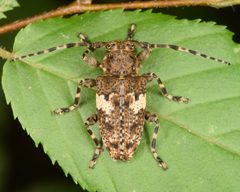
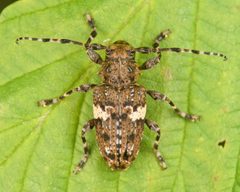
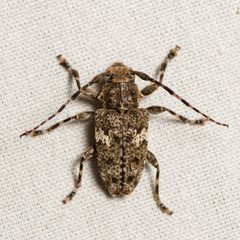
The combination of four pronotal gibbosities and the characteristic -shaped or scalloped elytral pattern distinguishes A. quadrigibbus from other North American Aegomorphus and Acanthoderes . The dense, -like on the creates a distinctive appearance that can superficially resemble dermestid beetles at first glance. Males have longer than the body; females with shorter antennae. The abruptly patterned elytra with symmetrical light markings on a dark background is diagnostic within its range.
Images
Appearance
Medium-sized cerambycid beetle, approximately 12 mm in length and 5 mm in width. Pronotum bears four conspicuous gibbosities (humps), two and two , giving the its specific epithet. covered with dense, short hairs creating a distinctive pattern: dark background with lighter, -shaped or scalloped markings along the midline. long, extending beyond body length in males. Body form cylindrical, typical of Lamiinae.
Habitat
Native range: hardwood forests, particularly associated with oak and other deciduous trees. Recently documented in agricultural settings: Persian lime orchards in Veracruz, Mexico. Larval : wood of living or stressed trees, particularly trunks and branches.
Distribution
Eastern North America: Ontario, Canada and eastern United States. Recently recorded as an agricultural pest in Martínez de la Torre municipality, central Veracruz state, Mexico. iNaturalist observations indicate broader presence across eastern North America with 859 records.
Diet
Larvae feed on wood/phloem tissue of trees. Documented hosts include hardwood (native range) and Persian lime (Citrus latifolia) in Mexico. Larval galleries excavated 2–5 cm deep in trunks and branches.
Host Associations
- Citrus latifolia - larval Persian lime; agricultural pest in Mexican orchards, first record on Rutaceae
- Quercus spp. - larval oaks; historical native association
Life Cycle
Complete . oviposit on trunks and branches of trees. Larvae form galleries 2–5 cm deep in wood; galleries may girdle trunk or branches, disrupting nutrient flow. occurs within galleries. Adult timing not well documented but likely corresponds to warmer months in native range.
Behavior
are and attracted to light. In agricultural settings, adults show oviposition on trunks and branches of trees. Larval boring behavior can girdle host tissues, causing branch desiccation and tree death. Damage severity increased in trees with pre-existing vascular or nutrient deficiencies.
Ecological Role
Native range: secondary colonizer of hardwood trees, likely associated with stressed or dying wood. Agricultural context: primary pest causing economic damage to Persian lime orchards with 10.8% average in sampled Mexican trees. Represents novel expansion onto cultivated citrus.
Human Relevance
Agricultural pest in Mexican Persian lime production region. First recorded damage to citrus in 2021; causes branch desiccation, tree death, and economic losses in Martínez de la Torre municipality, Mexico's most important Persian lime production area. No significant human relevance documented in native North American range.
Similar Taxa
- Acanthoderes quadrigibbaSynonym; same under original combination
- Aegomorphus modestusCongeneric in eastern North America; lacks four distinct pronotal and distinctive elytral pattern
- Anthrenus verbasciVaried carpet beetle; superficially similar elytral pattern and , but much smaller (2–3 mm), different (Dermestidae), flattened -like hairs versus cylindrical hair-like processes
More Details
Taxonomic History
Originally described as Acanthoderes quadrigibba by Thomas Say in 1831. Transferred to Aegomorphus by Yanega in 1996. The Aegomorphus was historically treated as a synonym of Acanthoderes but has been revalidated in modern classifications.
Agricultural Expansion
First record on Rutaceae and first documentation as agricultural pest reported in 2021 from Veracruz, Mexico. Represents significant range expansion from native hardwoods to cultivated citrus, with potential for economic impact in major lime production regions.
Sources and further reading
- BugGuide
- Wikipedia
- GBIF taxonomy match
- iNaturalist taxon
- NCBI Taxonomy
- Catalogue of Life
- ID Challenge #9 | Beetles In The Bush
- Tracking Tetraopes texanus with Terry | Beetles In The Bush
- 2018 Arizona Insect Collecting Trip “iReport” | Beetles In The Bush
- owl-flies | Beetles In The Bush
- First report of Aegomorphus quadrigibbus and Thryallis undatus (Coleoptera: Cerambycidae) damaging Persian lime orchards in Veracruz, México