
Acanthoderini
Thomson, 1860
Genus Guides
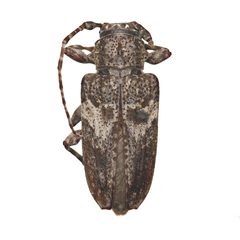
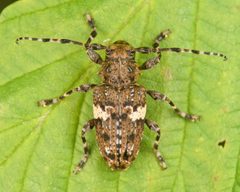
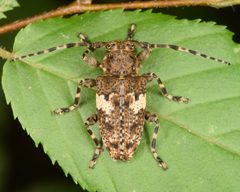
3Acanthoderini is a tribe of longhorn beetles (Cerambycidae) within the Lamiinae, established by Thomson in 1860. The tribe is primarily distributed in the Neotropical region, with some extending into North America. Members of this tribe exhibit considerable morphological diversity, with such as Acanthoderes, Aegomorphus, Scythropopsis, and Symperasmus. Recent taxonomic revisions have elevated Scythropopsis and Symperasmus to genus rank and resolved numerous synonymies within the group. The tribe includes both cryptically colored species and those with distinctive elytral patterns.
Pronunciation
How to pronounce Acanthoderini: /əˌkænθoʊdəˈrɪnaɪ/
These audio files are automatically generated. While they are not always 100% accurate, they are a good starting point.
Identification
Acanthoderini can be distinguished from related lamiine tribes by combinations of characters including pronotal and elytral . Within the tribe, can be separated by features such as the presence and arrangement of pronotal or gibbosities, elytral patterns, and antennal proportions. For example, Acanthoderes typically exhibit prominent pronotal , while Aegomorphus species often have more rounded pronota. Species-level identification frequently relies on elytral coloration and pattern, with some species displaying distinctive -shaped or transverse fasciate markings.
Images
Distribution
The tribe is predominantly Neotropical in distribution, with recorded from Mexico through Central and South America, including Bolivia, Brazil, Argentina, Rica, Paraguay, and Guyana. Some species extend into North America, with Acanthoderes quadrigibba occurring in the eastern United States, particularly in the Mississippi Alluvial Plain. The distribution of ten species has been expanded through recent taxonomic work.
Similar Taxa
- AcanthocininiAnother tribe within Lamiinae; Acanthoderini can be distinguished by differences in pronotal structure and elytral patterns, though some were historically confused between these tribes
- ParmeniniRelated lamiine tribe; Acanthoderini members often differ in having more pronounced pronotal gibbosities and distinct elytral setal patterns
More Details
Taxonomic instability
The of Acanthoderini has undergone significant revision, with the Psapharochrus synonymized under Aegomorphus, and Scythropopsis and Symperasmus elevated from subgeneric to generic status. The name Acanthoderus circumflexus has been proposed as nomen protectum over the older Acanthocinus rusticus.
Notable species
Acanthoderes quadrigibba, the 'four-humped longhorned beetle,' is among the most recognizable North American members of the tribe, characterized by four prominent pronotal and distinctive elytral patterning. Its larvae have been reared from numerous hardwood including Acer, Betula, Carya, Castanea, Celtis, Cercis, Fagus, Ficus, Quercus, Salix, Tilia, and Ulmus.
Sources and further reading
- BugGuide
- Wikipedia
- iNaturalist taxon
- NCBI Taxonomy
- Catalogue of Life
- Four-humped Longhorned Beetle | Beetles In The Bush
- Cactus beetle redux! | Beetles In The Bush
- Nomenclatural changes in Phymatodes | Beetles In The Bush
- North America’s most recognizable longhorned beetle | Beetles In The Bush
- Q: How do you photograph cactus beetles? | Beetles In The Bush
- ID Challenge #9 | Beetles In The Bush
- Notes on Acanthoderini (Coleoptera, Cerambycidae, Lamiinae) described by Ernst Fuchs, now in the Herbert Schmid Collection, Vienna, Austria
- Description of the female of Anasillus crinitus Marinoni & Martins 1978 (Coleoptera: Lamiinae: Acanthoderini) and new distribution records of longhorned beetles for Colombia
- Neotropical Acanthoderini (Coleoptera, Cerambycidae, Lamiinae): Synonymies and new status in some genera, new species, transferences and new distributional records