
Enaphalodes seminitidus
(Horn, 1885)
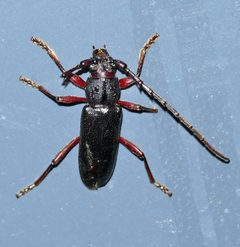
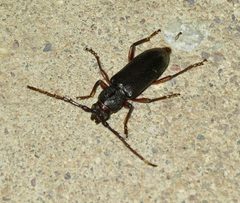
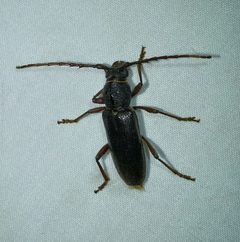
Enaphalodes seminitidus is a of longhorn beetle ( Cerambycidae) in the tribe Elaphidiini, described by George Henry Horn in 1885. The species belongs to a of wood-boring beetles whose larvae develop in hardwood trees. Like other Enaphalodes species, it is likely associated with oak or related hardwood , though specific host records for this species are not well documented in the available literature.
Pronunciation
How to pronounce Enaphalodes seminitidus: /ɛˌnæfəˈloʊdiːz ˌsɛmɪˈnaɪtɪdəs/
These audio files are automatically generated. While they are not always 100% accurate, they are a good starting point.
Identification
Enaphalodes seminitidus can be distinguished from by its partially shiny (semitinitidus = "half-shiny") elytral surface, which lacks the uniform seen in some related . The species is smaller than E. atomarius (robust oak borer) and lacks that species' more robust build and distinct pronotal . Within the Elaphidiini, Enaphalodes species are characterized by their elongate body form, typically shorter than the body in females and longer in males, and the presence of distinct elytral or sculpturing. Specific distinguishing features for E. seminitidus relative to E. taeniatus and other congeners require examination of genitalic structures and detailed elytral microsculpture.
Images
Habitat
Based on the and distribution records, E. seminitidus likely inhabits hardwood forests, particularly those containing oak . The species has been collected in mesic to dry deciduous woodland environments in the south-central United States.
Distribution
North America: recorded from the United States and Mexico. Specific state records include Texas and adjacent south-central states. The distribution appears to be centered in the southern Great Plains and south-central U.S., extending into northeastern Mexico.
Seasonality
activity period is not well documented, but based on related Enaphalodes , adults likely emerge in late spring through summer (May–August). Larval development occurs within wood year-round.
Host Associations
- Quercus - probable larval Inferred from ; specific records for this not documented
Behavior
are likely and attracted to light, as is typical for many Elaphidiini. Larvae are wood-borers, developing in the heartwood or sapwood of living or recently dead hardwood trees. Specific behavioral observations for this are not recorded.
Ecological Role
As a wood-boring , larvae contribute to nutrient cycling in forest by breaking down hardwood . The is a primary or secondary colonizer of oak and related hardwoods, facilitating decomposition and creating for other saproxylic organisms.
Similar Taxa
- Enaphalodes atomariusLarger, more robust with distinct pronotal and uniformly pubescent ; commonly known as robust oak borer
- Enaphalodes taeniatusSimilar size and distribution; distinguished by elytral pattern and male genitalia
- Enaphalodes rufulusRed oak borer; larger with different elytral coloration and more northern distribution
More Details
Taxonomic notes
The specific epithet 'semitinitidus' refers to the partially shiny (half-shiny) appearance of the , distinguishing it from more uniformly dull or pubescent . The was originally described by Horn in 1885 and has received limited modern taxonomic study.