
Enaphalodes rufulus
(Haldeman, 1847)
Red Oak Borer
Enaphalodes rufulus, commonly known as the Red Oak Borer, is a native North American cerambycid beetle that develops in oak trees. It is typically associated with stressed or declining oaks and normally occurs at low densities. However, the gained significant attention following a major in the Ozark and Ouachita Mountains during the late 1990s and early 2000s, which contributed to widespread mortality of northern red oak. The has become an important subject of ecological research regarding native insect outbreaks, tree resistance mechanisms, and climate-insect interactions.
Pronunciation
How to pronounce Enaphalodes rufulus: /ɛˌnæfəˈloʊdiːz ˈruːfjələs/
These audio files are automatically generated. While they are not always 100% accurate, they are a good starting point.
Identification
creates large circular exit holes in bark. Crescent-shaped oviposition scars approximately 3 mm long appear on bark surfaces. Late instar larval galleries are teardrop-shaped and relatively large. Woodpecker damage on oak trunks often indicates larval presence, as birds excavate larvae from beneath bark. Distinguished from similar cerambycids by host specificity (red/black oaks), gallery shape, and the characteristic pattern of attack clustering on lower and south-facing bole surfaces.
Images
Appearance
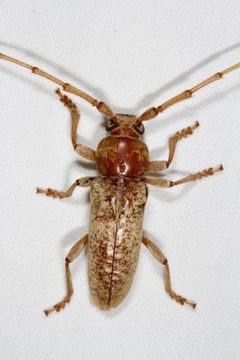
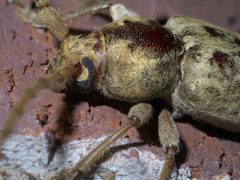
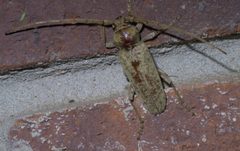
are 20–30 mm in length with an oblong body. Coloration is a faded combination of tan, brown, and red tones. is pronounced: females have larger, more robust bodies with approximately equal to body length, while males are smaller with antennae roughly twice the body length. are oblong, cream-colored, and 2–3 mm long. Larvae are cream-colored with dark and small jointed thoracic legs; mature larvae reach 40–50 mm. Pupae are tan, furrowed, with extremities visible externally.
Habitat
Mature oak forests, particularly those containing northern red oak, black oak, and scarlet oak. Occurs in both healthy and stressed stands, though are associated with drought-stressed trees. Within trees, larvae are concentrated in the lower and middle bole regions. are attracted to stressed or recently dead oaks for oviposition.
Distribution
Eastern North America from southeastern Canada (Ontario, Quebec, Nova Scotia) throughout the eastern and central United States. Range extends from Maine and Florida west to Minnesota, Iowa, Oklahoma, and Texas. Core area documented in the Ozark and Ouachita Mountains of Arkansas and Missouri.
Seasonality
activity period not explicitly documented in sources; likely summer-active based on typical cerambycid patterns. Larval development extends over multiple years with in wood. Historical dynamics show increases beginning in the mid-1970s, peaking in the late 1990s–early 2000s.
Diet
Larvae feed on phloem and sapwood of living oak trees. do not feed; their mouthparts are not adapted for chewing plant material.
Host Associations
- Quercus rubra - primary Northern red oak; major during Ozark
- Quercus velutina - primary Black oak
- Quercus coccinea - primary Scarlet oak
- Quercus spp. - Various oak across range
Life Cycle
are deposited in bark crevices. Larvae mine beneath bark in cambium and phloem, creating characteristic teardrop-shaped galleries, before tunneling into sapwood to overwinter. Development likely extends across two or more years. occurs in wood; emerge through circular exit holes. time appears to be 2 years based on gallery scar dating and seasonal development patterns.
Behavior
Females exhibit clustered oviposition patterns, concentrating attacks on lower and middle bole regions and preferring south-facing tree aspects—potentially related to temperature optimization for larval development. Larval galleries show spatial within trees. During conditions, attack densities increase dramatically, with resource partitioning and potential intraguild among larvae.
Ecological Role
Native wood-boring insect that contributes to oak decline and mortality, particularly during episodes. Serves as a food source for woodpeckers and other . Plays a role in nutrient cycling through wood decomposition, though this is limited in healthy forests. During outbreaks, acts as a significant mortality agent for mature oaks, altering forest structure and composition.
Human Relevance
Major pest during the 1999–2000s in the Ozarks, causing extensive mortality of commercially and ecologically valuable northern red oak. Subject of intensive research on native insect outbreak dynamics, tree resistance mechanisms, and climate-insect relationships. Management implications include monitoring drought-stressed oak stands and understanding that healthy trees exhibit better compartmentalization and wound closure capacity.
Similar Taxa
- Other Enaphalodes species members share general and oak-boring habits; distinguished by associations, geographic range, and subtle morphological differences
- Other oak-boring cerambycids (e.g., Goes tigrinus, Orthosoma brunneum)Share wood-boring in oaks; distinguished by gallery architecture, exit hole characteristics, and
More Details
Outbreak Dynamics
The late 1990s–early 2000s in the Ozark and Ouachita Mountains was historically unprecedented in . Dendroentomological evidence indicates growth began increasing regionally from 1976, with 11 of growth preceding the outbreak. Summer soil moisture availability (drought index) explained nearly half the variation in population growth, suggesting climate was a major contributing factor. Sites with higher outbreak densities sustained incipient populations longer, indicating greater potential for exponential increase when conditions became favorable.
Tree Resistance Mechanisms
Healthy northern red oaks exhibit superior resistance through compartmentalization—shorter vertical and faster wound closure of larval scars compared to declining or dying trees. Only healthy trees showed significant declining lesion length trends from 1988 to 2006, suggesting ability to reallocate resources to maintain resistance as feeding pressure increased. Callus formation appears to be an important physical defense, particularly early in the second year of larval development. Bark moisture does not appear to be a significant defense factor.
Research Significance
E. rufulus has become a model system for studying native insect in forest , challenging assumptions that such outbreaks are restricted to . Research has demonstrated that —sustaining growth while withstanding feeding pressure—may be a critical resistance mechanism for hardwoods against native borers. The species illustrates complex interactions between climate variability, tree condition, and eruptive in long-lived forest insects.
Sources and further reading
- BugGuide
- Wikipedia
- GBIF taxonomy match
- iNaturalist taxon
- NCBI Taxonomy
- Catalogue of Life
- Mammalia | Beetles In The Bush | Page 3
- crypsis | Beetles In The Bush
- Enaphalodes rufulus . [Distribution map].
- Vertical Distribution of the Red Oak Borer, Enaphalodes rufulus (Coleoptera: Cerambycidae), in Red Oak
- Dendroentomological evidence associated with an outbreak of the native wood-boring beetleEnaphalodes rufulus
- Factors that affect compartmentalization and wound closure of Quercus rubra infested with Enaphalodes rufulus
- Factors Affecting Suitability ofQuercus rubraas Hosts forEnaphalodes rufulus(Coleoptera: Cerambycidae)
- Stand and individual tree characteristics associated with Enaphalodes rufulus (Haldeman) (Coleoptera: Cerambycidae) infestations within the Ozark and Ouachita National Forests
- Historical dynamics of a native cerambycid, Enaphalodes rufulus , in relation to climate in the Ozark and Ouachita Mountains of Arkansas
- Callus formation and bark moisture as potential physical defenses of northern red oak,Quercus rubra, against red oak borer,Enaphalodes rufulus(Coleoptera: Cerambycidae)
- Spatial patterns of within-treeEnaphalodes rufulus(Coleoptera: Cerambycidae) attacks during outbreak conditions in the Ozark National Forest in Arkansas, United States of America