
Enaphalodes taeniatus
(LeConte, 1854)
Enaphalodes taeniatus is a of longhorn beetle in the Cerambycidae, described by John Lawrence LeConte in 1854. It belongs to the tribe Elaphidiini, a diverse group of cerambycids commonly known as elaphidiines. The species is known from North America and has been documented in the United States and Mexico. Like other members of its , it is a wood-boring whose larvae develop in dead or dying hardwood trees.
Pronunciation
How to pronounce Enaphalodes taeniatus: /ɛˌnafəˈloʊdiːz taɪˈnaɪətəs/
These audio files are automatically generated. While they are not always 100% accurate, they are a good starting point.
Identification
Enaphalodes taeniatus can be distinguished from by the banded color pattern implied by its specific epithet. Within the Elaphidiini, Enaphalodes are separated from related by combinations of antennal segment proportions, pronotal shape, and elytral . E. taeniatus specifically differs from the more commonly encountered E. atomarius (robust oak borer) by its banded rather than uniform coloration. Accurate identification requires examination of genitalic structures and comparison with or authoritative revisions.
Images
Appearance
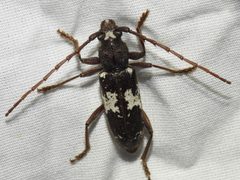
As a member of the Elaphidiini, Enaphalodes taeniatus likely exhibits the general elaphidiine body plan: elongate, somewhat cylindrical body form with that may approach or exceed body length. The specific epithet "taeniatus" (meaning "banded") suggests the presence of transverse bands or stripes on the or body. The is of moderate size typical for the . Detailed external has not been described in the available sources.
Habitat
The inhabits forested areas where its larval trees occur. Based on trapping records and the of , it is associated with deciduous woodlands, particularly those containing oak (Quercus) species. The species has been collected in mesic lowland deciduous forests and dry post oak woodlands.
Distribution
Enaphalodes taeniatus is distributed in North America, with records from the United States and Mexico. Specific documented occurrences include Missouri, Oklahoma, and Texas. The appears to be more frequently encountered in the south-central United States compared to eastern regions.
Seasonality
activity occurs during summer months. Trapping records indicate peak presence in July and August. One collector noted specimens appearing in ethanol-red wine baited traps from June through August, with the last official collection date in early October.
Host Associations
- Quercus spp. - larval Inferred from congeneric E. atomarius and trapping context; direct records not documented in available sources
Behavior
are attracted to fermenting traps containing ethanol and red wine, suggesting they are drawn to the odors of decaying wood and fungal fermentation. This is shared with numerous other cerambycid and facilitates collection for survey purposes. Adults are nocturnally active and have been collected at ultraviolet and mercury-vapor lights.
Ecological Role
As a wood-boring cerambycid, the larvae of Enaphalodes taeniatus contribute to the decomposition of dead and dying hardwood trees, facilitating nutrient cycling in forest . The is part of the saproxylic that depends on decaying wood resources.
Human Relevance
Enaphalodes taeniatus has no documented economic importance. It is not known to attack living trees or timber of commercial value. The is of interest to coleopterists and biodiversity researchers documenting cerambycid diversity in North American forests.
Similar Taxa
- Enaphalodes atomariusSimilar size, body form, and preference, but E. atomarius lacks the banded color pattern and has more uniform reddish-brown to dark brown coloration. E. atomarius is more commonly encountered in the eastern United States.
- Enaphalodes coronatusAnother congeneric with which E. taeniatus may co-occur; separation requires careful examination of elytral maculation and male genitalia
More Details
Taxonomic History
The was described by John Lawrence LeConte in 1854, one of the most prolific American coleopterists of the 19th century. The original description appeared in LeConte's contributions to the knowledge of North American Coleoptera.
Collection Methodology
Recent collectors have obtained this using 'jug traps' baited with a mixture of ethanol and red wine, which has proven more effective than ethanol alone for attracting diverse cerambycid including Enaphalodes species.
Sources and further reading
- BugGuide
- Wikipedia
- GBIF taxonomy match
- iNaturalist taxon
- Catalogue of Life
- Encyrtid Holdings | Entomology Research Museum
- August “jug trap” run | Beetles In The Bush
- Ascalaphidae | Beetles In The Bush
- August | 2022 | Beetles In The Bush
- ID Challenge #11 | Beetles In The Bush
- Ovipositing Pigeon Horntail | Beetles In The Bush