
Neoclytus tenuiscriptus
Fall, 1907
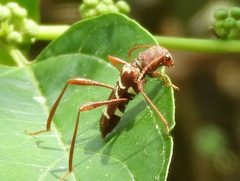
Neoclytus tenuiscriptus is a of longhorn beetle in the Cerambycidae, described by Fall in 1907. It belongs to the Neoclytus, a group of -mimicking beetles found in North America. The species is documented from Mexico and the United States, though specific details about its and remain limited in available sources. Like other members of its genus, it likely exhibits wasp-like coloration and rapid movement as defensive adaptations.
Pronunciation
How to pronounce Neoclytus tenuiscriptus: /ˌniːoʊˈklaɪtəs ˌtɛn.juːˈskrɪp.təs/
These audio files are automatically generated. While they are not always 100% accurate, they are a good starting point.
Images
Distribution
Middle America and North America; specifically recorded from Mexico (MX) and the United States (US).
Similar Taxa
- Neoclytus scutellatusBoth belong to the Neoclytus and share the characteristic -mimicking appearance common to the group. Neoclytus scutellatus has been documented in ethanol-baited traps in Missouri glade , suggesting similar ecological preferences may exist within the genus.
- Neoclytus mucronatusAnother congeneric with similar -mimicking . Neoclytus mucronatus has been reared from hackberry logs and exhibits the rapid movement and bold markings typical of the .
- Neoclytus acuminatusThe Red-headed Ash Borer is a widespread congeneric with similar -mimicking coloration and . It has been recorded from numerous hardwood and shows the same characteristic rapid, jerky movement that enhances its resemblance to stinging insects.
- Neoclytus capreaThe Banded Ash Borer is a well-documented congeneric with distinctive yellow and white banding against a dark background. It shares the -mimicking appearance and rapid movement of other Neoclytus species, and has been observed swarming on dying ash trees in spring.
Sources and further reading
- BugGuide
- Wikipedia
- GBIF taxonomy match
- iNaturalist taxon
- Catalogue of Life
- Recycling ash: Banded Ash Borer, Neoclytus caprea — Bug of the Week
- One of North America’s rarer longhorned beetles | Beetles In The Bush
- Bug Eric: Wasp Wednesday: Not Wasp VII
- Bug Eric: Wasp Wednesday: Not Wasp IX
- Insects roasting on an open fire: Bess beetles, Passalidae, carpenter ants, Formicidae, darkling beetles, Tenebrionidae, and longhorn beetles, Cerambycidae — Bug of the Week
- Ascalaphidae | Beetles In The Bush