
Neoclytus scutellaris
(Olivier, 1790)
Split-necked Neoclytus
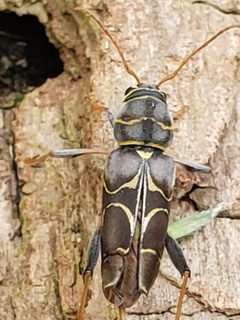
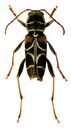
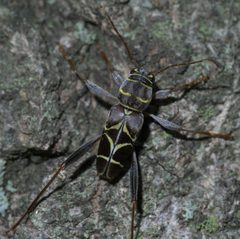
Neoclytus scutellaris is a longhorned beetle ( Cerambycidae) found in the eastern United States. First described by Guillaume-Antoine Olivier in 1790, this is strongly associated with dead or dying oak trees, where larvae develop in decaying wood. are attracted to fermenting baits and can be distinguished from similar species by the transverse yellow band on the pronotum. The species is sometimes confused with N. mucronatus, which occurs on hickory and hackberry rather than oak.
Pronunciation
How to pronounce Neoclytus scutellaris: /neˈɒklɪtəs ˌskjutəˈlɛərɪs/
These audio files are automatically generated. While they are not always 100% accurate, they are a good starting point.
Identification
Distinguished from the similar Neoclytus mucronatus by the presence of a transverse yellow band across the pronotum. N. mucronatus lacks this pronotal band and is associated with hickory and hackberry rather than oak. Both share the general Clytini pattern of yellow and black banding on the .
Images
Habitat
Deciduous woodlands, particularly areas with dead or dying oak trees. are frequently encountered at fermenting traps placed in open woodland , especially at the interface between dry post-oak woodland and glade .
Distribution
Eastern United States. Records from Missouri, with specific localities including Wayne County and glade in the Ozark Highlands.
Seasonality
active during summer months. In Missouri, collected in fermenting traps from early June through mid-September, with peak activity in mid-summer.
Diet
Larvae feed on decaying wood of dead or dying oak trees (Quercus spp.). have been observed feeding on fermenting baits; specific adult feeding habits in nature are not well documented.
Host Associations
- Quercus - larval Strongly associated with dead/dying oaks; larvae develop in decaying oak wood
Behavior
are attracted to fermenting baits, particularly molasses-beer and red wine mixtures. habits suspected based on collection patterns in traps, though activity cannot be ruled out.
Ecological Role
Wood decomposer. Larvae contribute to the breakdown of dead oak wood, facilitating nutrient cycling in forest .
Human Relevance
Collected by entomologists using fermenting traps for survey and study purposes. No significant economic importance as a pest; association with already dead or dying trees suggests limited forestry impact.
Similar Taxa
- Neoclytus mucronatusVery similar in general appearance and elytral patterning, but distinguished by lack of transverse yellow pronotal band and association with hickory/hackberry rather than oak
- Neoclytus acuminatusAnother oak-associated with similar size and coloration; precise distinguishing characters require examination of antennal and pronotal details