
Lyctus carbonarius
Waltl, 1832
southern lyctus beetle
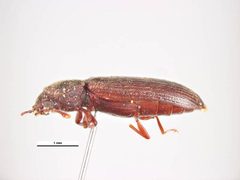
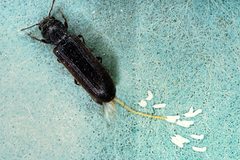
Lyctus carbonarius is a wood-boring in the Bostrichidae, commonly known as the southern lyctus beetle. It is a serious pest of hardwoods, particularly ash, hickory, oak, maple, and mahogany. The has been introduced to multiple continents through international timber trade and can infest finished wood products in homes, including flooring, furniture, and structural timbers. often begin before construction of wood articles and can remain undetected until holes appear.
Pronunciation
How to pronounce Lyctus carbonarius: /ˈlɪktəs ˌkɑr.bəˈnɛə.ri.əs/
These audio files are automatically generated. While they are not always 100% accurate, they are a good starting point.
Identification
Distinguished from other wood-boring beetles by the combination of a prominent uncovered , two-segmented antennal club, and pronotum wider than long. The longitudinal elytral ridges with double puncture rows separate it from similar Bostrichidae. Lyctus planicollis was synonymized with this ; separation from other Lyctus species requires examination of subtle morphological details. signs include circular holes approximately 1–2 mm in diameter with fine powdery .
Images
Appearance
beetles are 4–6 mm in length and dark brownish-black in color. The is prominent and not concealed beneath the pronotum. have eleven segments with the terminal two segments enlarged, forming a distinct club. The body is elongated and slightly flattened, with the pronotum wider than long. bear longitudinal ridges with double rows of small punctures between them. The entire body is covered with sparse, short yellowish setae.
Habitat
Develops within seasoned hardwood timber, particularly sapwood. Infests structural timbers, hardwood flooring, plywood, furniture, tool handles, picture frames, baskets, and ladders. Favors heated indoor environments where development accelerates. Does not infest softwoods such as pine; subfloors, joists, and rafters typically escape attack. Imported tropical hardwoods with poor drying and storage practices are especially vulnerable.
Distribution
Native to Europe; introduced to North America, South America, Australia, and Middle America. Distribution records span temperate and tropical regions globally. Within North America, established in multiple regions. Spread occurs through transport of infested timber by ship to new areas, followed by and local .
Seasonality
emerge primarily in spring. In heated buildings, continuous development occurs year-round with overlapping . Outdoors or in unheated conditions, activity peaks in warmer months; larvae may hibernate in colder regions, extending the . Adults are .
Diet
Larvae feed exclusively on the starchy components of hardwood sapwood; they cannot digest cellulose. Documented hardwoods include ash (Fraxinus), hickory (Carya), oak (Quercus), maple (Acer), and mahogany (Swietenia). do not feed on wood.
Host Associations
- Fraxinus - larval food planthardwood sapwood
- Carya - larval food planthardwood sapwood
- Quercus - larval food planthardwood sapwood
- Acer - larval food planthardwood sapwood
- Swietenia - larval food planthardwood sapwood
Life Cycle
Females mate soon after spring and lay up to 50 white, cylindrical (~1 mm) over one week. Eggs are deposited deep in wood tunnels, pores, cracks, or crevices, hatching in 1–3 weeks depending on temperature. Larvae are cream-colored, growing to ~7 mm while tunneling through sapwood along or across the grain, producing powdery . They construct pupal chambers near the surface. lasts 12 days to one month. chew circular exit holes to emerge. Adults live up to three months. Complete cycle ranges from 6 months to 4 years, typically ~1 year; accelerated in heated buildings, slowed in adverse conditions with larval hibernation in cold regions.
Behavior
are . Females locate -laying sites in existing tunnels, wood pores, or surface defects. Larvae remain within wood throughout development, never breaking the surface until adult . Adults may reinfest the same timber or disperse to new hardwood sources. Long-distance occurs through human transport of infested wood products rather than natural .
Ecological Role
Decomposer of dead hardwood timber in native range. As an introduced , functions as a destructive pest without significant natural ecological role. No documented beneficial services outside native European forests.
Human Relevance
Major economic pest of hardwood products globally. Damages hardwood flooring, furniture, structural timbers, plywood, tool handles, picture frames, baskets, and ladders. often originates in pre-construction timber, making prevention difficult. Varnished, painted, or polished surfaces resist direct attack but may conceal existing tunnels used for -laying. International timber trade facilitates global spread. Control relies on proper timber drying, storage , and chemical treatment of susceptible hardwoods.
Similar Taxa
- Lyctus brunneusSimilar powderpost beetle in same ; requires detailed morphological comparison for separation
- Anobium punctatumCommon furniture beetle; differs in smaller size, rounded pronotum, and ability to attack softwoods
- Heterobostrychus aequalisAnother Bostrichidae pest; larger size and different antennal structure distinguish it
More Details
Taxonomic Note
Formerly placed in Lyctidae, now treated as Lyctinae within Bostrichidae. Lyctus planicollis LeConte, 1859 is a synonym.
Control Significance
Only sapwood is attacked; heartwood remains immune. This influences timber grading and utilization practices for susceptible hardwood .