
Lyctus brunneus
(Stephens, 1830)
brown powderpost beetle, brown lyctus beetle, powder post beetle
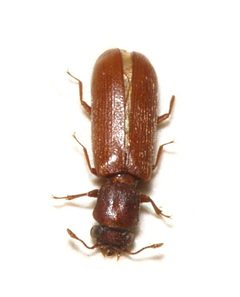
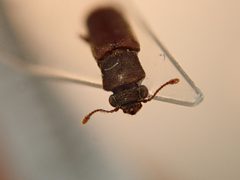
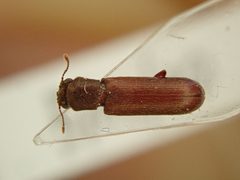
is a wood-boring in the Bostrichidae, Lyctinae, known as the brown powderpost beetle. It is a that causes significant damage to dry hardwood and bamboo. Originally native to the Neotropical region, it has achieved worldwide distribution through human commerce. The species is notable for its specialized chemosensory mechanism for detecting starch content in wood, which determines oviposition site selection.
Pronunciation
How to pronounce Lyctus brunneus: /ˈlɪk.təs ˈbruː.ni.əs/
These audio files are automatically generated. While they are not always 100% accurate, they are a good starting point.
Images
Habitat
Dry hardwood and bamboo substrates. The requires wood with sufficient starch content for successful larval development. It infests seasoned timber rather than living trees or freshly cut wood.
Distribution
Worldwide distribution, achieved through international trade in timber products. Originally native to the Neotropical region.
Diet
Larvae feed on wood tissues, primarily consuming surrounding earlywood vessels and axial parenchyma, followed by latewood areas including vessels, fibres, and axial parenchyma. A smaller proportion of rays is consumed. The diet is restricted to starch-containing hardwoods.
Host Associations
- dry hardwood - larval food source and oviposition substrateRequires sufficient starch content for development
- bamboo - larval food source and oviposition substrateAlternative material with adequate starch
- oak (Quercus sp.) - documented Specific feeding patterns documented in sapwood
Life Cycle
Larval development comprises three instars, marked by two moults, before reaching final size. The relative proportions of wood tissues consumed remain consistent across larval stages. emerge from wood after completing development.
Behavior
females exhibit specialized starch detection . They secrete amylase externally to decompose starch, then detect the resulting maltose using located on the maxillary and labial palps. This chemosensory mechanism allows females to identify optimal oviposition sites. Previously attributed 'tasting' behavior—gnawing the wood surface with to make small incisions—functions primarily as mechanical preparation for ovipositor insertion rather than as true chemosensory action. Females oviposit only on substrates with sufficient starch content.
Ecological Role
Decomposer of dead and seasoned hardwood. Contributes to nutrient cycling in forest , though primarily known as a pest of stored timber and finished wood products. Serves as for including Cryptontsira parva (Braconidae).
Human Relevance
Significant pest of dry hardwood and bamboo products. Causes structural damage to timber, furniture, and other wood products by reducing seasoned wood to a fine powder (). Economic impact is substantial in timber trade and heritage wood preservation. Detection methods and control strategies are important for wood protection industries.
Similar Taxa
- Lyctus planicollisSimilar powderpost beetle in the same ; both require starch-containing hardwoods
- Minthea rugicollisAnother lyctine powderpost beetle with similar and damage patterns
- Heterobostrychus brunneusDifferent (Bostrichidae: Bostrichinae) but similar and wood-boring habit; distinguished by larger size and different characteristics
More Details
Chemosensory Mechanism
Research has demonstrated that starch detection involves external secretion of amylase by females, followed by detection of maltose breakdown products using on the maxillary and labial palps. This represents a sophisticated external digestion and chemoreception system for evaluating quality.
Parasitoid Relationships
Cryptontsira parva (Hymenoptera: Braconidae) is a documented of L. brunneus, with records from South America indicating potential for research.
Sources and further reading
- BugGuide
- Wikipedia
- GBIF taxonomy match
- iNaturalist taxon
- NCBI Taxonomy
- Catalogue of Life
- Grasshoppers of Colorado
- Grasshoppers of Colorado
- Grasshoppers of Colorado
- Species Records and Accounts
- Bruner Slantfaced Grasshopper
- Field Guide
- Tasting Behaviour of Lyctus brunneus STEPHENS (Coleoptera : Lyctidae)
- An anatomical approach to investigating Lyctus brunneus feeding behaviour in oak sapwood
- Chemosensory mechanisms of starch detection and oviposition site selection in the powder-post beetle Lyctus brunneus (Stephens) (Coleoptera, Bostrichidae)
- FIRST OCCURRENCE AND SEXUAL BEHAVIOR OF Cryptontsira parva (MUESEBECK, 1941) (HYMENOPTERA, BRACONIDAE) PARASITIZING Lyctus brunneus (STEPHENS, 1830) (COLEOPTERA, BOSTRICHIDAE) IN SOUTH AMERICA