
Minthea rugicollis
(Walker, 1858)
hairy powderpost beetle
Minthea rugicollis, commonly known as the hairy powderpost beetle, is a of wood-boring in the Bostrichidae. It belongs to the Lyctinae, a group commonly referred to as powderpost beetles due to their larvae's ability to reduce wood to a fine powder. The species has a broad geographic distribution spanning the Caribbean, Oceania, Southern Asia, and Europe, with additional records from the Galápagos Islands. Like other members of its subfamily, it is likely associated with dry wood products.
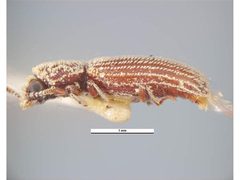
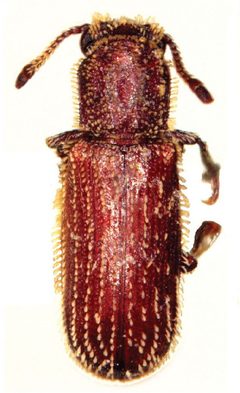
Pronunciation
How to pronounce Minthea rugicollis: /ˈmɪn.θi.ə ruː.dʒɪˈkɒl.ɪs/
These audio files are automatically generated. While they are not always 100% accurate, they are a good starting point.
Images
Habitat
Associated with dry wood environments; typical of powderpost beetles in the Lyctinae.
Distribution
Recorded from the Caribbean, Oceania, Southern Asia, Europe, and the Galápagos Islands.
Human Relevance
As a member of the powderpost beetle group, it has potential significance as a pest of seasoned wood and wood products, though specific documented impacts for this are not detailed in available sources.
Similar Taxa
- Other Lyctinae speciesSimilar wood-boring habits and powder-producing larval damage; precise identification requires examination of morphological details such as antennal club structure and pronotal features.
- Other BostrichidaeShared characteristics including cylindrical body form and wood-boring lifestyle; distinguished by -level traits of Lyctinae.
More Details
Taxonomic history
Originally described as Ditoma rugicollis by Walker in 1858, later transferred to the Minthea.
Nomenclatural note
The specific epithet 'rugicollis' refers to wrinkled or features of the pronotum (neck region), a characteristic that may aid in identification.