
Lyctus linearis
(Goeze, 1777)
European lyctus beetle, powderpost beetle
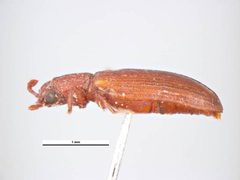
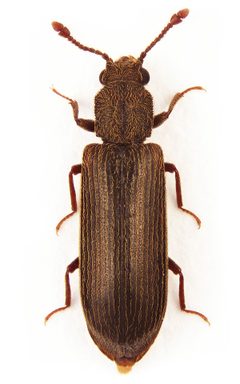
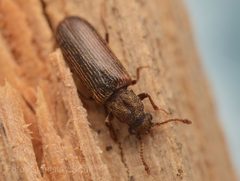
Lyctus linearis is a wood-boring in the Bostrichidae, commonly known as the European lyctus beetle or a powderpost beetle. Originally native to tropical regions, it has established worldwide through human transport of wood products. It is a significant pest of hardwood timber and finished wood products, causing damage through larval feeding that reduces wood to a fine powder. The shows particular association with deciduous tree woods.
Pronunciation
How to pronounce Lyctus linearis: //ˈlɪktʊs lɪˈneɪərɪs//
These audio files are automatically generated. While they are not always 100% accurate, they are a good starting point.
Identification
are small, slender beetles with a somewhat flattened profile. The is partially concealed from above by the pronotum, a characteristic feature of Bostrichidae. Identification to level requires examination of antennal structure and other subtle morphological features; separation from congeneric species such as Lyctus brunneus and Lyctus cavicollis typically requires knowledge and microscopic examination.
Images
Habitat
Associated with wood and wood products, particularly hardwoods. Found in timber yards, warehouses, and structures containing seasoned hardwood. Naturally associated with dead and dying wood of deciduous trees.
Distribution
Originally tropical in native range; now in distribution. Present in Australia, Europe and Northern Asia (excluding China), North America, and South America. Distribution closely follows human commerce in timber and wooden goods.
Diet
Larvae feed on starch-containing hardwoods, particularly the sapwood of deciduous trees. do not feed on wood; they may feed on pollen or not feed at all. The requires wood with sufficient starch content for larval development.
Host Associations
- deciduous trees - larval most common in deciduous tree woods
- hardwood timber - larval significant pest of seasoned hardwood in trade
Life Cycle
Complete with , larval, pupal, and stages. Females lay eggs in cracks, crevices, or pores of wood. Larvae tunnel through wood, feeding on starch-containing and reducing wood to a fine, powdery . Larval development period varies with wood moisture, starch content, and temperature. occurs near the wood surface. Adults emerge through small, round exit holes, typically 1–2 mm in diameter.
Behavior
Larvae are the destructive stage, creating extensive tunnel networks while feeding. are relatively short-lived and primarily function to disperse and reproduce. The has been transported globally through international trade in wooden goods, demonstrating its capacity to establish in new regions.
Ecological Role
In natural settings, contributes to decomposition of dead and dying hardwood. In human-modified environments, acts as a pest of economic importance through damage to timber, furniture, and structural wood.
Human Relevance
Major pest of wood products worldwide. Causes significant economic damage to hardwood timber, finished furniture, flooring, and structural elements. are often detected by the presence of fine, talc-like and small round exit holes. Control relies on reducing wood moisture content, chemical treatment, or use of wood .
Similar Taxa
- Lyctus brunneusAnother powderpost pest of hardwoods; requires detailed morphological examination to distinguish
- Lyctus cavicollisCongeneric with similar and pest status; separation requires identification
- Lyctus planicollisNorth American powderpost with overlapping preferences and distribution
More Details
Common name note
The 'European lyctus ' is somewhat misleading given the ' probable tropical origin and current distribution; the name likely reflects early European taxonomic description rather than true geographic origin.