
Anobium punctatum
(De Geer, 1774)
Common furniture beetle, Common house borer, House borer
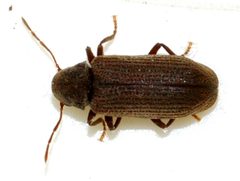
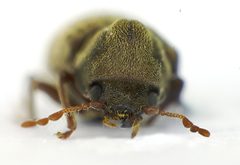
Anobium punctatum is a woodboring commonly known as the or house borer. are small beetles measuring 2.7–4.5 mm with brown, ellipsoidal bodies and a distinctive prothorax resembling a monk's cowl. The has a documented pattern in December in some , with females laying an average of 54.8 after a short preoviposition period. Larvae bore into and feed upon wood, making this species a significant pest of wooden structures and furniture.
Pronunciation
How to pronounce Anobium punctatum: //əˈnoʊ.bi.əm pʌŋkˈteɪ.təm//
These audio files are automatically generated. While they are not always 100% accurate, they are a good starting point.
Identification
The monk's cowl-shaped prothorax distinguishes from similar small brown beetles. Size range of 2.7–4.5 mm and ellipsoidal body form aid in field recognition. Larval identification requires examination of wood-boring damage and larval .
Images
Habitat
Wood-boring associated with wooden substrates; larvae develop within wood. Laboratory studies used sapwood blocks of Podocarpus dacrydioides as -laying substrate.
Distribution
Widespread distribution including New Zealand (Auckland), and European islands (Corvo, Faial, Flores, Graciosa, Pico in the Azores). Global distribution as a pest of wooden structures.
Seasonality
in December observed in Auckland, New Zealand .
Diet
Larvae bore into wood and feed upon it. Specific wood preferences in natural settings not documented in available sources.
Host Associations
- Podocarpus dacrydioides - -laying substrateUsed in laboratory studies as sapwood block for oviposition; not confirmed as natural
Life Cycle
pattern documented in some . females undergo short preoviposition period, followed by rapid -laying virtually complete by 15 days post-emergence. Average of 54.8 eggs per female. Adult female lifespan 24–31 days maximum. Larval development occurs within wood; specific duration not documented in available sources.
Behavior
Females lay rapidly following , with oviposition essentially finished within two weeks. Egg production correlates with female body weight in approximately 60% of individuals.
Ecological Role
Wood decomposer through larval boring activity.
Human Relevance
Significant pest of wooden furniture and structural timber. Commonly referenced in popular culture as evidenced by plush toy representations.
Similar Taxa
- Other Anobiidae/Ptinidae wood-borersSimilar size and wood-boring habit; distinguished by prothorax shape and specific morphological details requiring expert examination
More Details
Reproductive biology
Laboratory studies show higher production (54.8 eggs/female) than field-collected females, suggesting potential -dependent or environmental constraints on in natural settings. Egg-laying distribution in laboratory was normal, not skewed or censored.
Taxonomic note
placement varies between sources: treated as Anobiidae in some classifications, Ptinidae in others (including NCBI and iNaturalist).