
Copelatinae
Branden, 1884
copelatine diving beetles
Genus Guides
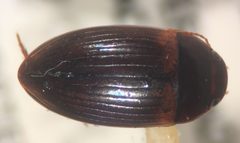
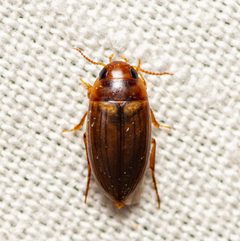
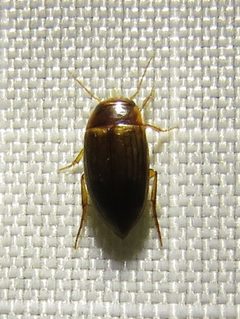
1Copelatinae is a of predaceous diving beetles (Dytiscidae) comprising seven : Agaporomorphus, Aglymbus, Copelatus, Exocelina, Lacconectus, Liopterus, and Madaglymbus. The genus Copelatus is the largest with approximately 470 described worldwide, showing greatest diversity in tropical South America, Africa, and Southeast Asia. Members are predominantly aquatic, though some species have colonized highly ephemeral including forest floor depressions. The subfamily exhibits remarkable morphological diversity and includes phylogenetically isolated lineages such as the South African genus Capelatus.
Pronunciation
How to pronounce Copelatinae: /ˌkəʊpɛlˈætɪniː/
These audio files are automatically generated. While they are not always 100% accurate, they are a good starting point.
Identification
Members of Copelatinae can be distinguished from other Dytiscidae by the combination of: prosternal process broadly in contact with mesosternum; metacoxal processes broadly separated, not contiguous medially; and male genitalia with distinct lobe and paramere structure. Within the subfamily, are distinguished by characters including body form, surface sculpturing, and male genitalia —particularly the shape of the median lobe and paramere setation. -level identification typically requires examination of male genitalia and, in many groups, protarsal and mesotarsal claw morphology.
Images
Habitat
Predominantly lentic (stagnant) freshwater including small rock pools, residual pools of streams, intermittent creek pools, forest pools, and flooded lake and river margins. Australian occur mainly in lowland areas up to 250 m elevation. Some species occupy lotic (running) water margins, avoiding currents and preferring puddles at stream edges and water-filled rock holes. Highly specialized species in Madagascar inhabit ephemeral tropical forest floor depressions in humid forests, remaining in drying habitats rather than dispersing.
Distribution
Worldwide distribution with centers of diversity in tropical regions. Copelatus is globally distributed; Exocelina and Austrelatus concentrated in New Guinea and Australasia; Agaporomorphus restricted to lowland tropical South America; Madaglymbus to Madagascar; Capelatus restricted to Western Cape, South Africa. Australian Copelatus occur in the northern half of the continent, with some species extending to New Guinea.
Behavior
Many are attracted to light at night and are frequently collected at light traps. Some Madagascar species exhibit unusual for diving beetles, remaining in place when ephemeral dry rather than dispersing to permanent water. Members of the Capelatus represent an evolutionary relict, having survived in a small stable climate region for approximately 30-40 million years.
Human Relevance
Capelatus prykei from South Africa has been assessed as Critically Endangered due to its single known and loss; conservation action has been recommended. The serves as an indicator group for aquatic habitat quality and biogeographic research, with several lineages representing significant phylogenetic diversity. Some have been described only recently, highlighting ongoing discovery of biodiversity in tropical regions.
Similar Taxa
- HydroporinaeBoth are of Dytiscidae; Hydroporinae generally have metacoxal processes contiguous or nearly so medially, and often exhibit more streamlined body forms adapted to running water.
- ColymbetinaeBoth are Dytiscidae with aquatic larvae; Colymbetinae typically have more elongate body forms and different male genitalia structure with reduced or modified parameres.
- DytiscinaeLargest Dytiscidae ; Dytiscinae generally have larger body size, different metacoxal process configuration, and distinct male genitalia with more complex internal sac structures.
Sources and further reading
- BugGuide
- iNaturalist taxon
- NCBI Taxonomy
- Catalogue of Life
- Copelatinae Archives - Entomology Today
- New Genus and Species of Diving Beetle Discovered in South Africa
- New Predaceous Diving Beetle Named after Pinocchio
- Taxonomic revision of Australian Copelatus Erichson, 1832 (Coleoptera, Dytiscidae, Copelatinae)
- Two new species of Agaporomorphus Guignot from Suriname (Coleoptera, Adephaga, Dytiscidae, Copelatinae)
- First record of the diving beetle Copelatus chevrolati Aubé, 1838 in Cuba (Coleoptera, Dytiscidae, Copelatinae)
- Discovery of a specialist Copelatinae fauna on Madagascar: highly ephemeral tropical forest floor depressions as an overlooked habitat for diving beetles (Coleoptera, Dytiscidae)
- Two new species of Austrelatus diving beetles from continental Southeast Asia, linking the distribution area of the genus (Coleoptera: Dytiscidae: Copelatinae)
- A species-group key and notes on phylogeny and character evolution in New Guinean Exocelina Broun, 1886 diving beetles (Coleoptera, Dytiscidae, Copelatinae)
- Revision of the Austrelatus papuensis group with descriptions of 42 new species from New Guinea (Coleoptera, Dytiscidae, Copelatinae)
- Copelatus Erichson, 1832 from Maharashtra, India, with description of three new species and notes on other taxa of the genus (Coleoptera: Dytiscidae: Copelatinae)
- Supplementary material 1 from: Ranarilalatiana T, Bergsten J (2019) Discovery of a specialist Copelatinae fauna on Madagascar: highly ephemeral tropical forest floor depressions as an overlooked habitat for diving beetles (Coleoptera, Dytiscidae). ZooKeys 871: 89-118. https://doi.org/10.3897/zookeys.871.36337
- Introduction of the Exocelina casuarina-group, with a key to its representatives and descriptions of 19 new species from New Guinea (Coleoptera, Dytiscidae, Copelatinae)
- Life history of Copelatus kammuriensis Tamu and Tsukamoto, 1955 (Coleoptera: Dytiscidae: Copelatinae) and biological implications
- Austrelatus gen. nov., a new genus of Australasian diving beetles (Coleoptera, Dytiscidae, Copelatinae), with the discovery of 31 new species from New Guinea.