
Notiophilus aquaticus
(Linnaeus, 1758)
black-legged springtail-stalker
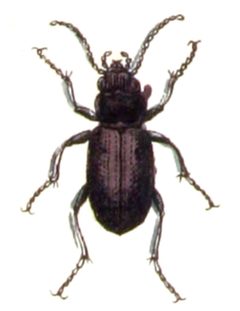
Notiophilus aquaticus is a Holarctic ground beetle in the Carabidae, commonly known as the black-legged -stalker. It occupies diverse open and semi-open including moraines, meadows, and forest edges. The is one of several in the Notiophilus, which are recognized for their specialized on springtails (Collembola).
Pronunciation
How to pronounce Notiophilus aquaticus: /nɔˈtiːoʊfɪləs əˈkwætɪkəs/
These audio files are automatically generated. While they are not always 100% accurate, they are a good starting point.
Identification
Members of the Notiophilus can be distinguished from other ground beetles by their large, bulging adapted for detecting small, fast-moving prey. The specific epithet "aquaticus" and "black-legged -stalker" suggest dark leg coloration, though -level diagnostic features for N. aquaticus require examination of genitalia and detailed morphological comparison with such as N. biguttatus and N. rufipes.
Images
Habitat
Moraines, fields, meadows, roadsides, sand and gravel pits, and forests. The shows flexibility across open, disturbed, and wooded environments.
Distribution
Holarctic distribution spanning Europe, Northern Asia, and North America. European records include Andorra, Austria, Belarus, Belgium, Bosnia and Herzegovina, Great Britain (including Isle of Man), Bulgaria, Croatia, Czech Republic, Denmark, Estonia, Faroe Islands, Finland, France, Germany, Iceland, and Ireland. North American records include Alaska.
Diet
Springtails (Collembola) constitute the primary prey. The "-stalker" directly references this specialized predatory .
Behavior
Active that stalks and captures springtails. The large of Notiophilus are an for tracking these small, erratically moving prey items.
Ecological Role
controlling in soil and leaf litter .
Similar Taxa
- Notiophilus biguttatusOverlaps in distribution and ; requires genital examination for reliable separation.
- Notiophilus rufipesSimilar size and ; distinguished by leg coloration and subtle morphological differences.
More Details
Taxonomic history
Originally described by Linnaeus in 1758 as Cicindela aquatica, later transferred to Notiophilus. The basionym reflects early classification within tiger beetles before recognition of its distinct lineage.
Genus characteristics
Notiophilus are among the few ground beetles with highly specialized vision for detecting Collembola, representing a distinct foraging guild within Carabidae.