
Pterostichus melanarius
(Illiger, 1798)
Rain Beetle
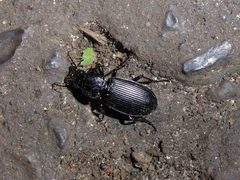
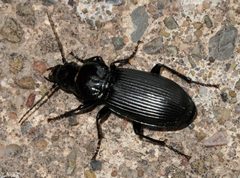
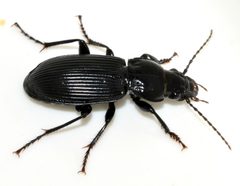
Pterostichus melanarius, commonly known as the rain beetle, is a ground beetle native to Europe that has become established in North America following introduction in the 1920s. are 12–18 mm long, black with straight elytral striations, and exhibit wing dimorphism with both -capable () and flightless (brachypterous) morphs. The is a of , with documented preference for slugs including the gray garden slug Deroceras reticulatum. It occupies diverse including forests, meadows, urban areas, and agricultural fields, and has been widely studied for its potential as a agent.
Pronunciation
How to pronounce Pterostichus melanarius: //tɛrɒsˈtɪkəs mɛləˈnɛriəs//
These audio files are automatically generated. While they are not always 100% accurate, they are a good starting point.
Identification
Distinguished from by the combination of laterobasal carina on the pronotum and denticulate angles of the pronotum. The straight elytral striations and uniformly black coloration separate it from many similar ground beetles. Wing dimorphism is present but not visible without dissection or close examination of the . Brachypterous individuals have shortened hind wings visible beneath the elytra; individuals have fully developed wings. In North America, it may be confused with native Pterostichus , but the denticulate pronotal angles are diagnostic.
Images
Appearance
are 12–18 mm in length with a black, somewhat shiny body. The bear straight, distinct striations. The pronotum has denticulate angles and a laterobasal carina that distinguishes this from other Pterostichus. Adults exhibit wing dimorphism: individuals have fully developed hind wings capable of , while brachypterous individuals have shortened, non-functional hind wings. are translucent white when laid, darkening before hatching. Larvae possess a hard, dark reddish-brown capsule. Pupae are poorly documented in the literature.
Habitat
Occupies forests, meadows, urban areas, and arable agricultural land. The is hydrophilic and eurythermic, tolerating wet conditions and wide temperature ranges. In agricultural settings, it is found in field margins, hedgerows, and crop interiors. use varies with hunger state: starved individuals range more widely across habitat types, while satiated individuals remain in favorable areas. Reproductive females select shaded, moist microsites for oviposition.
Distribution
Native to Europe, with documented occurrence in Scandinavia, Italy, Greece, Ireland, Russia, and Serbia. Introduced to North America in the 1920s, now established across the United States and Canada with on both coasts and expanding into the continental interior. Climate change models predict northward range shifts and significant reduction of southern European populations by 2070 under high-emission scenarios.
Seasonality
are active primarily from late spring through fall. Mating occurs in early autumn, followed by oviposition. Larval development occurs in soil through winter, with in spring. Adults emerge from late May to June. Seasonal activity peaks vary geographically: in Moscow Province, peaks occur mid-June to early July and late July to mid-August; in southwestern Moldova, peaks occur approximately 20 days later.
Diet
consuming insects, other , and some plant material. Documented prey includes ants, caterpillars, mollusks (with particular preference for slugs, especially Deroceras reticulatum), seeds, and plant tissue. Prey detection relies heavily on olfactory cues. Laboratory studies indicate initial preference for smaller, free-living prey over cocooned or buried prey, though field studies show reduced size selectivity when refugia are available.
Life Cycle
Combines one-year and two-year developmental . are laid in shaded, moist soil; females produce approximately 130 eggs. Larvae develop through three instars entirely in soil, with colder temperatures required for development to adulthood and warmer temperatures for pupal transition. Both larvae and hibernate. At the northern range limit, exhibit a compensatory monovariant cycle with two isolated subpopulation groups wintering at different ontogenetic phases. Wing dimorphism is inherited: brachypterous (flightless) is , (-capable) is recessive.
Behavior
activity pattern with movement speed and activity influenced by light quality; near-infrared illumination most closely approximates natural darkness for behavioral observation. Foraging is state-dependent: starved individuals are more active initially and utilize broader ranges, while satiated individuals show restricted movement. Exhibits odor-trail avoidance, where individuals avoid areas previously visited by conspecifics—a behavior associated with Lévy- search patterns optimal for dispersed prey. Larvae exhibit at high densities.
Ecological Role
contributing to regulation of , particularly slugs in agricultural systems. In North America, introduced populations have not been shown to negatively impact native carabid diversity or abundance, possibly due to filling. Serves as prey for birds, small mammals, amphibians, and is parasitized by mites, , flies, and . Functions as a agent in agricultural settings, though effectiveness varies with crop management practices.
Human Relevance
Valued as a agent in agriculture, particularly for slug management in cereal and vegetable crops. Vulnerable to agricultural practices: tillage disrupts larvae and pupae in soil, and cause direct mortality and indirect effects through prey reduction. Cover cropping and reduced tillage enhance . Used extensively in ecological research on -prey dynamics, foraging , and climate change impacts. No known negative economic impacts; considered beneficial.
Similar Taxa
- Pterostichus cristatusCo-occurs in Europe; competition mediated by segregation, with P. cristatus occupying different microhabitats
- Other Pterostichus speciesLack the diagnostic laterobasal carina and denticulate pronotal angles of P. melanarius
More Details
Wing Dimorphism Genetics
The two wing morphs are inherited according to Mendelian genetics with brachypterous (flightless) and (-capable) recessive. Macropterous individuals facilitate range expansion into new ; after establishment, brachypterous individuals become predominant due to competitive advantage in stable .
Climate Change Vulnerability
Temperature-dependent and development make vulnerable to climate change. Models predict sharp reduction in Southern European and Mediterranean populations by 2070 under RCP 8.5 scenario, with range shifts toward northwestern Europe and northeastern North America.
Sources and further reading
- BugGuide
- Wikipedia
- GBIF taxonomy match
- iNaturalist taxon
- NCBI Taxonomy
- Catalogue of Life
- Largest Carabid Beetle in California | Bug Squad
- New Guide Offers Latest in Carrot Weevil Management
- Bug Eric: A "New" Beetle in Colorado
- Bug Eric: May 2015
- Where siblings mingle: Ellipsoptera marginata vs. E. hamata | Beetles In The Bush
- Reuse of science for the benefit of all: the beauty of open access | Blog
- Geographic variability of the life cycle in Pterostichus melanarius (Coleoptera, Carabidae)
- ИЗМЕНЧИВОСТЬ РАЗМЕРОВ И ПОЛОВОЙ ДИМОРФИЗМ ЖУЖЕЛИЦЫ PTEROSTICHUS MELANARIUS Ill. В ГОРОДАХ
- Predation of Pterostichus melanarius on cocoons of soybean gall midge, Resseliella maxima
- Effect of light quality on movement of Pterostichus melanarius (Coleoptera: Carabidae)
- Changes in the behaviour of a carabid beetle (Pterostichus melanarius) following exposure to food and water
- Foraging activity of the carabid beetle Pterostichus melanarius Ill. in field margin habitats
- Modeling the bioclimatic range of Pterostichus melanarius (Coleoptera, Carabidae) in conditions of global climate change
- Specific features of the life cycle of Pterostichus melanarius (Coleoptera, Carabidae) in mosaic floodplain meadows
- Mandible wear in the carabid beetle Pterostichus melanarius in relation to diet and burrowing behaviour
- Activity and satiation state in Pterostichus melanarius : an experiment in different agricultural habitats
- Predation and prey size choice by the carabid beetle Pterostichus melanarius (Coleoptera: Carabidae): the dangers of extrapolating from laboratory to field
- NOTES ON THE BIOLOGY AND REARING OF TWO SPECIES OF GROUND BEETLES, PTEROSTICHUS MELANARIUS AND HARPALUS PENSYLVANICUS (COLEOPTERA: CARABIDAE)
- Predation behaviors of Pterostichus melanarius adults on larvae of the soybean gall midge, Resseliella maxima