
Cicindela limbata nympha
Casey, 1913
Nymphal Tiger Beetle
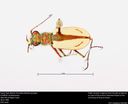
Cicindela limbata nympha is a of sandy tiger beetle restricted to open sand of northern Montana, North Dakota, and the Canadian Prairie Provinces. It is separated from the nominate subspecies by a distributional gap to the south. Individuals exhibit more extensively developed white maculations on the than the nominate form, with darker intervening areas. This subspecies is part of a fragmented distribution pattern across North America that likely resulted from historical climate-driven contractions of sand dune habitats.
Pronunciation
How to pronounce Cicindela limbata nympha: /sɪˈkɪndələ lɪmˈbɑːtə ˈnɪmfə/
These audio files are automatically generated. While they are not always 100% accurate, they are a good starting point.
Identification
Distinguished from nominate Cicindela limbata limbata by greater development of white elytral maculations and darker intervening areas. Separated from C. l. hyperborea by larger size and more extensive (rather than reduced) white maculations. Distinguished from C. l. labradorensis and C. l. nogahabarensis by geographic range. Eastern of nominate may show reddish suffusion in green sutural areas, which is absent in nympha.
Images
Appearance
with more extensively developed white maculations than nominate ; intervening areas between maculations darker. Overall coloration includes metallic green or blue on sutural area and small discal markings. Undersurface with dense pilosity. Body form typical of Cicindela limbata group.
Habitat
Open sand including sand blowouts and dunes. Occupies drier sand environments away from water. Vegetation typically sparse in occupied sites.
Distribution
Northern Montana and North Dakota, USA; Canadian Prairie Provinces (Alberta, Saskatchewan, Manitoba). Separated from main limbata in Nebraska and adjacent areas by a distributional gap.
Behavior
have been observed digging into sand during midday hours, a interpreted as to avoid high surface temperatures in white sand . Captive individuals have been maintained on lepidopteran larvae (fall armyworm and black cutworm) and can be trained to accept prey from forceps.
Ecological Role
Predatory insect in open sand dune . The dense pilosity on the undersurface and pale coloration represent apparent adaptations for heat reflection in exposed sandy environments.
Similar Taxa
- Cicindela limbata limbataLess extensive white maculations; lighter intervening areas on ; occurs in Nebraska and adjacent areas to the south
- Cicindela limbata hyperboreaSmaller size with greatly reduced white maculations; occurs further north in forest sand
- Cicindela limbata labradorensisIntermediate maculation pattern; restricted to Labrador, far to the east
- Cicindela limbata nogahabarensisMorphologically similar but genetically distinct; restricted to Nogahabara Dunes, northwestern Alaska
More Details
Historical biogeography
The fragmented distribution of Cicindela limbata , including the isolation of nympha from the main , likely originated from contractions following the mid-Holocene hypsithermal (~5,000 years ago), when declining temperatures and increasing moisture caused open sand habitats to shrink and fragment.
Taxonomic history
Mitochondrial analyses have supported the distinct status of nympha and other limbata . The subspecific classification reflects both morphological and genetic differentiation across disjunct .