
Carabus goryi
Dejean, 1831
Gory's worm and slug hunter
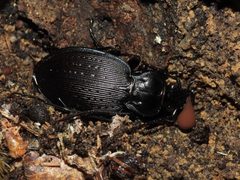
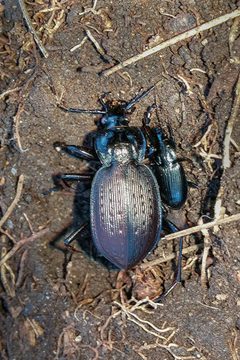
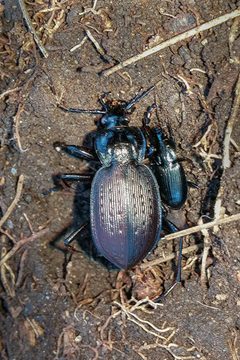
Carabus goryi is a North American ground beetle in the Carabidae, commonly known as Gory's worm and slug hunter. The inhabits cool, moist forests as well as agricultural settings including orchards and cultivated fields. are brachypterous (short-winged), , and exhibit gregarious . They are predatory, feeding on soft-bodied insect larvae including those of the spongy moth (Lymantria dispar).
Pronunciation
How to pronounce Carabus goryi: //ˈkærəbəs ˈɡɔːri.aɪ//
These audio files are automatically generated. While they are not always 100% accurate, they are a good starting point.
Identification
are brachypterous, with reduced wings that limit capability. This distinguishes them from fully winged Carabus . The species can be recognized by its association with moist woodland and agricultural across eastern and central North America. Specific morphological diagnostic features are not documented in available sources.
Images
Habitat
Cool, moist forests; orchards; cultivated fields. The shows flexibility in use, occurring in both natural forested environments and anthropogenically modified agricultural landscapes.
Distribution
Eastern and central North America: Canada (Ontario) and United States (Alabama, Connecticut, District of Columbia, Georgia, Iowa, Illinois, Indiana, Kentucky, Massachusetts, Maryland, Michigan, Minnesota, Mississippi, North Carolina, New Hampshire, New Jersey, New York, Ohio, Pennsylvania, Rhode Island, South Carolina, Tennessee, Virginia, Vermont, Wisconsin, West Virginia).
Diet
Predatory; feeds on larvae of Lymantria dispar (spongy moth) and various soft-bodied insect larvae.
Behavior
activity pattern. Gregarious — are observed in groups. Brachypterous condition results in limited capability.
Ecological Role
of soft-bodied insect larvae, including agricultural pest such as Lymantria dispar.
Human Relevance
Potential agent given on pest larvae. Occurs in cultivated fields and orchards, placing it in direct proximity to agricultural systems.
Sources and further reading
- BugGuide
- Wikipedia
- GBIF taxonomy match
- iNaturalist taxon
- NCBI Taxonomy
- Catalogue of Life
- Thinking small: how bugs are getting bulldozed by planning - Buglife Blog - Buglife
- Monitoring Ecological Change with Northern Beetles
- What do insects do in winter, Part 2? Tolerating the big chill: Banded woolly bears, Pyrrharctia isabella, field crickets, Gryllus spp., baldfaced hornets, Dolichovespula maculata, and others — Bug of the Week
- Agrilus fuscipennis on Persimmon | Beetles In The Bush
- I Brake for Dung Beetles! | Beetles In The Bush
- behavior | Beetles In The Bush | Page 6