
Ucididae
Števčić, 2005
mangrove crabs, uçá-crabs
Genus Guides
1- Ucides(Mangrove Ghost Crabs)
Ucididae is a of semiterrestrial brachyuran crabs currently recognized as containing a single , Ucides, with Ucides cordatus as the best-studied . These crabs are obligate inhabitants of neotropical mangrove , where they construct deep burrows in intertidal sediments. The family exhibits pronounced in and , with males possessing disproportionately large chelipeds and females showing enlargement for incubation. Ucididae species are economically significant throughout their range, supporting artisanal fisheries in Brazil, the Dominican Republic, and Suriname.
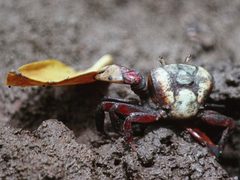
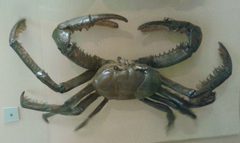
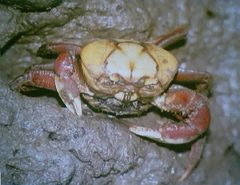
Pronunciation
How to pronounce Ucididae: /juːˈsɪdɪdiː/
These audio files are automatically generated. While they are not always 100% accurate, they are a good starting point.
Identification
Ucididae can be distinguished from other mangrove crab by the combination of: a rectangular with distinct anterolateral margins; sexually dimorphic chelipeds with males showing positive allometric growth of the major cheliped propodus; and a semiterrestrial habit with deep burrowing in mangrove substrates. The family is separated from the closely related Ocypodidae (fiddler crabs) by the absence of extreme cheliped asymmetry in males—Ucididae males possess enlarged but symmetrical chelipeds, and both chelipeds remain functional.
Images
Habitat
Obligate inhabitants of neotropical mangrove forests, occurring from high intertidal zones to low mangrove areas subject to varying flooding regimes. Found in association with Rhizophora mangle, Laguncularia racemosa, and Avicennia germinans vegetation types. Sediment composition (silt, sand, clay content) and vegetation type significantly influence crab abundance and body condition.
Distribution
Western Atlantic Ocean from Florida (USA) through the Gulf of Mexico, Central America, the Antilles, and northern South America to Santa Catarina, Brazil. Documented in Brazil (São Paulo, Piauí, Ceará, Pernambuco, Pará, Bahia, Rio de Janeiro), with particular abundance on the Amazon coast and northeastern Brazil.
Seasonality
Activity strongly tied to tidal and lunar cycles. Reproductive season extends from October through March, with peak mating activity December through February. The "andada" phenomenon—mass surface activity with agonistic —occurs November through February, concentrated during full and new moon periods. Surface activity increases during low tide periods and following heavy rainfall events.
Life Cycle
Development includes distinct and phases marked by morphological transitions. Juveniles construct burrows with lower declivity than adults, attributed to differential cheliped growth. Morphological sexual maturity occurs at approximately 37–38 mm width in males and 33–35 mm in females, though size at maturity varies geographically. Mating occurs during the intermoult period when female are decalcified. Oviposition follows copulation, with masses transferred to the female .
Behavior
mating activity during low tide periods. Males are polygynous, sequentially mating with multiple females nightly. Courtship involves males secreting a foamy substance from the , extending chelipeds and second pereiopods to form an arch around females, and intermittent opening. Male-male agonistic interactions involve claw prodding on the or claws. Females construct burrows with openings oriented toward river margins (70–71% of observations), possibly enhancing larval by tides; males show no significant burrow orientation preference. Females predominantly occupy red mangrove roots while males occupy mud flats.
Ecological Role
Engineer in mangrove through extensive burrowing that loosens and aerates soils. Burrow construction alters sediment structure and hydrology. Nutrient cycling through debris displacement and processing. Potential influence on larval patterns through female burrow orientation . Distribution and abundance correlate with sediment characteristics and vegetation type, indicating tight coupling to ecosystem structure.
Human Relevance
Economically important fishery throughout its range, particularly in northeastern Brazil, the Dominican Republic, and Suriname. Known as "uçá-crab" or "mangrove crab" in trade. Overexploitation has led to management concerns; studies support seasonal closures during reproductive periods and "andada" events. Serves as for mangrove health and environmental monitoring programs. Provides income for estuarine and supports local economies through commercial and artisanal fishing.
Similar Taxa
- OcypodidaeFiddler crabs share the superfamily Ocypodoidea and mangrove , but differ in having extreme cheliped asymmetry in males (one greatly enlarged, one reduced cheliped) versus the symmetrical enlarged chelipeds of Ucididae males.
- GrapsidaeMangrove-associated grapsid crabs occupy similar but lack the deep burrowing habit and show different ; Ucididae are distinguished by their obligate burrowing and rectangular carapace with distinct anterolateral teeth.
Sources and further reading
- BugGuide
- GBIF taxonomy match
- Catalogue of Life
- Reproductive behavior of the mangrove crab Ucides cordatus (Crustacea; Brachyura; Ucididae)
- Length-weight relationship and condition factor of the mangrove crab Ucides cordatus (Linnaeus, 1763) (Crustacea, Brachyura, Ucididae)
- Orientation and external morphology of burrows of the mangrove crabUcides cordatus(Crustacea: Brachyura: Ucididae)
- Sexual Shape Dimorphism of the Mangrove CrabUcides cordatus(Linnaeus, 1763) (Decapoda, Ucididae) Accessed through Geometric Morphometric
- Reproduction and management of the mangrove crab Ucides cordatus (Crustacea, Brachyura, Ucididae) at Iguape, São Paulo, Brazil
- Relative Growth and Its Use to Determine the Morphological Sexual Maturity of Ucides Cordatus (Linnaeus, 1763) (Decapoda, Brachyura, Ucididae) from Two Mangrove Areas on the Northeastern Brazilian Coast
- Distribution patterns of the crab Ucides cordatus (Brachyura, Ucididae) at different spatial scales in subtropical mangroves of Paranaguá Bay (southern Brazil)
- Population biology of the ‘uçá'-crab, Ucides cordatus(Linnaeus, 1763) (Brachyura: Ucididae), in mangroves of the Joanes River, Bahia State, Brazil
- Mangrove sedimentary characteristics and implications for crab Ucides cordatus (Crustacea, Decapoda, Ucididae) distribution in an estuarine area of the Amazonian region
- Temporal variation in the weight-size relationship of the mangrove crab Ucides cordatus L. (Decapoda: Ucididae) in relation to its life cycle phases
- Mangrove habitat partitioning by Ucides cordatus (Ucididae): effects of the degree of tidal flooding and tree-species composition during its life cycle
- Activity patterns, feeding and burrowing behaviour of the crab Ucides cordatus (Ucididae) in a high intertidal mangrove forest in North Brazil
- Habitat monitoring and genotoxicity in Ucides cordatus (Crustacea: Ucididae), as tools to manage a mangrove reserve in southeastern Brazil
- The perceptions of high school students on the habitat of the crab Ucides cordatus (Linnaeus, 1763) (Crustacea: Decapoda: Ucididae) in northern Rio de Janeiro State, southeastern Brazil