
Ucides
Rathbun, 1897
Mangrove Ghost Crabs, mangrove crabs
Species Guides
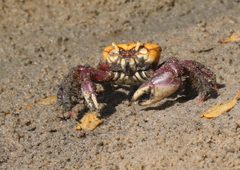
1- Ucides cordatus(swamp ghost crab)
Ucides is a of mangrove crabs comprising two : Ucides cordatus, distributed along the Atlantic coast from Florida to Uruguay, and Ucides occidentalis, found along the Pacific coast from Mexico to Peru. These semi-terrestrial crabs inhabit mangrove where they construct extensive burrow systems. Both species hold substantial economic importance as fishery resources for coastal and play significant ecological roles in nutrient cycling and soil aeration.
Pronunciation
How to pronounce Ucides: //juːˈsaɪdiːz//
These audio files are automatically generated. While they are not always 100% accurate, they are a good starting point.
Identification
Members of Ucides can be distinguished from other mangrove crab by their robust, semi-terrestrial adapted for burrowing in muddy substrates. The genus is placed in the Ucidinae within Ocypodidae. -level identification relies on geographic distribution: U. cordatus in the Atlantic and U. occidentalis in the Pacific. Males are larger than females; in U. cordatus, male width averages 69.8 mm versus 59.8 mm in females.
Images
Habitat
Tidal mangrove forests and associated estuarine environments. Ucides cordatus occupies mud flats and red mangrove (Rhizophora mangle) roots, with males predominantly on mud flats (96.6%) and females preferentially on mangrove roots (77%). use is tidally influenced, with surface activity and burrowing directly affected by tides and lunar cycles.
Distribution
Ucides cordatus: Atlantic coast from Florida to Uruguay, including the Gulf of Mexico, Caribbean, and northern South America. Ucides occidentalis: Pacific coast from Mexico to Peru, including the Gulf of Guayaquil in Ecuador.
Seasonality
Reproductive activity in Ucides cordatus has been observed in December and January-March, with mating occurring on three consecutive days monthly. Heavy rainfall triggers sudden increases in surface activity.
Life Cycle
Semi-terrestrial with complex involving extended burrowing . Embryonic development occurs on the female ; are initially liquid in appearance when deposited on mangrove roots, becoming more solid elsewhere. Larval development has been achieved in laboratory conditions for U. occidentalis, though high mortality rates present challenges. All sampled individuals of U. cordatus in one study were sexually mature.
Behavior
mating activity with males mating with multiple females each night. Courtship involves the male positioning in front of the female, extending chelipeds and second pereiopods laterally to form an arch, drawing the female close, raising his body, and inserting the . Copulation lasts 15-30 minutes, after which the male abandons the female immediately. Males secrete a foamy substance from the during courtship and mating. Limited male-male disputes involve using claws to prod each other on the or claws.
Ecological Role
Key in mangrove nutrient cycling, particularly in organic matter decomposition. Contributes to soil loosening and aeration through extensive burrowing and debris displacement. Considered one of the most important biological components of mangrove ecosystems.
Human Relevance
Important commercial fishery resource and source of income for low-income estuarine . Subject to national management and conservation action plans; reproductive closure periods (veda reproductiva) implemented in some regions. Declining stocks observed in Brazil due to intensive harvest pressure, destruction, and .
Similar Taxa
- CardisomaBoth are semi-terrestrial mangrove crabs with burrowing habits, but Ucides is distinguished by Ucidinae placement and specific partitioning between sexes (males on mud flats, females on mangrove roots) not reported in Cardisoma.
- Uca (fiddler crabs)Both occur in mangrove , but Ucides lacks the extreme in claw size characteristic of Uca males, and Ucides shows more pronounced spatial segregation between sexes.
More Details
Taxonomic Note
Ucides was historically placed in Ocypodidae, though some sources recognize the family Ucididae. The Catalogue of Life and NCBI currently classify it in Ocypodidae, Ucidinae.
Conservation Concern
Brazilian of U. cordatus show declining trends attributed to the combined effects of intensive fishing effort, mangrove destruction, and a specific affecting populations.
Sources and further reading
- BugGuide
- Wikipedia
- GBIF taxonomy match
- iNaturalist taxon
- NCBI Taxonomy
- Catalogue of Life
- Embryonic analysis and larval culture of Ucides occidentalis
- ESTADO DA ARTE DAS PESQUISAS COM O CARANGUEJO-UÇÁ, Ucides cordatus
- Reproductive behavior of the mangrove crab Ucides cordatus (Crustacea; Brachyura; Ucididae)
- Effect of salinity on modulation by ATP, protein kinases and FXYD2 peptide of gill (Na+, K+)-ATPase activity in the swamp ghost crab Ucides cordatus (Brachyura, Ocypodidae)
- Feeding ecology of the mangrove crab Ucides cordatus (Ocypodidae): food choice, food quality and assimilation efficiency
- Larval cycle, ecology and distribution of the red mangrove crab (<i>Ucides occidentalis</i>) in the Gulf of Guayaquil, Ecuador: understanding multiple impacts on fishery sustainability