
Ucides cordatus
(Linnaeus, 1763)
swamp ghost crab, caranguejo-uçá, Atlantic mangrove ghost crab
Ucides cordatus is a large mangrove crab to the Atlantic coast of the Americas, ranging from Florida to Uruguay. It is one of two in the Ucides and holds substantial economic and ecological importance, particularly in Brazil where it supports artisanal fisheries. The species exhibits pronounced , with females typically larger than males and differing in coloration. declines have been documented since 1988 due to overharvesting, loss, and .
Pronunciation
How to pronounce Ucides cordatus: /juːˈsaɪdiːz kɔrˈdeɪtəs/
These audio files are automatically generated. While they are not always 100% accurate, they are a good starting point.
Identification
Distinguished from other mangrove crabs by combination of: large body size; strongly asymmetrical chelipeds with massive right crusher claw and slender left cutter claw; pronounced in shape and coloration; strictly mangrove-associated . Differs from Ucides occidentalis (Pacific coast) by Atlantic distribution. Separated from other Ocypodidae by terrestrial habits, deep burrowing , and herbivorous diet focused on mangrove litter rather than deposit-feeding or carnivory.
Images
Appearance
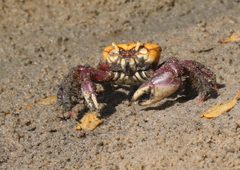
Large crab with oval . Males have flatter, more oval-shaped backs with distinct light blue central region and beige-white periphery. Females possess larger, more bulbous carapaces colored dull dark green with dark purple tones. Both sexes have legs of dark reddish-purple coloration. Left cheliped is sharp and slender, used for cutting and feeding; right cheliped is substantially larger and more robust, used for crushing. Females are larger than males on average (59.8±6.9 mm vs 69.8±6.7 mm carapace width in one studied ).
Habitat
Strictly associated with mangrove forests, particularly Rhizophora mangle stands. Terrestrial habits with construction of deep burrows at tree bases, recorded to depths of 1.6 meters. Occupies both mangrove interior and edge ; juveniles and young crabs more abundant at anthropogenic edges, while and molting juveniles require interior forest conditions. Tidal mud flats and red mangrove roots used for mating and oviposition.
Distribution
Western Atlantic Ocean from Florida (USA) south to Uruguay. Documented throughout Gulf of Mexico, Central America, Caribbean Antilles, northern South America, and Atlantic coast of Brazil. Specific studied in Piauí and other northeastern Brazilian states.
Seasonality
Mating season occurs November through January, with peak activity on three consecutive days monthly (second day most active). mating activity coincides with low tide periods. Reproductive observed December 2007 and January-March 2009 in studied .
Diet
Primarily herbivorous, feeding on mangrove litter including leaves, bark, and roots. Shows preference for Rhizophora mangle over Avicennia germinans. Early life stages consume polychaete worms and microorganisms from sediments. Documented to ingest animal remains opportunistically. Deliberately ingests sediments collected outside burrows.
Life Cycle
with separate sexes. Mating occurs during intermoult period when both sexes possess rigid . Females can mate before fully mature, with ovulation occurring after some delay. Time from mating/sperm transfer to ovulation/oviposition varies. -bearing females observed with ovaries in recovery phase; non-egg-bearing females may present mature ovaries. Males maintain in vas deferens when mature. Eggs transferred to female for external incubation.
Behavior
mating from burrows to ocean coast during reproductive season, creating phenomenon known as "a andada" (Portuguese: 'the '). Courtship involves male positioning before female, extending chelipeds and pereopods to form arch, drawing female closer, and introducing ; duration 15-30 minutes. Male secretes foamy substance from during courtship. Males polygynous, mating with multiple females per night. Male-male disputes involve claw prodding. Females may refuse males and withdraw. Males abandon females immediately after copulation. transference onto most frequent observed , primarily occurring while females perch on red mangrove roots (85% of egg-bearing females). Heavy rainfall triggers sudden activity increase during mating season.
Ecological Role
Key engineer in mangrove forests. Extensive burrowing and debris displacement loosens and aerates soil, increasing sedimentary surface area for oxidation processes. Burrows contribute to carbon dioxide balance in mangrove ecosystems, particularly during rainy season. Important in organic matter cycling and nutrient dynamics. Considered sentinel for environmental quality, sensitive to heavy metals, fertilizer , and xenobiotics.
Human Relevance
Substantial economic importance for low-income coastal in Brazil as source of income and food. Subject to intensive artisanal harvesting with documented declines since 1988. Legal restrictions on capture exist in some Brazilian states (e.g., Paraíba prohibits capture of females under 4.5 cm width), though enforcement reported as inconsistent. Used as bioindicator for mangrove reserve effectiveness and environmental . Population status informs conservation policy and protection decisions.
Similar Taxa
- Ucides occidentalisCongeneric distinguished by Pacific coast distribution (eastern Pacific from Mexico to Peru), with U. cordatus
- Cardisoma guanhumiAnother large terrestrial crab in overlapping range; distinguished by more uniformly blue or purplish coloration, different burrow architecture, and more generalized diet including greater animal matter consumption
- Goniopsis cruentataMangrove-associated graspid crab; smaller size, more aquatic habits, different claw symmetry pattern, and predatory/scavenging diet
More Details
Population sex ratio
Unusual male-biased sex ratio documented, with females comprising 53% and males 62% of in some studies (figures exceed 100% suggesting sampling or reporting issues, but male skew is consistent)
Conservation status
declines attributed to synergistic effects of overharvesting, mangrove destruction, and specific (possibly fungal or bacterial). Serves as flagship for mangrove conservation in Brazil.
Taxonomic placement
placement historically debated; treated here in Ocypodidae following Catalogue of Life and GBIF, though some sources recognize family Ucididae
Sources and further reading
- BugGuide
- Wikipedia
- GBIF taxonomy match
- iNaturalist taxon
- NCBI Taxonomy
- Catalogue of Life
- biodiversity | Blog - Part 44
- ESTADO DA ARTE DAS PESQUISAS COM O CARANGUEJO-UÇÁ, Ucides cordatus
- Reproductive behavior of the mangrove crab Ucides cordatus (Crustacea; Brachyura; Ucididae)
- Effect of salinity on modulation by ATP, protein kinases and FXYD2 peptide of gill (Na+, K+)-ATPase activity in the swamp ghost crab Ucides cordatus (Brachyura, Ocypodidae)
- Feeding ecology of the mangrove crab Ucides cordatus (Ocypodidae): food choice, food quality and assimilation efficiency
- EDGE EFFECTS ON THE ABUNDANCE OF THE CRAB Ucides cordatus (DECAPODA: OCYPODIDAE) IN A NEOTROPICAL MANGROVE