
Ocypodidae
Rafinesque, 1815
Ghost and Fiddler Crabs
Genus Guides
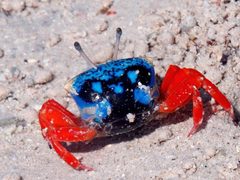
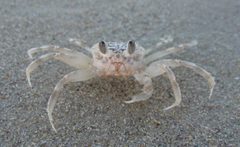
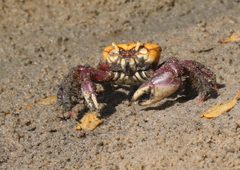
2Ocypodidae is a of semiterrestrial crabs comprising approximately 180 described across 13 extant . The family includes two well-known groups: ghost crabs (genus Ocypode) and fiddler crabs (multiple genera including Leptuca and Minuca), plus the mangrove crabs of genus Ucides. Members are characterized by markedly unequal chelipeds in males, with the larger cheliped always exceeding length. The family underwent substantial taxonomic revision in 2016, when the genus Uca was divided into 13 separate genera.
Pronunciation
How to pronounce Ocypodidae: /oʊˈsɪpəˌdaɪ/
These audio files are automatically generated. While they are not always 100% accurate, they are a good starting point.
Identification
Quadrate, transversely rectangular, or pentagonal that is markedly thick with moderately convex, smooth surface. Regions weakly defined or absent; lateral margins entire without dentation. Front markedly narrow, straight or very faintly bilobed, strongly deflexed. Orbits broad, occupying most of margin; eyestalks characteristically slender and long. Antennules fold obliquely to longitudinally with markedly enlarged, globose to ovate basal segment. with small basal segment and short . Third maxillipeds completely cover buccal cavern with gap between but never rhomboidal; exopod slender and sometimes very short. Chelipeds unequal, larger cheliped always longer than carapace, strongly sexually dimorphic. legs comparatively slender and long with characteristic pouch between bases of walking legs 2–3 or 3–4, serrated by setae, leading into buccal cavity and functioning as supplementary breathing system. with seven freely moving somites in both sexes.
Images
Habitat
Intertidal soft bottoms including mudflats, sandy beaches, and mangrove environments. Specific microhabitat partitioning occurs: some occupy supra-littoral sand dunes, others open beaches, and others marine inlets or estuarine khawrs.
Distribution
Tropical and temperate shorelines worldwide. Documented from the Persian Gulf, Arabian Gulf, Oman, Qatar, United Arab Emirates, Saudi Arabia, Panama, Hong Kong, Brazil, and New Zealand, among other locations.
Behavior
Acoustic and vibrational (substrate) communication documented in ghost crabs. Males of some employ search-intercept mating tactics without courtship or mate-guarding. Females may mate multiply with several males during limited receptivity periods. Burrow construction and maintenance is characteristic; some species construct hood structures at burrow entrances.
Similar Taxa
- DotillidaePreviously classified within Ocypodidae but now treated as separate within superfamily Ocypodoidea; distinguished by different proportions and burrowing
- MacrophthalmidaeFormerly included in Ocypodidae, now separate ; members lack the extreme cheliped dimorphism and characteristic orbital structure of Ocypodidae
- UcididaeSegregated from Ocypodidae; contains mangrove crab Ucides which was formerly placed in Ocypodidae but now recognized as distinct based on morphological and molecular data
Sources and further reading
- BugGuide
- Wikipedia
- GBIF taxonomy match
- iNaturalist taxon
- NCBI Taxonomy
- Catalogue of Life
- Mating behaviour of Macrophthalmus hirtipes (Brachyura: Ocypodidae)
- Ghost Crabs of Oman ( Crustacea : Brachyura :Ocypodidae)
- Family Ocypodidae Rafinesque, 1815 (Ghost Crabs, Fiddler Crabs)
- Unique foraging behavior ofDotillopsis brevitarsis (Crustacea Brachyura: Ocypodidae)
- New records of Minuca zacae (Brachyura: Ocypodidae) in the gulfs of Montijo and Parita, Panama Nuevos registros de Minuca zacae (Brachyura: Ocypodidae) en los golfos Montijo y Parita, Panamá Novos registros de Minuca zacae (Brachyura: Ocypodidae) nos golfos Montijo e Parita, Panamá
- The ecology of fiddler crabs (Crustacea: Ocypodidae) at the Mai Po Marshes Nature Reserve, Hong Kong
- Life history of the crab, Macrophthalmus boscii (Audouin, 1826) (Decapoda, Brachyura, Ocypodidae)
- Effect of salinity on modulation by ATP, protein kinases and FXYD2 peptide of gill (Na+, K+)-ATPase activity in the swamp ghost crab Ucides cordatus (Brachyura, Ocypodidae)
- MATING BEHAVIOR OF UCA LACTEA PERPLEXA (DECAPODA: OCYPODIDAE)
- Population structure and reproductive biology of the fiddler crab Leptuca leptodactyla (Rathbun in Rankin, 1898) (Brachyura: Ocypodidae) in two estuaries from Sergipe state Estrutura populacional e biologia reprodutiva do chama-maré Leptuca leptodactyla (Rathbun in Rankin, 1898) (Brachyura: Ocypodidae) em dois estuários do estado de Sergipe
- Reproductive Cycling in the Ghost Crab, Ocypode Quadrata (Fabr.) (Brachyura, Ocypodidae)