
Ocypode
Weber, 1795
Ghost Crabs
Species Guides
1- Ocypode quadrata(Atlantic Ghost Crab)
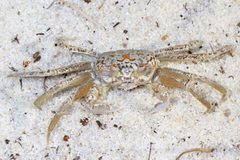
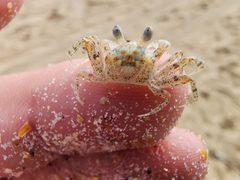
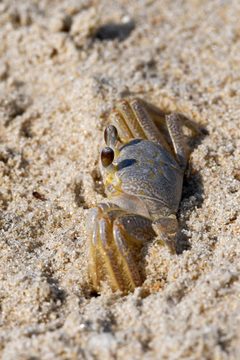
Ocypode is a of ghost crabs comprising 21 distributed across tropical and subtropical sandy shores worldwide. Members are characterized by deep box-like bodies, elongated eyestalks often tipped with horn-like projections in several species, and pronounced claw asymmetry with one cheliped substantially larger than the other. They construct deep burrows in intertidal sandy or muddy substrates and exhibit primarily activity patterns. The genus was established in 1795 and remained the sole genus in Ocypodinae until 2013, when Hoplocypode was segregated based on .
Pronunciation
How to pronounce Ocypode: /ˌɒsɪˈpoʊdiː/
These audio files are automatically generated. While they are not always 100% accurate, they are a good starting point.
Identification
Distinguished from the segregate Hoplocypode by : Ocypode has simple curved first gonopods versus the complex hoof-shaped tips in Hoplocypode. -level identification relies on stridulating ridge patterns on cheliped palms, eyestalk ornamentation (presence/absence and form of styles or setae), and subtle proportions. Seven species possess diagnostic ocular styles; O. cursor is uniquely identified by setal tufts on eyestalks. Juveniles may lack diagnostic eyestalk features present in .
Images
Appearance
Deep box-like with regions usually not clearly defined. Thick, elongated eyestalks held vertically when active; occupies most of lower portion. Eyestalks tipped with horn-like styles in seven (O. brevicornis, O. ceratophthalma, O. gaudichaudii, O. macrocera, O. mortoni, O. rotundata, O. saratan), though these may be reduced or absent in juveniles; O. cursor has tufted setae instead. Pale coloration blending with sand, with gradual color change capability to match environment and time of day. Chelipeds markedly unequal in size in both sexes, with stridulating ridges on palm for sound production. Chelipeds shorter than legs; last pair of walking legs shorter and thinner than pairs. Setae-fringed cavity present between bases of second and third walking legs.
Habitat
Sandy beaches, rubble flats, and estuarine intertidal zones with soft sandy or muddy substrates suitable for burrow construction. Occupies deep burrows ranging from simple to complex in architecture. Found from the waterline to upper beach zones, with microhabitat segregation observed: larger individuals and specific claw morphs occupy higher beach positions.
Distribution
Tropical and subtropical regions worldwide. Three in Atlantic Ocean and Mediterranean Sea; one species on eastern Pacific coast of Americas; remaining species distributed across western Pacific and Indian Ocean to southern Africa. Specific confirmed localities include Hong Kong, Singapore, Red Sea, Pakistan coast, Turkish Mediterranean coast, Bangladesh, and Dirk Hartog Island (Western Australia).
Diet
scavengers and of small animals. Ontogenetic trophic variation has been documented in at least one (O. quadrata), indicating dietary shifts across life stages.
Life Cycle
Ontogenetic dietary shifts indicate distinct trophic across developmental stages in at least some . Sexual maturity reached at size thresholds varying by species and . Juveniles may lack diagnostic morphological features such as fully developed eyestalk styles.
Behavior
Primarily surface activity. Constructs and maintains deep burrows used for shelter; burrow varies from simple to complex and is modified under human disturbance (smaller, steeper, simpler burrows in high-disturbance areas). Exhibits via stridulation using cheliped ridges. Capable of learning leg position and proprioceptive motor control. Demonstrates responses to acoustic stimuli and orientation using polarized light. Documented behavioral modifications during mirror exposure in at least one .
Ecological Role
Trophic dynamics in sandy beach as both and scavengers. Bioindicator for human disturbance on sandy shores; and burrow respond to anthropogenic pressure. Contributes to sediment turnover through burrowing activity.
Human Relevance
Used as bioindicator for assessing human disturbance on sandy beaches. Burrow and serve as measurable response variables to coastal development and recreational pressure. Subject of behavioral research including learning, , and mirror self-recognition studies.
Similar Taxa
- HoplocypodeFormerly classified within Ocypode; distinguished by hoof-shaped versus simple curved first tips. Includes the gulf ghost crab (formerly O. occidentalis).
More Details
Taxonomic history
Ocypode was the sole in Ocypodinae until 2013, when Sakai and Türkay reclassified O. occidentalis into the new genus Hoplocypode based on . Several have been synonymized: O. longicornuta, O. platytarsis, O. pygoides, and O. sinensis are now synonyms of O. ceratophthalma, O. brevicornis, O. convexa, and O. cordimanus respectively.
Etymology
name derived from Ancient Greek ὠκύς (okús, 'swift') and πούς (poús, 'foot'), referring to rapid locomotion.
Lateralization and coloration
In O. saratan, right-clawed individuals are lighter colored (yellow, sand) than left-clawed individuals (brown, purple), with microhabitat segregation: sand-colored left-clawed crabs closer to water, yellow right-clawed crabs higher on beach. Color also varies with UV radiation intensity.
Sources and further reading
- BugGuide
- Wikipedia
- GBIF taxonomy match
- iNaturalist taxon
- NCBI Taxonomy
- Catalogue of Life
- The Ghost Crabs (Ocypode) of Dirk Hartog Island
- Ontogenetic trophic variation in ghost crab Ocypode quadrata
- Learning of leg position by the ghost crab Ocypode ceratophthalma
- Orientation of the ghost-crab Ocypode in polarized light
- Responses of the Ghost Crab, Ocypode, to Acoustic Stimuli1
- Laterality affects coloration in Red Sea Ghost Crabs (Ocypode saratan)
- Mirror self-recognition in ghost crab (Ocypode quadrata)
- Variation in burrow morphology of ghost crab Ocypode cursor (Linnaeus, 1758) under human influence
- Comparative Biochemical and Genetic Analysis of Two Species of Ghost Crabs, Ocypode rotundata and Ocypode ceratophthalmus from the Coast of Pakistan
- The ghost crab Ocypode mortoni George, 1982 (Crustacea: Decapoda: Ocypodidae): redescription, distribution at its type locality, and the phylogeny of East Asian Ocypode species
- The Atlantic Ghost Crab Ocypode quadrata (Decapoda: Ocypodidae) as bioindicator of sandy beaches: assessment of the influence of environmental, behavioral and population factors
- Operant conditioning through positive reinforcement in the ghost crab (Ocypode quadrata)
- Relative Growth and Sexual Maturity of the Texas Ghost Crab, Ocypode Quadrata (Fabr.) (Brachyura, Ocypodidae)
- Ghost crab (Ocypode quadrata) modify their behavior during mirror exposure
- Anthropogenic Disturbances: the Red Ghost Crab (Ocypode Macrocera) Is under Threat at Lalkakrar Char, Kuakata, Bangladesh