
Ocypode quadrata
(Fabricius, 1787)
Atlantic Ghost Crab
Ocypode quadrata, the Atlantic Ghost Crab, is the only ghost crab occurring along the Atlantic coast of the United States. It inhabits sandy beaches from Massachusetts to tropical regions of the Western Atlantic. The species has been demonstrated to possess notable cognitive abilities including operant conditioning, landmark-based wayfinding, and mirror self-recognition. It functions as a , scavenger, and deposit-feeder in coastal , and is widely used as a bioindicator for sandy beach health.
Pronunciation
How to pronounce Ocypode quadrata: /ˌɔkɪˈpoʊdi ˈkwɒdrətə/
These audio files are automatically generated. While they are not always 100% accurate, they are a good starting point.
Identification
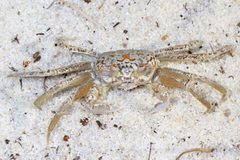
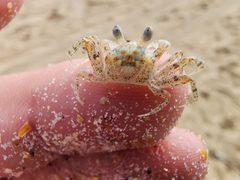
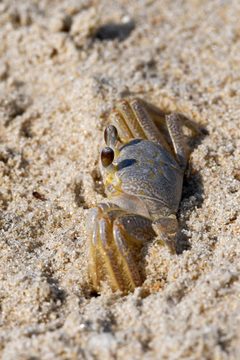
Distinguished from other Ocypode by its exclusively Atlantic distribution; O. quadrata is the only ghost crab native to the eastern United States. Characterized by a square or rectangular , large on elongated stalks, and pale coloration that provides camouflage against sand. Males possess one greatly enlarged claw, though this feature is shared with other ocypodid crabs and not diagnostic alone.
Images
Habitat
Sandy ocean beaches, from the intertidal zone to supratidal areas above the high tide line. Burrows in dry sand above the waterline, typically in areas with moderate to low human disturbance. Occupies dynamic coastal environments characterized by shifting substrates, wave action, and periodic inundation.
Distribution
Atlantic coast of North America from Westport, Massachusetts southward through the tropical Western Atlantic Ocean. Range extends along the eastern seaboard of the United States and continues through Caribbean and tropical Atlantic regions.
Diet
and opportunistic. Preys on mole crabs (Emerita talpoida) and other small . Engages in deposit-feeding, consuming organic material from sand. Scavenges carrion and detritus. Specific dietary composition varies ontogenetically.
Life Cycle
Exhibits ontogenetic variation in trophic , with dietary shifts occurring during development. Sexual maturity and relative growth patterns have been documented; larger individuals demonstrate enhanced learning rates in conditioning experiments, suggesting cognitive development continues across the lifespan. Reproductive cycling occurs, with mating documented in video records.
Behavior
Demonstrates operant conditioning through positive reinforcement, with learning rates positively correlated with size. Exhibits mirror self-recognition as evidenced by mark-directed during mirror exposure, interpreted as self-awareness rather than social response to perceived conspecifics. Uses landmarks for wayfinding in complex mazes. Modifies behavior during mirror exposure. Constructs and maintains burrows in supratidal sand.
Ecological Role
of including mole crabs. Scavenger and deposit-feeder contributing to nutrient cycling in sandy beach . Serves as a widely recognized bioindicator for assessing sandy beach health and environmental quality; and distribution reflect condition and anthropogenic disturbance levels.
Human Relevance
Used extensively as a bioindicator organism for monitoring sandy beach health and the impacts of recreational activity. Subject of cognitive research demonstrating advanced learning and self-recognition capabilities. are negatively affected by beach recreation and anthropogenic disturbance, with distribution patterns reflecting human activity levels.
Sources and further reading
- BugGuide
- GBIF taxonomy match
- iNaturalist taxon
- NCBI Taxonomy
- Catalogue of Life
- Ontogenetic trophic variation in ghost crab Ocypode quadrata
- Mirror self-recognition in ghost crab (Ocypode quadrata)
- Operant conditioning through positive reinforcement in the ghost crab (Ocypode quadrata)
- Ghost crab (Ocypode quadrata) modify their behavior during mirror exposure
- Deposit-feeding by the ghost crab Ocypode quadrata (Fabricius)
- OCULAR STRUCTURE OF THE GHOST CRAB Ocypode quadrata (Fabricius, 1787)
- Within-Habitat Spatial Patterns of Ocypode Quadrata (Fabricius) (Decapoda Brachyura)
- Vertical distribution by demographic groups of ghost crab Ocypode quadrata (Crustacea: Brachyura)
- Recreational impacts on the distribution of ghost crabs Ocypode quadrata fab.
- The Atlantic Ghost Crab Ocypode quadrata (Decapoda: Ocypodidae) as bioindicator of sandy beaches: assessment of the influence of environmental, behavioral and population factors
- Relative Growth and Sexual Maturity of the Texas Ghost Crab, Ocypode Quadrata (Fabr.) (Brachyura, Ocypodidae)
- Reproductive Cycling in the Ghost Crab, Ocypode Quadrata (Fabr.) (Brachyura, Ocypodidae)
- Landmark use by ghost crab (Ocypode quadrata) during wayfinding in a complex maze
- Apparent Predation on the Mole Crab Emerita talpoida (Say) by the Ghost Crab Ocypode quadrata (Fabricius)
- First video record of mating behavior of the ghost crab Ocypode quadrata (Fabricius, 1787) (Crustacea, Decapoda, Ocypodidae)