
Emerita talpoida
(Say, 1817)
Atlantic mole crab, Atlantic sand crab
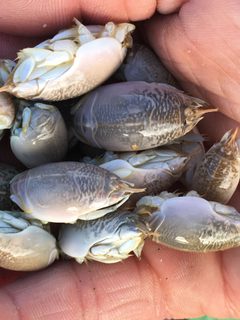
Emerita talpoida is a mole crab in the Hippidae, to the western Atlantic Ocean. It inhabits the swash zone of sandy beaches, where it burrows backwards into sand and filter-feeds using feathery . The exhibits a circatidal rhythm in activity with a ~12.4 hour period, with smaller crabs distributed higher intertidally than larger ones. is flexible, with reproductive timing and growth patterns varying in response to environmental conditions.
Pronunciation
How to pronounce Emerita talpoida: //ɛˈmɛrɪtə tælˈpɔɪdə//
These audio files are automatically generated. While they are not always 100% accurate, they are a good starting point.
Identification
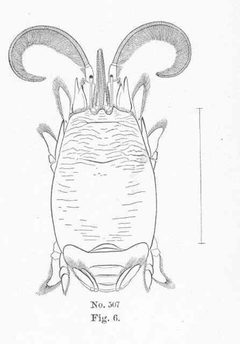
Distinguished from other Emerita by geographic range (western Atlantic only). Smaller individuals occur higher in the intertidal zone than larger ones, a size-distribution pattern not seen in all . Distinguished from Hippa species by antennal and burrowing ; Emerita species have more developed, feather-like antennal structures for filter feeding. is smooth and -shaped, adapted for rapid burrowing in sand.
Images
Habitat
Swash zone of exposed sandy beaches in the intertidal region. Requires moving water to feed. Distribution within beaches is zoned by size: smaller crabs higher intertidally, larger crabs lower. Beach and artificial structures (e.g., research piers) can alter local distribution through changes in sediment scour and deposition.
Distribution
Western Atlantic Ocean from Cape Cod, Massachusetts south to Gulf Coast of Mexico. Present in Caribbean region including Lesser Antilles and Guadeloupe. One of seven New World Emerita .
Seasonality
Active year-round in suitable . Recruitment peaks in September following summer spawning. Ovigerous females more common in spring; greater proportion of females in spring and fall due to differential mortality of larger males.
Diet
. Uses exposed feathery to capture , detritus, and plankton from swash zone water. Requires water motion to feed effectively.
Life Cycle
Multiple larval stages including megalopae. stages: megalopae, juveniles, small females, small males, mature males, large ovigerous females. Growth rapid in spring for animals. Recruitment of new individuals occurs in summer with death of many large . Females carry on pleopods; can produce multiple clutches in summer. Sex ratio skews female in spring (male mortality) and fall (63% female recruitment). No evidence of sex reversal observed.
Behavior
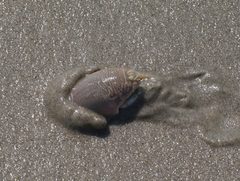
Burrows backwards into sand, leaving exposed to filter feed. Exhibits circatidal rhythm in vertical swimming with free-running period of ~12.4 hours; activity peaks after high tide. Rhythm entrained by mechanical agitation, not by light:dark cycles. Activity amplitude varies with tidal amplitude: larger crabs most active after lower amplitude high tides, small crabs equally active on consecutive tides. This differential activity drives oscillating size distributions on the beach. Migrates up and down beach with tide.
Ecological Role
Important prey item for Atlantic ghost crab (Ocypode quadrata), blue crab (Callinectes sapidus), certain fish in the swash zone, and shorebirds including sanderlings. Serves as bioindicator for effects of large- coastal engineering works due to reliance on swash zone . Contributes to nutrient cycling in sandy beach .
Human Relevance
Used as for beach health and impacts of coastal development. Subject of ecological research on sandy beach dynamics and evolution. No significant direct economic use or pest status documented.
Similar Taxa
- Emerita analogaPacific coast ; distribution prevents overlap, but similar and . E. talpoida distinguished by Atlantic range.
- Hippa spp.Sister formerly including E. talpoida; distinguished by less developed filter-feeding and different burrowing .
- Ocypode quadrataCo-occurs in and preys on E. talpoida; distinguished by larger size, different body plan, and predatory rather than filter-feeding .
Sources and further reading
- BugGuide
- Wikipedia
- GBIF taxonomy match
- iNaturalist taxon
- NCBI Taxonomy
- Catalogue of Life
- Sharon Lawler: Professor Emerita, Compassionate Human Being | Bug Squad
- Diane Ullman's Incredible Accomplishments | Bug Squad
- Entomologist Lynn Kimsey in Video Tribute Celebrating Newest UC Davis Emeriti | Bug Squad
- UC Davis Program on Feb. 7: Celebrating Our Newest Emeriti | Bug Squad
- Paying Tribute to Richard 'Doc' Bohart | Bug Squad
- Of Raptors and Insects | Bug Squad
- The Mole Crab Emerita talpoida (Say): A Case of Changing Life History Pattern
- The tidal rhythm in activity of the mole crab Emerita talpoida
- The influence of a research pier on beach morphology and the distribution of Emerita talpoida
- Apparent Predation on the Mole Crab Emerita talpoida (Say) by the Ghost Crab Ocypode quadrata (Fabricius)
- A Comparative Size Study of the Mole Crab, Emerita Talpoida Say, Associated with Epizoic Enteromorpha Flexuosa (Wulfen) J. Ag.