
Emerita analoga
(Stimpson, 1857)
Pacific sand crab, Pacific mole crab, coldwater mole crab
Emerita analoga is a small sand-burrowing decapod crustacean inhabiting exposed sandy beaches along temperate Pacific coasts of North and South America. The exhibits strong , with females nearly twice the size of males. It is a suspension feeder that captures plankton using specialized extended into retreating waves. The species has been widely studied as an indicator organism for coastal pollution and harmful algal blooms.
Pronunciation
How to pronounce Emerita analoga: //ɛˈmɛrɪtə əˈnæləɡə//
These audio files are automatically generated. While they are not always 100% accurate, they are a good starting point.
Identification
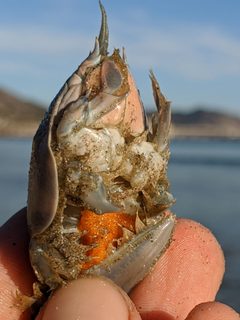
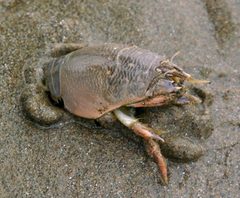
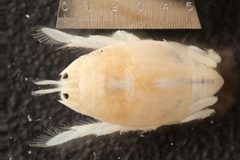
Distinguished from other intertidal decapods by its lack of claws or spines, dome-shaped body, and specialized for suspension feeding. pronounced: females significantly larger and often carrying visible orange mass. Distinguished from Atlantic Emerita talpoida by geographic range (Pacific coast). Distinguished from Hippa by body proportions and antennal structure.
Images
Appearance
Small crustacean reaching 35 mm long and 25 mm wide. Body is sand-colored and elongated dome-shaped, adapted for rapid burrowing. Females nearly twice as large as males; females often identifiable by orange mass beneath . Lacks claws and spines. Five pairs of legs and three pairs of pleopods. on long stalks; antennules elongated to project above sand surface, forming tube channeling water to gills. Longer retractable, extending above sand to collect food particles when water overhead. Legs and uropods with hairy margins for digging and food transfer.
Habitat
Exposed sandy beaches in the swash region of the intertidal zone. Burrows in unstable sand substrate, moving up and down beach with tidal state. Requires wave wash zone; distribution within beaches varies with water flow and behavioral responses to wave action.
Distribution
North America: Alaska to Baja California. South America: Salaverry, Peru south to Cape Horn and southern Argentina. Common on California beaches; in Oregon appear largely sustained by larval recruitment from California rather than self-sustaining. Established population on Twin Harbors Peninsula, Washington.
Seasonality
Ovigerous females observed February/March through early September in southern California. reproduce in first and second summers; most die in autumn of second year. Larval planktonic stage lasts up to 130 days, enabling wide .
Diet
Suspension feeder consuming plankton, primarily dinoflagellates. Captures food particles by extending into retreating waves, scraping collected material into mouth. Can feed multiple times per wave.
Life Cycle
Five planktonic zoeal stages followed by single megalopal stage. Zoeal stages last up to 130 days. Megalopae settle on sandy beaches, , and develop into juveniles maturing to within weeks. Female produces up to 45,000 per batch, carrying egg mass approximately 22.5 days. Can produce up to four consecutive egg masses under favorable conditions.
Behavior
Moves backward when burrowing or crawling. Swims backward using rapid uropod beating with three coordinated components: protopodite return/power stroke, rami spreading/folding, and whole appendage . extension/flexion accompanies each swimming stroke. Exhibits two distinct swimming programs: 'swimming' (cycle duration ~80–400 ms) and 'treading water' (~100–700 ms), differing in power stroke timing. Migrates up and down beach with tide, maintaining position in wave wash zone. When uncovered by water, coils and burrows deeper backward into sand.
Ecological Role
Important prey for shorebirds including sanderlings, willets, godwits, surf scoters, black-bellied plovers, and curlews. Prey for barred surfperch (Amphistichus argenteus). to intermediate stages of parasitic worms including acanthocephalans, which can be transmitted to . Functions as suspension feeder linking planktonic production to higher .
Human Relevance
Used extensively as by surf fishermen; commercial bait fisheries extract from beaches, retaining soft-shelled post- individuals. Evaluated as for monitoring domoic acid-synthesizing diatoms (Pseudo-nitzschia spp.) causing toxic blooms off California. Accumulates residues, serving as bioindicator for coastal pollution.
Similar Taxa
- Emerita talpoidaAtlantic with similar and ; distinguished by geographic range (Atlantic coast of North America)
- Hippa spp.Related hippid crabs with sand-burrowing habit; distinguished by body proportions and antennal structure
Sources and further reading
- BugGuide
- Wikipedia
- GBIF taxonomy match
- iNaturalist taxon
- NCBI Taxonomy
- Catalogue of Life
- Sharon Lawler: Professor Emerita, Compassionate Human Being | Bug Squad
- Diane Ullman's Incredible Accomplishments | Bug Squad
- Entomologist Lynn Kimsey in Video Tribute Celebrating Newest UC Davis Emeriti | Bug Squad
- UC Davis Program on Feb. 7: Celebrating Our Newest Emeriti | Bug Squad
- Paying Tribute to Richard 'Doc' Bohart | Bug Squad
- Of Raptors and Insects | Bug Squad
- Swimming behavior of the sand crab, Emerita analoga (Crustacea, Anomura)
- Swimming behavior of the sand crab, Emerita analoga (Crustacea, Anomura)
- Swimming behavior of the sand crab, Emerita analoga (Crustacea, Anomura)
- Diel Distribution Differences in the Sand Crab, Emerita Analoga (Stimpson) (Decapoda, Hippidea)
- DDT Residues: Distribution of Concentrations in Emerita analoga (Stimpson) along Coastal California
- Role of Proprioceptive Feedback From Nonspiking Mechanosensory Cells in the Sand Crab, Emerita Analoga
- Seasonal Pattern of Reproduction of the Sand Crab, Emerita Analoga, in Southern California
- Behavior and Physical Factors Causing Migration and Aggregation of the Sand Crab Emerita Analoga (Stimpson)
- Proprioception from Nonspiking Sensory Cells in a Swimming Behavior of the Sand Crab, Emerita analoga
- CHANGING NUCLEAR HISTONE PATTERNS DURING DEVELOPMENT I. FERTILIZATION AND EARLY CLEAVAGE IN THE CRAB, EMERITA ANALOGA