
Uca
Leach, 1814
Narrow-fronted Fiddler Crabs, fiddler crabs, calling crabs
Species Guides
6- Leptuca crenulata(Mexican fiddler crab)
- Minuca longisignalis(longwave gulf fiddler)
- Uca minax(red-jointed fiddler crab)
- Uca pugilator(sand fiddler crab)
- Uca pugnax(Atlantic marsh fiddler crab)
- Leptuca thayeri(Atlantic mangrove fiddler crab)
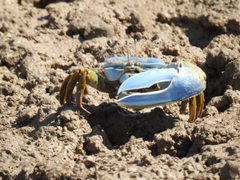
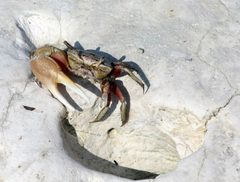
Uca is a of semi-terrestrial marine crabs comprising approximately 100 , commonly known as fiddler crabs or calling crabs. Males are distinguished by one greatly enlarged claw used for visual displays and combat. These small crabs inhabit intertidal zones worldwide, where they construct burrows and feed on organic material in surface sediments. Their burrowing activity contributes significantly to sediment turnover and nutrient cycling in coastal .
Pronunciation
How to pronounce Uca: /ˈjuːkə/
These audio files are automatically generated. While they are not always 100% accurate, they are a good starting point.
Identification
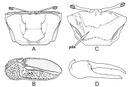
Males possess one dramatically enlarged cheliped (claw), typically the right, used for waving displays and combat; females have two small claws of equal size. is roughly square with a narrow front. Small body size, with largest reaching slightly over two inches across. Distinguished from ghost crabs (Ocypode) by the single enlarged claw in males and more compact body form.
Images
Habitat
Intertidal mudflats, sandflats, and brackish lagoons along sea beaches. Occupies zones from mid-tide level to upper shore. Substrate preferences vary by : some prefer firm substrates, others softer mud.
Distribution
Worldwide distribution in tropical and subtropical coastal regions. Present in Hong Kong waters, eastern and western Atlantic coasts, Indo-Pacific, and eastern Pacific. Records include Zanzibar, Tanzania.
Diet
Deposit feeders that consume organic material in surface sediment during low tide. Food is processed through specialized mouthparts.
Life Cycle
Larval development includes planktonic zoea and megalopa stages before settlement to benthic . Recruitment occurs seasonally. Females incubate in burrows and release larvae on spring tides.
Behavior
Males perform rhythmic claw waving displays for mate attraction and recognition. Complex territorial includes burrow construction, defense, and combat between males for burrow ownership. Activity rhythms are synchronized with tidal cycles, with crabs emerging during low tide to feed and engage in social behaviors.
Ecological Role
Biourbators through extensive burrowing activity. Burrow construction contributes to sediment turnover, aeration, and nutrient cycling in intertidal .
Similar Taxa
- OcypodeGhost crabs share Ocypodidae and similar intertidal , but lack the single enlarged claw characteristic of male Uca; Ocypode are generally larger and more
More Details
Taxonomic Note
Approximately 100 recognized; has undergone taxonomic revision with some former species now placed in related genera such as Gelasimus and Tubuca by some authorities
Sources and further reading
- BugGuide
- Wikipedia
- GBIF taxonomy match
- iNaturalist taxon
- NCBI Taxonomy
- Catalogue of Life
- Celebrating the15th Anniversary of the UC Davis Bee Haven | Bug Squad
- Did Anyone Say "Insect-Vectored Pathogens?" | Bug Squad
- The Day That Cockroaches Stole the Show | Bug Squad
- It's All the Buzz: 4-H'ers Learning How to Keep Bees | Bug Squad
- Ground-Breaking Research: Sex Pheromone of Asian Citrus Psyllid Discovered | Bug Squad
- CAMBP Classes on Pollinator Gardens and Apiary Technology | Bug Squad
- The behaviour and ecology of the Hong Kong fiddler crabs, with special reference to Uca lactea and Uca vocans
- Fiddler Crab Behavioral Ecology: Burrow Density in Uca Pugnax (Smith) and Uca Pugilator (Bosc) (Decapoda Brachyura)