
Cardisoma guanhumi
Latreille, 1828
blue land crab, great land crab
Cardisoma guanhumi is a large terrestrial crab native to tropical and subtropical Atlantic coastlines of the Americas. exhibit striking in coloration and claw , with males developing enlarged claws and typically displaying deep blue coloration while females remain lighter. The constructs deep burrows in coastal soils that extend to the water table, enabling survival in terrestrial environments despite reproductive dependence on marine for larval development. have declined across much of their range due to overharvesting and habitat degradation, leading to protected status in several countries including Puerto Rico and Colombia.
Pronunciation
How to pronounce Cardisoma guanhumi: /ˌkɑːrdɪˈsoʊmə ˌɡwɑːnhuˈmiː/
These audio files are automatically generated. While they are not always 100% accurate, they are a good starting point.
Identification
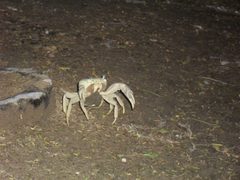
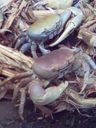
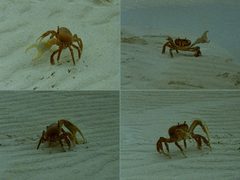
Distinguished from other Cardisoma by geographic range (Atlantic coast of Americas only) and coloration pattern. C. carnifex (Indo-Pacific) and C. hirtipes (Indo-Pacific) occupy different ranges. Within range, distinguished from the blackback land crab (Gecarcinus lateralis) by burrow depth and preference—C. guanhumi constructs deeper burrows (to water table) in lower supratidal zones versus G. lateralis in higher intertidal areas. Color change with size is diagnostic: smaller crabs orange/brown, larger crabs blue/gray.
Images
Appearance
Large-bodied terrestrial crab with width reaching up to 15 cm and body mass exceeding 500 g. Carapace color varies ontogenetically and sexually: juveniles typically brown with orange legs; males deep blue to dark brown with dimorphic claws where the larger cheliped may exceed carapace width; adult females pale gray to white. Stalked . Sexual maturity in coloration generally achieved between 80–180 g body mass.
Habitat
Coastal supratidal and terrestrial adjacent to estuaries, mangroves, and maritime forests. Constructs deep burrows in sandy-loam soils that extend to the water table, providing access to moist substrate and enabling survival away from surface water. Found in natural coastal scrub, mangrove edges, and increasingly in human-modified environments including urban areas and agricultural croplands where suitable burrowing substrate persists.
Distribution
Atlantic coast of tropical and subtropical Americas: from Brazil and Colombia north through Caribbean islands, Gulf of Mexico, Bahamas, and Bermuda to northern limit at Ponce Inlet and Vero Beach, Florida. Northern range limited by winter water temperatures below 20°C affecting larval survival.
Seasonality
Reproductive triggered by heavy spring rains. In Florida, spawning season extends June–December peaking October–November; Bahamas July–September; Venezuela July–November. surface activity year-round in suitable climates; movement avoided due to desiccation risk.
Diet
: consumes leaves, fruits, and seeds near burrow entrances; actively preys upon insects and other small ; scavenges carrion. documented. Food detection mediated by light and sound sensors; crabs respond to auditory cues of falling fruit and ground vibrations (10–1500 Hz, 70 dB threshold).
Life Cycle
Slow-growing and long-lived: requires >60 to reach maximum size, approximately three times more than comparable crab . Pre-molt burrow sealing with mud occurs 6–10 days before to reduce risk during vulnerability period. internal; females carry fertilized externally July–August. Eggs hatch after ~2 weeks into planktonic larvae requiring immediate release to saltwater. Larval development: five zoeal stages and one megalopa stage; laboratory development time 42 days from hatching to first crab stage, potentially shorter in wild. Multiple spawns possible annually.
Behavior
foraging to avoid desiccation; activity restricted to shaded microhabitats. Constructs and maintains permanent burrows with characteristic architecture including inclined entrance tunnel and large terminal chamber. Pre- burrow sealing reduces risk. Reproductive occur during spring rains with mass movements of toward coastal release sites. Acoustic and vibrational sensitivity enables detection of food resources and .
Ecological Role
Keystone burrower in low-latitude supratidal ; burrowing activity modifies soil structure, drainage, and aeration in coastal . Large terminal chambers serve as organic matter repositories and microhabitats. Potential prey for larger vertebrates; carrion consumption contributes to nutrient cycling.
Human Relevance
Historically and currently exploited as food resource throughout range; meat high in protein (14–22.6%) and minerals with low lipid content. Subject to fisheries regulations including closed seasons, minimum size limits (64 mm width in Puerto Rico), and protected area prohibitions. declines from overharvesting and loss have prompted conservation listings in Puerto Rico, Colombia, and other jurisdictions. Increasing occurrence in urban and agricultural landscapes suggests adaptability to human-modified environments, though long-term size reduction in harvested populations indicates exploitation pressure.
Similar Taxa
- Gecarcinus lateralissympatric blackback land crab; distinguished by shallower burrows in higher intertidal zones and different color pattern (black with purple claws)
- Cardisoma carnifexcongeneric of Indo-Pacific distribution; but morphologically similar; distinguished by range
- Cardisoma hirtipescongeneric Indo-Pacific ; ; distinguished by range and preferences
More Details
Conservation Status
Listed as threatened or subject to protective regulations in multiple jurisdictions including Puerto Rico (Administrative Order 1999), Colombia, and Brazil. Primary threats: overharvesting, degradation and loss, and continued illegal capture in Natural Protected Areas. Slow growth and late maturity make vulnerable to overexploitation.
Urban Adaptation
Recent research demonstrates proliferation in human-dominated systems including urban areas and croplands, particularly near southern range edge. in anthropogenic may show higher abundance and larger body size than natural habitats in some regions, though maximum body size has declined range-wide under exploitation pressure.
Sources and further reading
- BugGuide
- Wikipedia
- GBIF taxonomy match
- iNaturalist taxon
- NCBI Taxonomy
- Catalogue of Life
- Thin Layer Drying Kinetics of Salt Water Crab (Cardisoma Guanhumi)
- The Burrow Habitat of the Land Crab, Cardisoma guanhumi (Latreille)
- Observations On the Feeding Behavior of Cardisoma Guanhumi (Latreille) in Southern Florida1)
- Long-term monitoring of crab Cardisoma guanhumi (Decapoda: Gecarcinidae) captures in Jobos Bay Estuary, Puerto Rico
- MORPHOMETRY OF BLUE LAND CRAB (CARDISOMA GUANHUMI) BURROWS: ICHNOLOGICAL CONTEXT AND PALEOENVIRONMENTAL IMPLICATIONS
- Parámetros de crecimiento de Cardisoma guanhumi en el departamento del Magdalena, Colombia
- Distribution of calcium in the land crab Cardisoma guanhumi during shell wound recalcification
- Variation in the adult sex ratio and morphological traits of Cardisoma guanhumi (Latreille, 1828) in contrasting habitats in the southwest of the Gulf of Mexico
- Is the threatened land crab Cardisoma guanhumi conquering human‐dominated systems?
- Variation in the Adult Sex Ratio and Morphological Traits of Cardisoma guanhumi (Latreille, 1828) in Contrasting Habitats in the Southwest of the Gulf of Mexico.