
Gecarcinidae
MacLeay, 1838
land crabs
Genus Guides
1- Cardisoma(land crab)
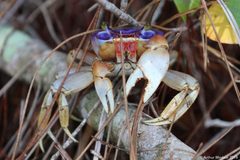
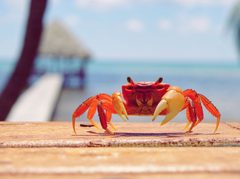
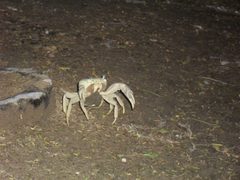
Gecarcinidae is a of true crabs (Brachyura) adapted for terrestrial existence, commonly known as land crabs. Members possess modified gill chambers called branchiostegal lungs that allow aerial respiration. are primarily terrestrial but require marine environments for ; larvae develop in seawater. The family includes approximately eight distributed across tropical regions worldwide.
Pronunciation
How to pronounce Gecarcinidae: //dʒɛkɑːrˈsɪnɪˌdiː//
These audio files are automatically generated. While they are not always 100% accurate, they are a good starting point.
Identification
Distinguished from other crab by the combination of terrestrial habits and branchiostegal lungs—inflated regions over the gills with increased vascularization for air breathing. Most exhibit pronounced claw asymmetry, with one cheliped substantially larger than the other. Distinguished from the related Sesarmidae (also terrestrial) by genetic and morphological characters; mitochondrial data place Gecarcinidae as sister to Sesarmidae. Distinguished from Coenobitidae (terrestrial hermit crabs) by lack of gastropod shell use and fully calcified .
Images
Habitat
Tropical terrestrial environments including coastal forests, mangroves, and inland areas near the coast. occupy burrows in soil or leaf litter. Require proximity to marine environments for larval development. Some show partitioning by size class, with smaller individuals in areas of higher disturbance.
Distribution
Tropical regions worldwide: Caribbean, Pacific coast of the Americas from Mexico to Colombia and offshore islands (including Gorgona Island, Revillagigedo Islands, Cocos Island, Galápagos), Central Pacific (Tokelau Islands), and Indo-Pacific (Taiwan). Johngarthia planata demonstrates a disjunct distribution spanning over 3,000 km in the East Pacific, with influenced by the California Current and Equatorial Countercurrent.
Seasonality
Activity patterns vary by and locality. Reproductive activity typically coincides with rainy seasons: Cardisoma crassum shows gravid females July–September with maturation January–April; Cardisoma guanhumi reproductive peak May–June. Some species show diel activity patterns with foraging.
Diet
Tropical omnivores; diet includes plant material, detritus, and opportunistic animal matter. Some cause crop damage in agricultural areas.
Life Cycle
Larval development occurs in marine environment; females release into seawater where they hatch and develop through planktonic stages. Megalopae and early crab stages return to terrestrial . Sexual maturity size varies by : Cardisoma crassum males at 52.7–63.7 mm width, females at 49.6–56.0 mm (morphometric estimates); Cardisoma guanhumi regulated at 64 mm minimum capture size in Puerto Rico.
Behavior
construct and occupy burrows. Males use enlarged chelipeds for combat and mating displays. in claw size is pronounced, with males showing positive allometric growth in chelipeds while females show negative allometry. Adults undertake periodic to the sea for breeding. Some show ontogenetic color changes: Cardisoma guanhumi shifts from orange in small individuals through brown to blue in large adults.
Ecological Role
Significant engineers through burrowing activity, which influences soil structure, organic carbon distribution, and root systems in tropical forests. Important components of mangrove and coastal forest ecosystems. Contribute to nutrient cycling between terrestrial and marine environments through mass and larval export.
Human Relevance
Subject to artisanal fisheries throughout the tropics; Cardisoma guanhumi and Cardisoma crassum are harvested for food. have declined due to overfishing, degradation, and capture in protected areas. Management measures include closed seasons, minimum size limits, and protected area restrictions. Minimum landing sizes of 58–64 mm width recommended or enforced in Panama and Puerto Rico. Color-based size estimation used by hunters to assess legal status. Some considered agricultural pests due to crop damage.
Similar Taxa
- SesarmidaeAlso contains terrestrial crabs; distinguished phylogenetically as sister , with Gecarcinidae representing a separate lineage within Grapsoidea. Morphological distinctions require detailed examination of gill chamber structure and genetic analysis.
- CoenobitidaeTerrestrial hermit crabs; distinguished by use of gastropod shells to protect the and soft, asymmetrical abdomens. Gecarcinidae have fully calcified, symmetrical abdomens and do not use shells.
Sources and further reading
- BugGuide
- Wikipedia
- GBIF taxonomy match
- iNaturalist taxon
- NCBI Taxonomy
- Catalogue of Life
- Reproduction of Epigrapsus Notatus (Brachyura: Gecarcinidae) in Taiwan
- Size at sexual maturity in <i>Cardisoma crassum</i> (Brachyura: Gecarcinidae) from the Gulf of Montijo, Panama Talla de madurez sexual en <i>Cardisoma crassum</i> (Brachyura: Gecarcinidae) del Golfo de Montijo, Panamá Tamanho de maturidade sexual em <i>Cardisoma crassum</i> (Brachyura: Gecarcinidae) do Golfo de Montijo, Panamá
- Closing a distributional gap of over 3000 km and encountering an invisible barrier: new presence/absence data for Johngarthia planata Stimpson, 1860 (Decapoda, Brachyura, Gecarcinidae) for Central America and biogeographic notes on East Pacific Gecarcinidae
- Long-term monitoring of crab Cardisoma guanhumi (Decapoda: Gecarcinidae) captures in Jobos Bay Estuary, Puerto Rico
- PRIMER REGISTRO DE Gecarcinus (Johngarthia) planatus STIMPSON, 1860 (CRUSTACEA: GECARCINIDAE) PARA COLOMBIA Y NOTAS SOBRE SU ZOOGEOGRAFIA EN EL PACIFICO AMERICANO
- Dry season distribution of land crabs, Gecarcinus quadratus (Crustacea: Gecarcinidae), in Corcovado National Park, Costa Rica
- Influence of land crabs Gecarcinus quadratus (Gecarcinidae) on distributions of organic carbon and roots in a Costa Rican rain forest
- Densities, diel activity, burrow shape, and habitat characteristics of Gecarcinus (Johngarthia) planatus Stimpson, 1860 (Decapoda, Brachyura, Gecarcinidae) at Socorro Island, Revillagigedo, Mexico
- Systematics and ecology of the land crabs (Decapoda: Coenobitidae, Grapsidae and Gecarcinidae) of the Tokelau Islands, Central Pacific