
Sesarmidae
Dana, 1851
Sesarmid Marsh Crabs
Genus Guides
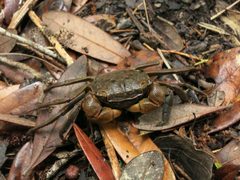
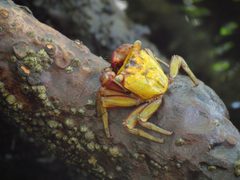
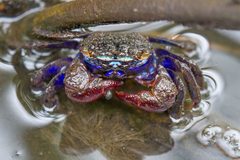
2The Sesarmidae are a of crabs within the superfamily Grapsoidea, historically classified within Grapsidae by many authors. Several , notably Geosesarma, Metopaulias, and Sesarma, contain true terrestrial crabs that complete their entire without returning to the sea, including for breeding. The family encompasses both marine-intertidal and fully terrestrial , with many associated with mangrove . Species within this family show considerable ecological and morphological plasticity.
Pronunciation
How to pronounce Sesarmidae: //sɛˈsɑr.mɪˌdeɪ//
These audio files are automatically generated. While they are not always 100% accurate, they are a good starting point.
Identification
Sesarmidae can be distinguished from other grapsoidean crabs by a combination of shape, structure, and ecological traits. True terrestrial in such as Geosesarma exhibit adaptations for life away from water, including modified gill structures for air breathing. Species-level identification relies on detailed examination of male first gonopod , cheliped tuberculation patterns, and carapace proportions. The Parasesarma plicatum species-group is distinguished by the number of dactylar on the chelipeds and live coloration.
Images
Habitat
Primarily associated with mangrove forests, ranging from estuarine to marine and hypersaline conditions. Structural development of mangrove varies from arboreal (tall, well-developed) through arbustive (shrubby) to scrub (dwarf) forms. Some inhabit high intertidal zones, while true terrestrial occupy forest floors and even climb trees (e.g., Haberma tingkok observed at 1.5–1.8 m height on bark). Highland vampire crabs in Geosesarma occur in semiterrestrial freshwater-associated habitats away from coastlines.
Distribution
Global distribution centered on tropical and subtropical regions. Parasesarma plicatum: eastern Indian Ocean; P. affine: Japan, China, Taiwan; P. ungulatum: throughout Southeast Asia; P. dumacense: Philippines. Armases angustipes: South America (southern form, no confirmed Bahamas record); A. miersii: northern distribution. Aratus pisonii: Neotropical mangroves. Neosesarma: Indo-west Pacific, with N. hirsutus in northern Australia and N. rectipectinatum extending to southern Papua. Geosesarma documented from Borneo (12 species), Sarawak, and Peninsular Malaysia.
Diet
Varies by and conditions. Aratus pisonii feeds predominantly on mangrove leaf tissue and bark, with mangrove fragments comprising 58–96% of gut content by index of relative importance. Dietary diversity increases with mangrove structural complexity during rainy seasons; animal matter (including , indicating ) becomes more important during dry seasons in resource-poor hypersaline scrub mangroves. Opportunistic feeding observed when leaf quality declines.
Life Cycle
Direct development without marine larval stages in true terrestrial (Geosesarma, Metopaulias, Sesarma), eliminating dependence on seawater for . Marine and intertidal species retain planktonic larval stages. varies substantially with quality: Aratus pisonii produces 6,463–24,584 per female depending on mangrove structural development and salinity conditions. Egg quality (C/N ratio) and reproductive output correlate with environmental productivity.
Behavior
Aratus pisonii exhibits tree-climbing to forage on fresh leaf tissue. Some show -specific morphological plasticity in response to environmental conditions, with females in hypersaline dwarf mangroves developing more robust chelipeds, possibly as to biomechanical properties of sclerophyllous leaves. of has been documented, particularly in stressed .
Ecological Role
Important consumers and processors of mangrove , particularly leaf litter. Contribute to nutrient cycling in intertidal and coastal forest . Serve as prey for higher . Tree-climbing facilitate vertical transfer of nutrients between and forest floor.
Human Relevance
Some maintained in aquarium trade (e.g., red-clawed crab Chiromantes haematocheir, vampire crabs Geosesarma). degradation through pollution, land reclamation, and deforestation threatens multiple species. Mangrove-dependent species serve as indicators of coastal health.
Similar Taxa
- GrapsidaeSesarmidae were historically included within Grapsidae; separation based on , larval development mode, and degree of terrestrial
- OcypodidaeBoth occur in mangrove and include intertidal ; distinguished by shape, burrowing (ocypodids), and cheliped asymmetry (fiddler crabs)
More Details
Taxonomic History
Long classified as or included within Grapsidae; elevated to status based on phylogenetic and morphological evidence, though relationships within Grapsoidea remain under study.
Reproductive Adaptations
Evolution of direct development in terrestrial lineages represents a major transition, allowing of inland but potentially limiting capacity.
Conservation Concerns
Mangrove loss globally threatens intertidal ; terrestrial species in Geosesarma localized extinction risks from deforestation and collection for pet trade.
Sources and further reading
- BugGuide
- Wikipedia
- GBIF taxonomy match
- iNaturalist taxon
- NCBI Taxonomy
- Catalogue of Life
- biodiversity | Blog - Part 44
- Feeding ecology of the mangrove crab Neosarmatium smithi (Crustacea: Decapoda: Sesarmidae)
- Revision of the Parasesarma plicatum (Latreille, 1803) species-group (Crustacea: Decapoda: Brachyura: Sesarmidae)
- Can contrasting environmental conditions of mangroves induce morphological variability in Aratus pisonii (Crustacea: Brachyura: Sesarmidae)?
- Morphological and genetic distinction of Armases angustipes and A. miersii (Decapoda, Brachyura, Sesarmidae)
- A new species of highland vampire crab (Crustacea: Brachyura: Sesarmidae: Geosesarma) from Serian, Sarawak
- The population dynamics and feeding ecology of the mangrove crabs, Metopograpsus frontalis (Grapsidae) and Perisesarma bidens (Sesarmidae), in Hong Kong
- Population structure and reproductive biology of the crab Sesarma rectum Randall, 1840 (Brachyura, Sesarmidae) in an impacted tropical mangrove in northeast Brazil
- Dietary variation in the crab Aratus pisonii (H. Milne Edwards, 1837) (Decapoda, Sesarmidae) in a mangrove gradient in northwestern Venezuela
- Inversión reproductiva de Aratus pisonii (Decapoda: Sesarmidae): diferencias entre hábitats y análisis de rutas
- A revision of Neosesarma (Crustacea: Brachyura: Sesarmidae) with the description of a new species
- Geosesarma wongi sp. nov., a distinctive new species of semiterrestrial crab from Tapah Hills in Perak, Peninsular Malaysia; with notes on G. peraccae (Nobili, 1903) and G. cataracta Ng, 1986 (Crustacea, Brachyura, Sesarmidae).
- A new species of Parasesarma (Brachyura, Sesarmidae) from Western Australia, with a key to the species from Australia.