
Aratus pisonii
(H. Milne Edwards, 1837)
Mangrove Tree Crab
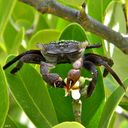
Aratus pisonii is a small sesarmid crab to Neotropical mangrove forests of the Americas. It is one of the most abundant crab in mangrove , where it occupies the and feeds primarily on mangrove leaf tissue. The species exhibits considerable plasticity, with and reproductive investment varying across environmental gradients. It has expanded its range into salt marsh in recent decades, facilitated by anthropogenic structures.
Pronunciation
How to pronounce Aratus pisonii: //əˈreɪtəs pɪˈsoʊni.aɪ//
These audio files are automatically generated. While they are not always 100% accurate, they are a good starting point.
Identification
Small crab with wider at front than back; males average ~2 cm, females slightly smaller. Mottled brown and olive coloration provides camouflage in foliage. Large set far apart on stalks. Legs brown or mottled with tufts of black hairs near pointed tips, an for climbing. Distinguished from other mangrove crabs by its arboreal habit and association with Rhizophora mangle ; differs from congeneric A. pacificus (Pacific coast only) by Atlantic distribution.
Images
Habitat
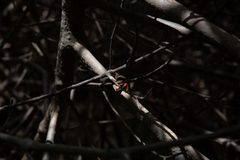
Primarily inhabits mangrove forests, especially red mangrove (Rhizophora mangle), but also occurs on white mangrove (Laguncularia racemosa) and black mangrove (Avicennia germinans). Occupies during high tide, descends to exposed substrate at low tide. Found across structural development gradients from arboreal to scrub mangroves, and in estuarine, marine, and hypersaline conditions. Has expanded into salt marsh using boat docks and similar structures as surrogate habitat.
Distribution
Atlantic coast of the Americas from Florida to northern Brazil, including entire Caribbean region. Pacific previously attributed to this now classified as Aratus pacificus (Nicaragua to Peru).
Seasonality
Active year-round in tropical range; breeding peaks during rainy season in northern Brazil. Activity patterns influenced by tidal cycles, with foraging during high tide.
Diet
Feeds primarily on mangrove leaf , which can constitute over 90% of herbivory in some forests. Diet supplemented with , organic debris, and opportunistically with carrion, small (polychaetes, , foraminiferans), and . Shows seasonal dietary plasticity: increases animal matter consumption during dry season when leaf quality declines, and exhibits in hypersaline scrub mangroves with lowest structural development.
Life Cycle
Females carry fertilized under until hatching. Larvae pass through four zoeal stages and one megalopa stage over approximately one month in plankton. Juveniles acquire bacterial ectosymbionts on gill from environmental sources after settlement, beginning at megalopa stage; not transmitted vertically. Reproductive strategy combines capital and income breeding: uses stored energy and energy acquired during breeding season.
Behavior
Arboreal climber using pointed leg tips and hair tufts to grip foliage. Rapid escape response: can scuttle along branches at 1 m/sec and leap into water to evade . Forages in during high tide, descends to substrate at low tide. Shows opportunistic feeding when resource quality declines. Exhibits microhabitat selection for , with documented patterns of sun and shade use varying by type.
Ecological Role
herbivore in mangrove , with leaf consumption representing major of herbivory in many systems. Contributes to nutrient cycling through leaf tissue processing and consumption of decaying root material and . Serves as prey for birds, terrestrial mammals, larger crabs, and predatory fishes. Proposed as model organism for mangrove due to abundance and characterized profile.
Human Relevance
Expanding into salt marshes due to climate-induced range shifts and anthropogenic structures (boat docks), providing case study for climate change impacts on distributions. Used in comparative studies of visual physiology and metabolic . Potential for mangrove health.
Similar Taxa
- Aratus pacificusFormerly considered ; occurs on Pacific coast from Nicaragua to Peru, distinguished by geography and now recognized as separate
- Sesarma rectumCo-occurs in Brazilian mangroves; differs in use and parameters
Sources and further reading
- BugGuide
- Wikipedia
- GBIF taxonomy match
- iNaturalist taxon
- NCBI Taxonomy
- Catalogue of Life
- Inversión reproductiva de Aratus pisonii (Decapoda: Sesarmidae): diferencias entre hábitats y análisis de rutas
- Can contrasting environmental conditions of mangroves induce morphological variability in Aratus pisonii (Crustacea: Brachyura: Sesarmidae)?
- Range Expansion ofAratus pisonii(Mangrove Tree Crab) into Novel Vegetative Habitats
- Comparing Aratus pisonii Distributions across Built and Woody Habitats along a Population Range Margin
- Proportion of time the mangrove tree crab Aratus pisonii spent in different behaviors related to diet and energy storage (Cannizzo et al, (2018) Ecol & Evol.)
- A method of tagging Aratus Pisonii (H. Milne Edwards, 1837) (Decapoda, Brachyura, Grapsidae) crabs for population and behavioural studies
- Proportion of time that mangrove tree crab Aratus pisonii spent in sun and shade in three habitats, 2015-2016. Cannizzo et al, (2018) Ecol & Evol.
- Evidence for use of both capital and income breeding strategies in the mangrove tree crab, Aratus pisonii
- Dietary variation in the crab Aratus pisonii (H. Milne Edwards, 1837) (Decapoda, Sesarmidae) in a mangrove gradient in northwestern Venezuela
- Comparative study of spectral sensitivity, irradiance sensitivity, spatial resolution and temporal resolution in the visual systems of Ocypode quadrata and Aratus pisonii
- Pathology and genetic connectedness of the mangrove crab (Aratus pisonii) – a foundation for understanding mangrove disease ecology
- A Comparative Analysis of the Population Biology of the Mangrove Crabs Aratus Pisonii and Sesarma Rectum (Brachyura, Grapsidae) from the North Coast of São Paulo State, Brazil
- Similar Metabolic Costs for Mangrove Tree Crabs ( Aratus pisonii ) in Historic and Range‐Shifted Habitats
- Environmental Transmission of Symbionts in the Mangrove Crabs Aratus pisonii and Minuca rapax: Acquisition of the Bacterial Community through Larval Development to Juvenile Stage