
Aratus
H. Milne Edwards, 1853
mangrove tree crabs
Species Guides
1- Aratus pisonii(Mangrove Tree Crab)
Aratus is a of semi-terrestrial sesarmid crabs comprising at least two recognized , with Aratus pisonii (mangrove tree crab) being the best studied. These crabs are specialized arboreal inhabitants of mangrove throughout the Neotropics, occupying the and prop root zones. The genus has gained scientific attention due to documented climate-induced range expansion along the Atlantic coast of North America, with establishing in salt marsh beyond the historical mangrove range limit. Research on Aratus pisonii has revealed significant phenotypic plasticity in traits, , and physiology across native and novel habitats.
Pronunciation
How to pronounce Aratus: /əˈreɪtəs/
These audio files are automatically generated. While they are not always 100% accurate, they are a good starting point.
Identification
Distinguished from other sesarmid crabs by specialized arboreal habits and association with mangrove structure. Aratus pisonii specifically identified by Neotropical distribution and propensity for high intertidal arboreal . Separation from co-occurring mangrove sesarmids (e.g., Aratus pisonii from other Sesarmidae) requires examination of shape, , and habitat use patterns. Range-expanded in salt marshes may be confused with native marsh crabs but distinguished by climbing on vegetation and dock structures.
Images
Appearance
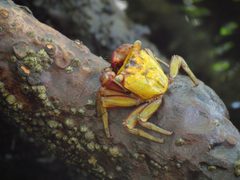
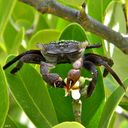
Small to medium-sized semi-terrestrial crabs with laterally compressed adapted for climbing. Body size varies by , with salt marsh individuals exhibiting smaller body size than mangrove conspecifics. present, with females generally larger than males. Coloration typically cryptic, matching bark and leaf litter substrates. Appendages modified for arboreal locomotion, with slender legs and sharp dactyls for gripping mangrove roots and branches.
Habitat
Primary : native mangrove forests, occupying and prop root zones. Secondary habitats: range-shifted salt marsh where mangroves are absent; anthropogenic boat docks embedded within salt marshes that mimic mangrove structural complexity. Microhabitat selection varies: uses home tree as foraging base in mangroves; lacks fixed home base in salt marshes. Thermal refugia accessed through water-dipping during high tide in salt marsh habitats to mitigate heat exposure.
Distribution
Neotropical distribution from Brazil to Florida. Undergoing documented northward range expansion along the United States Atlantic coast into salt marshes beyond the historical mangrove range limit. Range expansion has outpaced mangrove rates, facilitated by anthropogenic structures (boat docks) serving as analogs and stepping stones.
Diet
with -dependent composition. Lower quality diet in salt marsh habitats compared to mangrove habitats, with differential consumption patterns between habitats. Specific dietary items not documented in available sources.
Life Cycle
or with -modified schedules. Smaller body size and earlier maturity at reduced size in salt marsh compared to mangrove . Altered reproductive timing and reduced energy storage in salt marsh habitats. Lower quality offspring production documented in salt marsh. Boat dock populations exhibit patterns matching mangrove crabs rather than surrounding salt marsh conspecifics.
Behavior
Exhibits Lévy walk foraging pattern from home tree base in mangrove ; foraging movement decreases exponentially with distance from home tree. Lacks home base and associated Lévy walk in salt marsh habitat. Performs high-risk ritualistic displays more frequently on salt marsh substrate, presumably due to altered risk or substrate characteristics. Engages in thermal regulation through water-dipping during high tide in salt marshes. Strictly arboreal in mangroves; climbing behavior modified in salt marshes to use dock structures and marsh vegetation.
Ecological Role
Arboreal crab occupying upper intertidal and supratidal zones of mangrove . Foraging impacts on vegetation and detrital processing altered by behavioral changes in different . Boat dock facilitate continued northward range expansion by providing structural habitat analogs. Potential role in nutrient cycling between marine and terrestrial components of mangrove ecosystems.
Human Relevance
Subject of climate change research due to documented range expansion. for mangrove health and climate tracking. Minor nuisance potential on boat docks in expanded range. Named after Greek poet Aratus of Soli (3rd century BCE), though etymological connection to astronomical poetry unclear.
Similar Taxa
- SesarmaCo-occurring sesarmid crabs in mangrove ; distinguished by less specialized arboreal habits and different .
- MetopograpsusMangrove-associated grapsid crabs; distinguished by primarily benthic habits and different use patterns.
- GoniopsisNeotropical mangrove sesarmids; distinguished by distribution and degree of arboreal specialization.
More Details
Climate Change Research Significance
Aratus pisonii has emerged as a model organism for studying phenotypic plasticity and rapid during climate-induced range expansion. Metabolic costs remain similar across despite temperature and dietary differences, suggesting energetic constraints drive observed divergence.
Etymology Note
name Aratus shared with Hellenistic didactic poet Aratus of Soli (c. 315/310–240 BCE), author of the astronomical poem Phenomena. The zoological naming connection to the poet is not documented in available sources.