
Grapsidae
MacLeay, 1838
shore crabs, marsh crabs, talon crabs
Genus Guides
3- Grapsus(lightfoot crabs)
- Hemigrapsus
- Pachygrapsus(shore crabs)
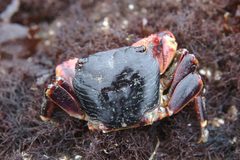
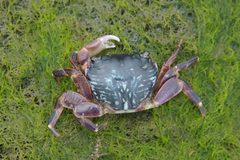
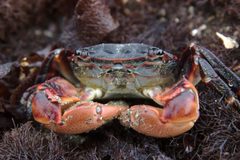
The Grapsidae are a of crabs commonly known as shore crabs, marsh crabs, or talon crabs. The family's monophyly remains unconfirmed, with some potentially belonging to other families. The family currently comprises ten and approximately forty , including two fossil genera. Members occupy diverse coastal ranging from rocky intertidal zones to pelagic environments.
Pronunciation
How to pronounce Grapsidae: //ˈɡræp.sɪ.diː//
These audio files are automatically generated. While they are not always 100% accurate, they are a good starting point.
Identification
Grapsidae crabs can be distinguished from closely related Varunidae and Plagusiidae—formerly treated as —by a combination of shape, structure, and preferences, though precise diagnostic characters require examination. The lacks confirmed synapomorphies due to its uncertain monophyletic status.
Images
Habitat
Primarily coastal environments including rocky shores, estuaries, and salt marshes. Some occupy pelagic , living among drifting seaweed and flotsam in open ocean surface waters.
Distribution
Global distribution in coastal marine and estuarine waters. Records confirmed from Denmark, Norway, and Sweden; broader distribution inferred from description but not explicitly documented in provided sources.
Similar Taxa
- VarunidaeFormerly treated as a of Grapsidae but now recognized as a distinct based on morphological and molecular evidence.
- PlagusiidaeFormerly treated as a of Grapsidae; elevated to status following taxonomic revision.
More Details
Taxonomic instability
The Grapsidae has undergone substantial revision, with many former (including Varunidae and Plagusiidae) elevated to family rank. The remaining Grapsidae contains ten : Geograpsus, Goniopsis, Grapsus, Leptograpsodes, Leptograpsus, Litograpsus (fossil), Metopograpsus, Miograpsus (fossil), Pachygrapsus, and Planes.