
Armases
Abele, 1992
square-back American marsh crabs
Species Guides
1- Armases cinereum(squareback marsh crab)
Armases is a of sesarmid crabs comprising approximately 13 described distributed across tropical and subtropical coastal regions of the Americas. These semi-terrestrial crabs inhabit salt marshes, mangroves, and estuarine environments, with some species exhibiting notable movement between marine and terrestrial . Several species have been extensively studied for their larval development, metabolic , and role in energy transfer. The genus includes both species with larval export strategies to continental shelves and those breeding in supratidal rock pools.

Pronunciation
How to pronounce Armases: /ˈɑːr.mə.siːz/
These audio files are automatically generated. While they are not always 100% accurate, they are a good starting point.
Identification
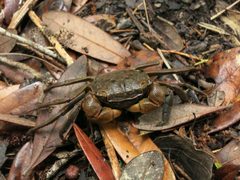
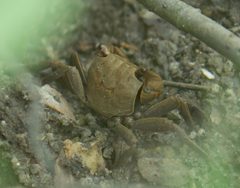
Armases are distinguished from other sesarmid by their square-backed shape, giving rise to the "square-back marsh crabs." Species-level identification requires examination of carapace width, male , and coloration patterns. Armases angustipes and A. miersii are particularly difficult to distinguish morphologically and have historically been misidentified; genetic analysis may be required for definitive identification where ranges approach potential overlap.
Images
Habitat
Salt marshes, mangroves, and estuarine creeks; semi-terrestrial at the marine-terrestrial . Some inhabit supratidal rock pools. Larvae of at least one species (A. rubripes) occur in oligohaline Amazonian creeks with floodplain vegetation, influenced by mesotides.
Distribution
Tropical and subtropical zones of the Americas. A. cinereum ranges from Chesapeake Bay to Florida and throughout the Gulf of Mexico to Veracruz, Mexico. A. rubripes occurs along the Brazilian coast and Amazon region. A. angustipes is primarily South American; museum specimens from the Bahamas previously attributed to this have been re-identified as A. miersii, suggesting A. angustipes may be restricted to southern distributions without geographic overlap with A. miersii.
Seasonality
Reproductive activity varies by and region. A. rubripes shows peak larval abundance during the Amazon rainy season (January) with larvae present quarterly. A. angustipes exhibits ovigerous females primarily in summer months. A. cinereum shows year-round activity with temperature-dependent metabolic rates.
Life Cycle
Four zoeal larval stages followed by a megalopa stage. At least one (A. rubripes) exhibits larval exportation to the continental shelf, with only zoea I present in oligohaline nursery . A. miersii breeds in supratidal rock pools with facultative lecithotrophic larval stages. First sexual maturity occurs at approximately 6.5 mm width in male A. rubripes and 8.1 mm in females.
Behavior
Highly mobile with bi-directional movement between marsh and forest in some . A. cinereum females feed preferentially in salt marshes and move to upland forest, while males prefer forest habitat with more restricted ranges. Limb loss and are common. Larval exportation to marine environments represents a key strategy for some species.
Ecological Role
Mediates energy fluxes between and along marine-terrestrial . Acts as a potential for spatial subsidies of energy from salt marshes to upland forests, though high metabolic expenditures limit net energy transfer. Serves as a bioindicator of water quality; larval abundance and distribution are sensitive to anthropogenic , nitrogenous compounds, and coliform concentrations.
Similar Taxa
- SesarmaSimilar semi-terrestrial sesarmid crabs; Armases distinguished by square-backed and specific characteristics
- AratusAnother sesarmid inhabiting mangroves; Armases typically occupy lower intertidal and marsh rather than arboreal mangrove roots
Sources and further reading
- BugGuide
- Wikipedia
- GBIF taxonomy match
- iNaturalist taxon
- NCBI Taxonomy
- Catalogue of Life
- Larvae of Armases rubripes (Decapoda, Brachyura) in Amazon oligohaline creeks: larval exportation?
- Metabolic rates in the squareback marsh crab Armases cinereum
- Morphological and genetic distinction of Armases angustipes and A. miersii (Decapoda, Brachyura, Sesarmidae)
- Population biology of the crab Armases angustipes (Crustacea, Decapoda, Sesarmidae) at Brazilian tropical coast
- Developmental biology of Armases miersii (Grapsidae), a crab breeding in supratidal rock pools. II, Food limitation in the nursery habitat and larval cannibalism
- Population dynamics of Armases rubripes in southwestern Atlantic salt marshes: seasonality, abiotic influence and reproductive biology
- Developmental biology of Armases miersii (Grapsidae), a crab breeding in supratidal rock pools. I. Facultative lecithotrophy of larval stages
- EFFECTS OF SALINITY AND STARVATION ON LARVAL DEVELOPMENT OF THE CRABS ARMASES RICORDI AND A. ROBERTI (DECAPODA: GRAPSIDAE) FROM JAMAICA, WITH NOTES ON THE BIOLOGY AND ECOLOGY OF ADULTS
- The effects of temperature and salinity on larval development of Armases rubripes Rathbun, 1897 (Brachyura, Grapsoidea, Sesarmidae), and the southern limit of its geographical distribution
- Effects of Salinity and Starvation on Larval Development of the Crabs Armases ricordi and A. roberti (Decapoda: Grapsidae) from Jamaica, with Notes on the Biology and Ecology of Adults
- Reproductive biology of the sesarmid crab Armases rubripes (Decapoda, Brachyura) from an estuarine area of the Sahy River, Sepetiba Bay, Rio de Janeiro, Brazil