
Cardisoma
Latreille in Latreille, Le Peletier, Serville & Guérin, 1828
land crab, purple land crab
Species Guides
1- Cardisoma guanhumi(blue land crab)
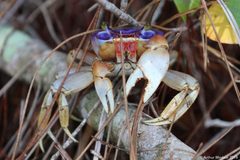
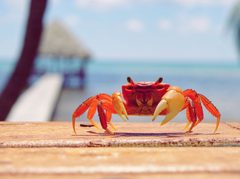
Cardisoma is a of large, semi-terrestrial land crabs in the Gecarcinidae. The genus currently contains four found in warm coastal regions, where they construct burrows in terrestrial while maintaining physiological connections to water sources. are capable of living substantial distances inland—up to 5 km from the sea—though females must return to marine environments to spawn. Juveniles display striking coloration with purple-blue and orange-red legs that fades with age.
Pronunciation
How to pronounce Cardisoma: /ˌkɑːr.dɪˈsoʊ.mə/
These audio files are automatically generated. While they are not always 100% accurate, they are a good starting point.
Identification
Distinguished from the related Discoplax (which formerly contained three now separated from Cardisoma) by morphological and genetic characteristics. The moderate claw asymmetry separates Cardisoma from Uca, which shows extreme enlargement of one claw in males. The combination of large body size, semi-terrestrial burrowing habit, and coastal distribution distinguishes it from strictly aquatic crab genera. coloration is distinctive but not diagnostic without geographic and context.
Images
Appearance
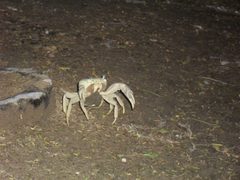
Large-bodied crabs with a broad, domed . Juveniles exhibit vivid coloration: purple-blue carapace with orange-red legs. Color intensity diminishes with age; coloration becomes duller, with females typically less vivid than males. One claw is markedly enlarged relative to the other, though the asymmetry is less pronounced than in fiddler crabs ( Uca). in size and color saturation has been documented.
Habitat
Warm coastal regions with access to groundwater. Natural include mangrove forests with soft, clayey substrates, hydroperiods, humid soils, and shade from mangrove (Rhizophora mangle, Laguncularia racemosa, Avicennia germinans). Also occupies transformed environments such as pastures, provided burrows can reach the water table. Burrows are typically constructed 300 m to 5 km inland from the sea. Soil hardness negatively affects .
Distribution
Tropical and subtropical coastal regions: southern Florida through the Caribbean to Brazil, including Caribbean islands; West Africa. In Mexico, occurs along Caribbean and Gulf of Mexico coasts (documented from 18.14°–23.78°N; 94.14°–97.90°W).
Seasonality
active during September and October in sampled Gulf of Mexico . Year-round activity likely in tropical portions of range, with seasonal breeding to marine .
Diet
, with plant material as primary food source.
Life Cycle
Semi-terrestrial inhabit burrows inland from the sea. Females undertake periodic to marine waters to spawn. Larval stages are strictly marine and pelagic, developing in coastal waters. Early developmental stages are marine; juveniles transition to terrestrial burrow .
Behavior
Constructs and maintains burrows in both natural and disturbed , requiring connection to groundwater for survival. Females exhibit periodic seaward for spawning. Burrow temperature at deepest accessible point has been recorded as a microhabitat variable.
Human Relevance
Subject to commercial exploitation; threatened by harvesting pressure in parts of range. Juveniles collected for pet trade due to attractive coloration. Occupies both natural and anthropogenically modified landscapes, indicating some to provided water table access is maintained.
Similar Taxa
- DiscoplaxThree formerly classified in Cardisoma are now placed in Discoplax based on morphological and genetic revision.
- Uca (fiddler crabs)Both exhibit claw asymmetry, but Uca shows extreme enlargement of one claw (especially males) and occupies intertidal mudflat rather than inland burrow systems.
More Details
Taxonomic revision
The underwent significant revision, with three transferred to Discoplax. The genus Tuerkayana now holds additional species formerly placed in both Discoplax and Cardisoma.
Conservation status
Cardisoma guanhumi is identified as threatened and subject to commercial exploitation in the Gulf of Mexico region.
Habitat quality effects
Mangrove support higher , larger body size, and heavier females compared to pasture habitats. Sex ratios differ between habitat types: male-biased in mangroves, female-biased in pastures.