
Procambarus fallax
(Hagen, 1870)
Slough Crayfish, Deceitful Crayfish
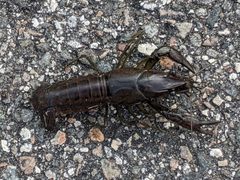
Procambarus fallax is a freshwater crayfish native to peninsular Florida and southern Georgia, USA, where it inhabits tributaries of the Satilla River. The is notable as the sexual parental species of the parthenogenetic Marmorkrebs (marbled crayfish), which originated as a single lineage from P. fallax through apomictic . While P. fallax reproduces sexually with separate males and females, its parthenogenetic derivative has achieved global distribution through the aquarium trade and exhibits high potential due to single-female founding capability.


Pronunciation
How to pronounce Procambarus fallax: //proʊˈkæmbərəs ˈfælæks//
These audio files are automatically generated. While they are not always 100% accurate, they are a good starting point.
Identification
Procambarus fallax can be distinguished from by morphological features typical of the , including a rostrum with marginal spines and characteristic structure in males. The is most reliably differentiated from its parthenogenetic derivative Marmorkrebs (P. fallax f. virginalis) by reproductive mode: P. fallax contain both males and females and reproduce sexually, whereas Marmorkrebs populations are all-female and reproduce via apomictic . Coloration in P. fallax is typically more subdued compared to the marbled pattern of its derivative form.
Images
Habitat
Freshwater lentic and lotic including lakes, streams, wetlands, and sloughs in the native range. The occurs in tributaries of the Satilla River in Georgia and Florida, occupying burrowing habitats typical of cambarid crayfish.
Distribution
Native to Florida and southern Georgia, USA, specifically in the Satilla River basin. The parthenogenetic derivative Marmorkrebs has been introduced to Europe (Germany, Italy, Madagascar, Japan) and other locations globally through the aquarium trade.
Life Cycle
with separate males and females; females carry attached to pleopods. Reproductive activity occurs primarily in spring and summer in the native range. The has produced a parthenogenetic lineage (Marmorkrebs) through a single evolutionary origin, which reproduces via apomictic producing all-female offspring without males.
Behavior
Burrowing typical of burrowing crayfish, constructing subterranean chambers in muddy or sandy substrates. The parthenogenetic derivative exhibits high invasiveness potential due to the ability of a single female to establish new .
Ecological Role
engineer through burrowing activities that modify substrate structure and hydrology. Potential for competitive displacement of native crayfish where introduced of the parthenogenetic derivative occur.
Human Relevance
Parental of the globally distributed aquarium pet known as Marmorkrebs or marbled crayfish. The parthenogenetic derivative has become an of concern in multiple countries, with potential economic impacts on fisheries and aquatic . No direct human uses documented for P. fallax itself.
Similar Taxa
- Procambarus fallax f. virginalis (Marmorkrebs)Parthenogenetic derivative of P. fallax; distinguished by all-female , marbled coloration, and apomictic versus with separate sexes in P. fallax
- Procambarus alleniSympatric in southern Florida; distinguished by morphological and ecological differences, though detailed comparative data require examination
- Procambarus clarkii with broader distribution; distinguished by reproductive mode and morphological features, though specific diagnostic characters for P. fallax require examination
Sources and further reading
- BugGuide
- Wikipedia
- GBIF taxonomy match
- iNaturalist taxon
- NCBI Taxonomy
- Catalogue of Life
- Meloidae Holdings | Entomology Research Museum
- Invasive crayfish can cause high fisheries damage | Blog
- Honey Locust Borer | Beetles In The Bush
- Conservation Translocations: It’s Not Just Beavers - Buglife Blog - Buglife
- Buprestidae | Beetles In The Bush | Page 9
- taxonomy | Beetles In The Bush | Page 4
- The Behavior of Chromosomes During Parthenogenetic Oogenesis in Marmorkrebs Procambarus fallax f. virginalis
- The enigmatic Marmorkrebs (marbled crayfish) is the parthenogenetic form of Procambarus fallax (Hagen, 1870)
- THE MARBLE CRAYFISH PROCAMBARUS FALLAX AS INVASIVE SPECIES IN THE WATER BODIES OF THE REPUBLIC OF BELARUS
- Distribution and relative abundance of the crayfishes Procambarus alleni (Faxon) and P. fallax (Hagen) in Southern Florida
- Abundance and habitat associations of two Florida crayfishes, Procambarus paeninsulanus (Faxon, 1914) and P. fallax (Hagen, 1870) (Decapoda: Astacoidea), assessed with N-mixture modeling
- Features of histological adaptation of Marbled crayfish Procambarus fallax f. virginalis (Decapoda) to the different concentration of cadmium ions in model experiment
- Characterization of locomotor response to psychostimulants in the parthenogenetic marbled crayfish (Procambarus fallax forma virginalis): A promising model for studying the neural and molecular mechanisms of drug addiction