
Procambarus
Ortmann, 1905
crayfish, crawfish, crawdad
Species Guides
4- Procambarus acutus(White River Crayfish)
- Procambarus alleni(Everglades crayfish)
- Procambarus clarkii(red swamp crayfish)
- Procambarus fallax(Slough Crayfish)
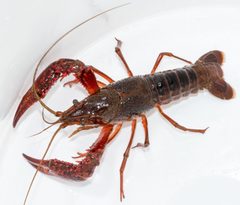
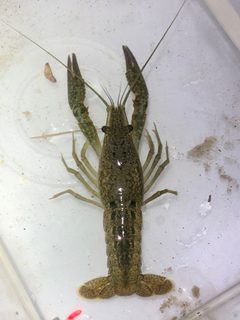
Procambarus is a of freshwater crayfish in the Cambaridae, native to North and Central America. The genus contains approximately 160 in 16 subgenera, making it one of the most species-rich crayfish genera. It includes both widespread surface-dwelling species and numerous troglobitic (cave-dwelling) species. The marbled crayfish (marmorkrebs), a parthenogenetic form, is also classified within this genus. Several species, particularly P. clarkii (red swamp crayfish), have been introduced globally and are recognized as with significant ecological and economic impacts.
Pronunciation
How to pronounce Procambarus: //proʊˈkæmbərəs//
These audio files are automatically generated. While they are not always 100% accurate, they are a good starting point.
Identification
Distinguished from other crayfish by the form of the first pleopod in males, which typically has three or more processes at the tip. This contrasts with Faxonius and Cambarus, where males have two or fewer processes. Morphological identification to level requires examination of structure and other detailed anatomical features.
Images
Habitat
Most inhabit above-ground freshwater systems including rivers, streams, lakes, ponds, and swamps. Several species are troglobitic, occurring in cave systems, particularly in karstic regions. In the United States, cave-dwelling species include P. acherontis and P. morrisi (subgenus Lonnbergius), plus P. attiguus, P. erythrops, P. franzi, P. leitheuseri, P. lucifugus, P. milleri, and P. orcinus. In Cuba, P. niveus is cave-dwelling. In Mexico, strict cave-dwellers include P. cavernicola, P. oaxacae, P. rodriguezi, and P. xilitlae.
Distribution
Native to North and Central America. Highest diversity occurs in the southeastern United States. Mexico contains approximately 45 , the second-highest diversity after the United States. Native range extends south to Guatemala (2 species: P. pilosimanus, P. williamsoni), Belize (1 species: P. pilosimanus), and Honduras (1 species: P. williamsoni). Three species are native to Cuba (P. atkinsoni, P. cubensis, P. niveus). The earliest known fossil, P. primaevus, from the Early Eocene Green River Formation of Wyoming, indicates the formerly extended into the Intermountain West where it no longer occurs.
Ecological Role
Serves as a major dietary component for fishes in floodplain river systems. can cause substantial damage to aquatic vegetation and compete with native .
Human Relevance
Several are commercially harvested for food, particularly P. clarkii in Louisiana's Atchafalaya River Basin. Widely used in aquaculture, with P. clarkii being one of the most cultivated crayfish species globally. Used as a model organism in behavioral and physiological research. Multiple species have been introduced outside native ranges and are categorized as , representing documented threats to native crayfish biodiversity and causing economic damage to fisheries through scavenging and destruction.
Similar Taxa
- FaxoniusFormerly included in Orconectes; males have two or fewer processes on the first pleopod tip versus three or more in Procambarus.
- CambarusMales have two or fewer processes on the first pleopod tip; Procambarus distinguished by three or more processes.
Sources and further reading
- BugGuide
- Wikipedia
- GBIF taxonomy match
- iNaturalist taxon
- NCBI Taxonomy
- Catalogue of Life
- Invasive crayfish can cause high fisheries damage | Blog
- Flood pulse characteristics and physicochemical influences on harvested Procambarus clarkii and Procambarus zonangulus populations in the Atchafalaya River basin, Louisiana
- Review of: "Behavioral effects of ethanol in the Red Swamp Crayfish (Procambarus clarkii)"
- Reproduction of Procambarus llamasi in a recirculating aquaculture system (RAS) Reproductive potential of the acocil Procambarus llamasi in an aquaculture recirculating system (ARS) in Campeche
- Thermal stress responses of two sympatric crayfishes in Louisiana, Procambarus clarkii Girard, 1852 and Procambarus zonangulus Hobbs & Hobbs, 1990 (Decapoda: Astacoidea: Cambaridae)
- An integrative taxonomic assessment leads to the synonymy of the Waccamaw Crayfish Procambarus braswelli Cooper 1998 with the Cedar Creek Crayfish Procambarus chacei Hobbs 1958 (Decapoda: Cambaridae)
- Reproductive and feeding ecology of red swamp crayfish procambarus clarkii (Girard, 1852) in China