
Procambarus alleni
(Faxon, 1884)
Everglades crayfish, Florida crayfish, blue crayfish, electric blue crayfish, sapphire crayfish
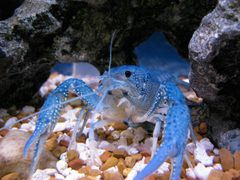
Procambarus alleni is a freshwater crayfish to Florida, where it serves as a foundation in the Everglades aquatic . Wild exhibit variable coloration from brown-tan to blue, though an aquarium strain has been selectively bred for brilliant cobalt blue coloration. The species is strongly associated with wetland hydroperiod, reaching highest densities in longer-hydroperiod marshes dominated by Cladium. It is listed as Least Concern by the IUCN and is popular in the aquarium trade.
Pronunciation
How to pronounce Procambarus alleni: /proʊˈkæmbərəs ˈælɪnaɪ/
These audio files are automatically generated. While they are not always 100% accurate, they are a good starting point.
Identification
Distinguished from co-occurring Procambarus fallax by preference—P. alleni is the sole crayfish in short hydroperiod marshes of Everglades National Park and Big Cypress National Preserve, where P. fallax is absent. Should not be confused with Cambarus monongalensis, also called 'blue crayfish,' which is native to Pennsylvania, Virginia, and West Virginia and is a burrowing species.
Images
Appearance
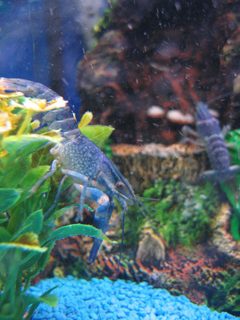
Variable coloration in wild ranging from brown-tan to blue; aquarium strain exhibits brilliant cobalt blue coloration. Standard freshwater crayfish with ten legs (decapod), prominent chelipeds (claws), and segmented with fan-like .
Habitat
Seasonally flooded marl marshes of Everglades National Park; specifically wetlands classified by vegetation structure weighted by hydroperiod. Occurs in both shorter-hydroperiod Muhlenbergia-dominated marsh and longer-hydroperiod Cladium-dominated marsh, with highest densities associated with longer hydroperiods.
Distribution
to Florida, United States. Natural range extends east of St. Johns River and throughout Florida from Levy County and Marion County southwards, including some of the Florida Keys. Core in Everglades National Park and Big Cypress National Preserve.
Life Cycle
Stage-structured model indicates populations can decline and stabilize at reduced densities over multi-decadal timescales under current environmental conditions. Specific details of developmental stages, breeding, or frequency not documented in available sources.
Ecological Role
Foundation for Everglades aquatic ; contributes to secondary aquatic productivity. is strongly tied to hydrological conditions and vegetation distribution. Restoration of historical hydropatterns that increase hydroperiod could produce cascading positive effects throughout the Everglades aquatic food web, with simulated 7-month hydroperiod over 90% of marl marsh landscape potentially supporting 7-fold increase in crayfish .
Human Relevance
Popular in freshwater aquarium trade; selectively bred aquarium strain widely available. Listed as Least Concern on IUCN Red List.
Similar Taxa
- Procambarus fallaxCo-occurs in southern Florida but excluded from short hydroperiod marshes where P. alleni occurs alone; P. alleni is the sole crayfish in these
- Cambarus monongalensisAlso called 'blue crayfish' but native to Pennsylvania, Virginia, and West Virginia; burrowing with different
More Details
Population response to hydrology
Research using spatially explicit modeling demonstrates that P. alleni is strongly associated with classification based on vegetation types weighted by hydroperiod. Under current environmental conditions, populations declined and stabilized at approximately 13% of initial density over 50 years. Simulated 4-month hydroperiod increase converting Muhlenbergia-dominated to Cladium-dominated marsh predicted 7-fold increase in crayfish density.
Aquarium trade
The is frequently kept in freshwater aquaria. A selectively bred aquarium strain has been developed to achieve brilliant cobalt blue coloration not typically seen in wild .
Sources and further reading
- BugGuide
- Wikipedia
- GBIF taxonomy match
- iNaturalist taxon
- NCBI Taxonomy
- Catalogue of Life
- Invasive crayfish can cause high fisheries damage | Blog
- Let’s make a deal! | Beetles In The Bush
- a citizen scientist’s journey into botany
- Distribution and relative abundance of the crayfishes Procambarus alleni (Faxon) and P. fallax (Hagen) in Southern Florida
- Spatially explicit population responses of crayfish Procambarus alleni to potential shifts in vegetation distribution in the marl marshes of Everglades National Park, USA