
Centruroides gracilis
(Latreille, 1804)
Slender Brown Scorpion, Florida Bark Scorpion, Brown Bark Scorpion, Red Bark Scorpion, Slender Red Scorpion, Alacran Prieto, Alacran Azul
Centruroides gracilis is a medium to large in the Buthidae, notable for its wide color variation and extensive introduced range. Females reach up to 10 cm, while males can exceed 15 cm. The exhibits remarkable phenotypic plasticity, with individuals in single or even litters showing colors ranging from reddish to dark brown with contrasting leg and chelae coloration. It is native to northern Central America but has been introduced to numerous regions including Florida, the Caribbean, South America, Africa, and the Canary Islands, often occurring in .
Pronunciation
How to pronounce Centruroides gracilis: /sɛn.trʊˈɔɪ.diːz ˈɡræ.sɪ.lɪs/
These audio files are automatically generated. While they are not always 100% accurate, they are a good starting point.
Identification
Distinguished from native Florida Centruroides (C. hentzi, C. guianensis) by larger size and color variability. C. hentzi and C. guianensis show more consistent striping patterns. C. gracilis males notably larger than females, unlike some . Fluoresces blue-green under ultraviolet light due to beta-carboline and 4-methyl-7-hydroxycoumarin compounds in —a trait shared with other scorpions but useful for detection. In introduced ranges, identification relies on size, variable coloration, and association with human structures.
Images
Appearance
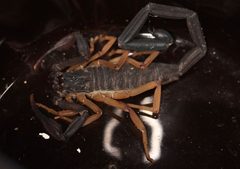
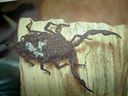
Large, slender with pronounced in size. Females reach approximately 10 cm in length; males commonly exceed 15 cm. Coloration highly variable: individuals may be uniformly reddish, black with reddish chelae, dark brown with yellowish legs and red chelae, or dark brown with alternating reddish and black tail segments. Color variation can occur within single and even within single litters. (pincers) well-developed for prey capture. Tail (metasoma) slender with terminal bearing stinger.
Habitat
Natural include areas under rocks and beneath tree bark. Strongly : readily colonizes wall voids, building crevices, and rubbish piles in residential areas. In tropical regions, occurs in rainforest floor litter and under fallen logs. Introduced thrive in disturbed habitats and human-modified environments.
Distribution
Native to northern Central America: Mexico, Guatemala, Belize, Honduras. Introduced to Cuba, Panama, Colombia, Ecuador, Jamaica, Florida (USA), Cameroon, Gabon, and Tenerife (Canary Islands). In Florida, sympatric with native C. hentzi and C. guianensis.
Seasonality
. Activity likely year-round in tropical native range; in temperate introduced areas, activity probably seasonal with warmer months. Laboratory studies indicate sexual maturity reached at 235–300 days, with females living approximately 38 months and males 33 months on average.
Diet
: feeds on insects, particularly . In captivity, accepts and crickets. Specific natural prey spectrum otherwise undocumented.
Life Cycle
: females give birth to live young. Litter size typically 25–35, with exceptional litters of 91 recorded. Juveniles climb onto female's back and remain there until first at approximately 8 days. Development through seven instars (some males mature at sixth). Females reach maturity at ~300 days; males at 235–281 days depending on instar. Females can reproduce via . Males produce and engage in courtship .
Behavior
forager. Rapid movement when disturbed. When threatened, raises tail with stinger curved over back. Juveniles exhibit post-birth maternal association, riding on female's back until first . Exhibits negative ; whole-body fluorescence may function in light detection, with UV exposure triggering rapid movement toward dark refugia. In laboratory conditions, males show courtship involving deposition.
Ecological Role
of small arthropods, particularly insects. Prey for tarantulas (documented: Tliltocatl vagans). In introduced ranges, may compete with native . habits bring it into regular contact with humans, though ecological impacts in introduced ranges remain unstudied.
Human Relevance
Venomous sting: neurotoxic and cardiotoxic, causing catecholamine release. Local effects include pain, redness, itching, swelling. effects can include arrhythmia, pulmonary edema, tachycardia or bradycardia, hyper- or hypotension, nausea, vomiting, sweating, diarrhea, shock, convulsions, coma; fatalities possible but considered much less toxic than . Sting pain compared to honeybee or yellow jacket. Regularly enters human dwellings in native and introduced ranges. Occasionally kept as pet. Common cause of envenomation in areas where it occurs.
Similar Taxa
- Centruroides hentziNative to Florida; distinguished by smaller size and consistent striping pattern
- Centruroides guianensisNative to Florida; distinguished by smaller size and consistent striping pattern
- Centruroides vittatusNative to south-central USA; more consistent striped pattern, not known from Florida naturally
Misconceptions
"Florida bark scorpion" is misleading: is not native to Florida but introduced. Name "alacran azul" (blue ) refers to fluorescence under UV light, not normal coloration. Despite being less toxic than some , not harmless—envenomation can produce serious effects.
More Details
Fluorescence
contains beta-carboline and 4-methyl-7-hydroxycoumarin, which absorb UV light and emit blue-green fluorescence. Entire body may function as photoreceptor to detect light levels and locate dark refugia.
Parthenogenesis
Females capable of ; documented in laboratory conditions.
Sources and further reading
- BugGuide
- Wikipedia
- GBIF taxonomy match
- iNaturalist taxon
- NCBI Taxonomy
- Catalogue of Life
- Forgotten Foto Friday: Centruroides vittatus | Beetles In The Bush
- Scorpion glow, scorpion sting: Slenderbrown and other scorpions in Central America, Centruroides spp. — Bug of the Week
- A face only a mother could love | Beetles In The Bush
- Traffic Jam Treehoppers | Beetles In The Bush
- Bichos Argentinos #2 – Pseudomyrmex sp. | Beetles In The Bush